
Big Thunder Ski Jumping Center
The Big Thunder Ski Jumping Centre (also spelled Center) was a twin ski jumping hill located in Thunder Bay in Northwestern Ontario, Canada. It was the centrepiece of the wider Nordic skiing complex, also known as the Big Thunder National Training Centre (Big Thunder National Training Center), which this article also covers. The complex opened in 1963 and closed in 1995–96, and its jumps were K-90 and K-120 hills.[1]
The first hills were built by Knute and Thor (Tor) Hansen and opened in 1963. They were originally known as Lille Norway Ski Area, then Mt. Norway Ski Area, and Sundance Northwest Resort before taking the Big Thunder name. The large and normal hills were built in 1974 and the venue was taken over by the provincial government in 1985. The hills hosted 29 FIS Ski Jumping World Cup and 50 Canadian Ski Jumping Championships tournaments between 1975 and 1995, climaxing with the FIS Nordic World Ski Championships 1995. Funding was then cut and the venue has since been closed and unmaintained.[1][2]
Portions of this article are adapted from the intros of the Wikipedia articles "Big Thunder Ski Jumping Center" and "Big Thunder National Training Center", available under a CC BY-SA 4.0 license. This page merges the former Curriepedia articles "Big Thunder Ski Jumping Center" and "Big Thunder National Training Center" (October 2026).
Big Thunder Frozen in Time
Any articles like the below would be most helpful, especially around the opening/Nordics/closing of the Big Thunder etc.
1. The FIS Nordic World Ski Championships 1995 took place 9–19 March 1995 in Thunder Bay, Ontario, Canada. This marked the second time the separate championships (not part of Winter Olympics) were held outside Europe (the first was in the US towns of Lake Placid, New York, and Rumford, Maine, in 1950). The Nordic combined team event was changed from a 3 × 10 km relay to a 4 × 5 km relay for these championships.
2. Big Thunder National Training Center is a Nordic skiing complex located in Thunder Bay, Ontario, Canada. It was opened in 1963, and closed in 1995. The centerpiece was the Big Thunder Ski Jumping Center, which had K-90 and K-120 hills.
3. A scan of "Superior Outdoors: 26–30" with article "Big Thunder Frozen in Time", 2011, by Jean-Paul Marion
4. Early ski news articles in Port Arthur News-Chronicle: (some ideas, don't need to check all of these...)
Port Arthur Ski Club NEWS n/a 8 Nov 1929 p.18 Plan ski jump Port Arthur Ski Club NEWS 03-Dec-39 4 Dec 1939 p.1 Clubhouse destroyed by fire/pic p.3 Port Arthur Ski Club NEWS n/a 5 Dec 1938 p.10 pics Clubhouse at Strathcona completed Port Arthur Ski Club NEWS n/a 17 Oct 1938 p.10 pic New clubhouse Port Arthur Ski Club NEWS n/a 23 Jan 1937 p.5 pics 3 pics of clubhouse & skiers Port Arthur Ski Club NEWS n/a 8 Jan 1940 p.9 pic New clubhouse (#2)
Ruttan, Susan NEWS n/a 23 Feb 1939 p.1 In Dominion Ski Championship
Bachinski, Marian Lorraine(age 19) BIO n/a 5 Nov 1965 p.1 pic Lakehead Ski Queen Candy Mountain NEWS n/a 10 Apr 1970 p.16 pic Proposed ski resort site Centennial Park NEWS 20 Feb 1966 21 Feb 1966 p.1 Ski hill officially opened McCormack, Catherine PIC n/a 8 Feb 1963 p.10 Ski fashions Moose Mountain Ski Resort NEWS 14 Jan 1962 10 Jan 1962 p.15 pic Officially opens in Beardmore Trowbridge Falls Park PIC n/a 12 Dec 1964 p.2 Future site of ski jump Crooks, Andrew BIO n/a 22 May 1971 p.3 pic Skier since he was four Hansen, Knute BIO n/a 1 Apr 1966 p.2 Skiing accident Harja, Henry (age 15) PIC n/a 2 Feb 1963 p.1 Winter Carnival skiing event Young, Judy (Miss)(d/o Gavin) BIO n/a 8 Sep 1964 p.8 pic Combines skiing & schooling
https://www.cbc.ca/news/canada/thunder-bay/big-thunder-bay-olympic-ski-jumping-1.4546036
The Big Thunder National Training Centre (including the Big Thunder Ski Jumping Center) in Thunder Bay closed permanently in 1996 due to severe federal and provincial government funding cuts following the 1995 FIS World Nordic Ski Championships. [1] The 1995 World Championships: The venue hosted the prestigious world-class event in 1995, which required massive infrastructure investments and upgrades. [1, 2] Funding Withdrawal: Shortly after the games concluded, both federal and provincial governments pulled ongoing financial support, making the expensive facility unsustainable to maintain. [1, 2] Political Shift: Following the 1995 Ontario provincial election, the new government viewed the facility as a heavy financial drain, and the site was officially shut down and locked up in 1996. [1, 2, 3] If you'd like, I can share more details on community efforts to redevelop the site or the history of the 1995 World Nordic Ski Championships.
Research notes: what the sources say (October 2026)
Ownership and names, 1963–1996
- 1963: Knute and Tor Hansen open Little Norway on Mount McRae as a training hill for downhill skiers and jumpers.[6][1][4] Tor Hansen was the father of the Thunder Bay theatre director Kim Hansen.[7]
- 1963–1964 (museum clippings): Trail-cutting began in April 1963; the A-frame clubhouse went up in December 1963; the first rope tow to the top ran in late February 1964 and the first race (the Spring Fever Open Downhill) was held in April 1964. The Hansens' stated main purpose was a 90-metre FIS jump and a jumping academy. See Building Little Norway.[8][9][10]
- 1969: The hill is sold after financial trouble and renamed Mt. Norway; the buyer is not named in any source found.[1]
- 1974–1975: The province funds the main twin jumps. The Big Thunder National Ski Training Centre opens on 2 February 1975 with the first Canadian championships held there.[1][11][12]
- Published discrepancy (1975): Bayview Magazine (Diane Imrie, 2017) says Little Norway "eventually became Sundance and in 1975 transitioned into Big Thunder National Ski Training Centre". That puts Sundance before 1975, but John Beals dates his purchase and the Sundance name to 1977, and the province took over only in 1983. Bayview's 1975 fits the opening of the training-centre jumps, not a change of owner or name. Flagged, not resolved.[13][14][1][15]
- 1977: John Beals says he acquired Mount Norway in 1977 and renamed it Sundance; the Lakehead University business case says "Little Norway" became "Sundance" by the 1970s.[14][16]
- 1983–1985: the province buys it. The Globe and Mail reported "Ontario purchases ski-jumping hill" on 11 May 1983, at $540,000; John Beals calls it a provincial "expropriation".[15][14] TBNewsWatch gives 1984 and 1985 in different articles.[17][4] Conflict: 1983 has the only contemporary source.
- Early 1980s to 1996: The business case says the site took the Big Thunder name in the early 1980s and was run as an agency of the provincial government under the culture and recreation ministry, which kept an office in Thunder Bay.[16] In January 1992 the index files its provincial dealings under the Ministry of Tourism and Recreation.[18] Its board also bought about 75 more acres and negotiated access to roughly 17,000 acres of City of Thunder Bay watershed land for trails.[16]
- Name in 1995–96: "Big Thunder Sports Park" appears in local headlines from late 1995.[19]
Building up for the 1995 Worlds
The Fort William MPP James Jessiman (1967–1975) was credited in the Legislature with helping create "Big Thunder National Ski Training Centre".[20] On 28 May 1990 Mr Kozyra told the Legislature that Thunder Bay had won the 1995 World Nordic Ski Championships. He said the Ministry of Tourism and Recreation would provide "up to $5 million". He forecast $35 million in economic benefits and "a legacy of improved facilities".[21] Ottawa's share was reported as "Feds ante $2 million for Nordic Games" (Chronicle-Journal (CJ), 12 April 1990).[22] The bid chair put the total cost of staging the event at about $20 million, half of it for capital projects.[23] Organizing was troubled early: CJ headlines in November and December 1990 include "'Bewildering beginning' for Nordic Games, infighting plagues organizers" and "World Nordics' local organizing mired in bickering".[22]
The building programme included lights for night jumping, plastic-covered summer jumps with porcelain in-runs, about 60 km of trails, a cross-country chalet over a stadium, and a 75 by 100 foot freestyle aerial pool. That pool was described as Canada's only one at the time.[3] Lakehead University built a biomechanics lab on the site, and in 1993 the CJ reported a "Testing centre for Big Thunder", a joint project of the Nordic Games Committee and Lakehead.[3][24] By one count the site hosted 39 World Cups and 50 national championships; Wikipedia gives 29 World Cups.[3][1]
Bayview Magazine describes the 1995 Worlds as the first held in a Canadian city and only the second held outside Europe, with cross-country, jumping and Nordic combined events at Big Thunder.[25] The opening and closing ceremonies were choreographed by Gina Almgren.[26] A 2016 Bayview retrospective on the amalgamated city says "along with it came our new airport"; no other source found ties the airport to the Worlds.[27]
Money and management trouble before the closure (1992–1995)
The closure did not come out of nowhere. The index shows the province weighing Big Thunder's future for four years before the Harris government:[18][24]
- January 1992: "Ski association announces offer to buy Big Thunder" (CJ, 17 January). "Big Thunder head scoffs at $1 million offer" (19 January). "Big Thunder not for sale, at least not until review" (18 January). "Less than $800,000 annually in govt. funds for Big Thunder" (20 January). "No Olympic medallists trained at Big Thunder" (21 January).
- August 1992: "Truce in Thunder Bay's ski hills battle" (CJ, 7 August), described in the index as "a one-year agreement between facilities after 18 months of negotiations". The Walleye later wrote that Big Thunder "was often mired in controversy as a publicly funded facility competing with private businesses".[18][3]
- April 1993: "Province may sell Big Thunder" (CJ, 3 April). "Big Thunder says facility not for sale" (4 April). "Province slashes local funding" (24 April). "Big Thunder board members replaced" (1 May).
- October–November 1993: "Big Thunder blasted in audit [sloppy management by former board]" (CJ, 28 October). "Big Thunder audit throws doubt on McCormack as manager (severance package questioned)" (7 November). "Big Thunder was warned of problems in '88 audit" (16 November).
- December 1993: "Nats ski team at Big Thunder [Cross-country home for development squad]" (CJ, 4 December).
Inference: A one-time subsidy of up to $5 million (1990) for the Worlds sat on top of a site that already needed something under $800,000 a year in government money (1992). It had a disputed management record and a competing private ski industry. That made it an easy target for a government looking for cuts.
The closure decision (1995–1996)
Context. Mike Harris's Progressive Conservatives took office in June 1995 on the "Common Sense Revolution". Their first budget announcement in July cut nearly $2 billion from that year's spending, and Finance Minister Ernie Eves said the government had inherited a $10.6 billion deficit.[28] The November 1995 economic statement cut $6.3 billion over three years from a $56 billion budget. Maclean's noted that some observers had expected the Ministry of Citizenship, Culture and Recreation (budget $403 million) to be eliminated outright.[29] During the election campaign Harris had called Big Thunder a "cash cow".[3] In Ottawa, contributions to national sport organizations had been cut by about 25% in the early 1990s. The new Sport Funding and Accountability Framework then cut the number of fully funded sports from 60 to 38, and eight Olympic sports lost all federal funding.[30] Which sports, and what it meant for ski jumping, is covered under Federal sport cuts below.
Sequence (CJ headlines unless noted):[19][31]
- 9–19 March 1995: the World Championships. "By the light of the moon", more than 11,000 spectators saw the Finns "fly to gold" (17 March), and a survey found the "Nordics a big hit" (30 March).
- 20 July 1995: "Big Thunder board unveils grand vision".
- 7 October 1995: "Funding slashed for Big Thunder" (front page). 21 October: "Big Thunder struggles with debt". 11 November: "Nordics boss files lawsuit [alleges breach of contract by Big Thunder management]". 25 November: "Big Thunder cuts a blow to tourism". 5 December (Thunder Bay Post): "Taking the 'big' out of Big Thunder Sports Park".
- 3 March 1996: the last competition.[1] March 1996 (Lake Superior Magazine): "Big Thunder Cuts Back".
- February–March 1996: the city sets up an ad hoc advisory committee ("New committee looks at ways to save Big Thunder facility", 21 February). "Rally held for Big Thunder" (10 March, front page). "LU looks to takeover of Big Thunder" (12 March).
- 29 June 1996: "Rescue bid for Big Thunder" (front page).
- 30 June 1996: the gates are locked.[3] The 2005 retrospective says the province "cut its subsidies to Big Thunder in July of 1996, forcing local officials to lock the gates for good".[5]
Who decided. Every account names the Ontario government. TBNewsWatch says "the decision to close the facility was made in 1995 after the Mike Harris Progressive Conservatives were elected". CBC says the site was "shuttered by the provincial government in 1996".[4][32] The business case written with Friends of Big Thunder says the site "was closed in 1996 by the Ontario Provincial Government". It puts the blame on both sides: management "came to depend on a great deal of Government support" and "failed to imagine" a new government withdrawing it.[16] No source found names the minister who signed the decision. Not found: I checked the House Hansard for every sitting day from 25 September to 14 December 1995, 18 March to 27 June 1996 and 23 September to 19 December 1996. Big Thunder is not mentioned on any of them, so the decision seems to have been made administratively and in the budget, not debated in the House. The searchable Hansard did return the 1989 and 1990 statements cited above.
Cost, subsidy and losses: what is known. Government funding was under $800,000 a year in 1992 (headline only).[18] The October 1995 funding cut and the debt are known only from headlines; no figures have been found.[19] The 1995 championships themselves broke even or did better: "Nordics chalk up surplus of $27,480, reports show" (CJ, 25 June 1996).[31] After the closure the province kept paying to heat, maintain and secure the empty buildings, "six figures" a year according to Friends of Big Thunder and the 2010 and 2015 reports.[17][4][3]
Reaction, lobbying and attempts to sell or save it
- 1996: a city advisory committee, a rally, a Lakehead University takeover idea, and in July two plans from developers who "want city as partner".[31] September: "Big Thunder facility not for sale just yet". 28 December: "Big Thunder to remain idle until suitable buyer found".[31]
- 1997: "Buyer for Big Thunder?" (CJ, 1 March 1997, A3) is known from a museum index entry. The library's 1997 index volume extracted only partly and had no Big Thunder entries.
- 1998: "Ski area sale looks certain [Alabama company acquires Big Thunder]" (22 January). "U.S. group wraps up deal on Big Thunder" (9 July). "Buyers of Big Thunder have big plans in mind" (Thunder Bay Post, 21 July). Then "Big Thunder deal goes bust" (29 August) and "Other options waiting for Big Thunder" (19 September).[33] The Alabama company is not named in the index. Named by the museum material: the Alabama company was Southern Ventures Inc., whose spokesman David Parsons described plans to keep Big Thunder as a national Nordic training centre; the only other bidders were Ward Bond and investors (Chronicle-Journal, 23 January 1998).[34] See below.
- 1999: "New bids on Big Thunder" (27 May). "McLeod questions delay in Big Thunder sale" (28 May). "Drewes against breaking up Big Thunder" (29 May). "Big Thunder assets may be on selling block" (1 June). "Election no factor in Big Thunder sale: province" (5 June).[35]
- 2003–2005: A Lakehead University outdoor recreation study (2003) and a UMA Engineering study for the Ontario Realty Corporation (2005) both found only three key challenges to reopening it: the right to use the site, enough funding, and long-term sustainability. The 2003 study proposed a partnership of the university, the city, Fort William First Nation and the Nordic sports bodies.[16][5] In 2005 John Hatton, who had run the site during the Worlds, said that buyers looked at operating costs and that "when you have a jump on the facility your insurance costs are astronomical". The same report said proposals "from casinos to condos" had been "held up by native land claims by the Fort William First Nation".[5]
- 2010: The Ministry of Tourism invited expressions of interest with a 4 March deadline. It received six proposals by 31 March and on 9 July rejected all of them, including Friends of Big Thunder's, on criteria including "access to capital", sustainability and environmental issues. It said it would keep the property.[17][36] Ski Jumping Canada was asking Ontario for a jumping facility at the time.[17] CBC dates the six rejected proposals to 2012; TBNewsWatch's contemporary reports give 2010.[32][36]
- 2011–2012: The Lakehead business case by Bryan Poulin and Douglas Ng put the cost of reopening at $22 million, $20 million of it from senior governments. It assumed a hotel on site to cover jump insurance, estimated at $80,000 a year without jumping and $300,000 with it.[16]
- 2015: Fort William First Nation Chief Peter Collins presented a partnership plan to the province.[37]
- 2017: Infrastructure Ontario said "there is no continued need for the province to own this property".[32]
- c. 2018: The Walleye reported Infrastructure Ontario's position that Big Thunder "is not for sale. It never was", and that most movable assets went to the Ministry of Natural Resources and Forestry in 2015 and were sold.[3]
What happened to the jumps and buildings
In about 2007 the facility still looked intact from Highway 61, with nine jumps of different sizes, light towers and the summer aerial pool.[38] By 2015 a TBNewsWatch reporter found the welcome sign "almost entirely erased by time". MPP Bill Mauro said that by 2003 "the buildings were not habitable" and the equipment had been left on the property. Friends of Big Thunder disputed this, saying the main buildings were still heated.[4] In 2012 Infrastructure Ontario demolished three buildings as unsafe and moved the groomers and some snowmaking equipment off site. By 2017 the runs were growing in and the jumps needed "not only repair, but reformation" to meet FIS standards.[32] No source found reports the jumps themselves being demolished; the K-120 in-run tower was still visible from Highway 61 in about 2018.[3]
The land and the Fort William land claims
Big Thunder is in Neebing, about 3 km west of the south-western boundary of Fort William First Nation's reserve. Chief Peter Collins said in 2015 that it is "on the back part of our lands that was originally Fort William lands", but that his community was seeking a partnership, not a claim.[37] Two Fort William claims have since been settled:
- The Boundary Claim (submitted 1986 and 1987; settlement 2011) concerned the 1853 survey of the reserve. It paid about $149 million from Canada and $5 million from Ontario, and added Pie Island and Flatland Island Crown land to the reserve.[39]
- The Grand Trunk Pacific claim (filed 1999, signed 2016) concerned 1,600 acres along the Kaministiquia River taken for a railway terminus in 1905; the claim covered about 1,100 acres of it. It paid about $99 million.[40]
Inference: Neither settlement, as described in these sources, includes the Big Thunder lands. The 2005 report that sales were "held up" by land claims cannot be checked further from the sources found.[5]
Athletes and programmes: where did training go?
Michael's belief: that after Big Thunder closed, training moved to Calgary (Canada Olympic Park, built for 1988).
Verdict: partly right. For ski jumping it is right in effect: after 1996 Calgary was the only place in Canada for jumpers to train at home. That lasted until 2018.[41] But two qualifications apply:
- The national programme was already centred in Calgary before 1996. The Calgary Olympic Development Association (CODA) said in 2005 that it had spent more than $10 million on ski jumping and Nordic combined since 1988, about 80% of the national teams' funding.[42] Earlier, after the 1985 season, Collins and other Thunder Bay members of the national team were told to move to a training centre in Ottawa, not Calgary. Collins refused and trained on his own at home.[12] So there was no single move from Thunder Bay to Calgary in 1996. Thunder Bay lost its role as a second centre.
- Cross-country did not go to Calgary. The Big Thunder Nordic Ski Club moved to Kamview in 1996.[43] Thunder Bay later had a National Team Development Centre for cross-country, and Lakehead won national university titles in 2005 and 2006.[44][45]
After Calgary. CODA stopped funding ski jumping and Nordic combined from 31 March 2005.[42] Own the Podium did not fund ski jumping in the 2013/14 Olympic season and dropped both sports for 2014/15.[46][47] WinSport closed the Canada Olympic Park jumps after the national championships in October 2018. Maintenance cost more than $400,000 a year; full decommissioning was announced in 2024.[48][49] By 2022 the national team was based in Slovenia, and Calgary club jumpers trained on a volunteer-made plastic hill.[50][51] After Albertville in 1992, Canada did not send a ski jumping team to the Olympics again until 2006.[52] The sport came back with a mixed-team bronze at Beijing 2022.[53]
| Athlete | From | Big Thunder link | Afterwards |
|---|---|---|---|
| Steve Collins | Fort William First Nation | Home hill; jumped 128.5 m there on 15 December 1980; World Cup winner at 15 | Olympics 1980, 1984 and 1988; competitive career ended in 1992; then home construction work, then the Fort William arena; lit the flame at the 1995 Worlds; now builds small snow jumps for young people at Mount Baldy and says "It should have never closed".[54][55][56][41] |
| Horst Bulau | Gloucester (Ottawa) | Won his first national jumping competition in Thunder Bay in 1975; World Cup wins at Big Thunder in January 1982 and 1983 | Four Olympics; 7th at Calgary 1988 is still the best Canadian Olympic jumping result; retired in 1992; then an automotive sales executive in Toronto.[57][58][47] |
| Ron Richards (Jr.) | Oshawa (born 1963) | Pictured at Big Thunder in 1983 with his brother Randy, a Canadian team coach | Olympics 1984, 1988 and 1992.[59][60] |
| Ron Richards Sr. | Southern Ontario jumper (eight-time Southern Ontario champion) | The Hall of Fame credits him with "the building of the world-class ski jumping complex in Thunder Bay" and a national winter training centre | Managed national jumping teams (1972, 1976); chief of distance measurers at Calgary 1988.[61] |
| Kardas brothers | Thunder Bay | Grew up at Big Thunder, where their father coached | Left for Lake Louise for 10–12 years; Daniel coached at the 2002 Olympics; they now own Mount Baldy.[2] |
Correction: Bulau and the Richards were Ontario jumpers, not Thunder Bay ones. Bulau was from the Ottawa area and Ron Richards Jr. from Oshawa.[57][59][47] A Thunder Bay man named Ron Richards who died in 2017 was a different person (a taxi owner), not the jumping official.
From the Thunder Bay Museum archives (October 2026)
Knute Hansen and the 1939 meets


The museum's 1939 photographs show Knute Hansen, "one of the co-founders of what would eventually become Big Thunder", jumping at a Port Arthur Ski Club meet at Strathcona Heights, above the Strathcona golf course in Port Arthur.[63][62] Emma Warren cites a 1987 Lakehead Living article by Diane Imrie of the Northwestern Ontario Sports Hall of Fame, which says Knute "reached a height of 155 ft off the Mount McKay jump at this meet, setting a new hill and Ontario record".[64]
Conflict to check. The museum captions put the photographed meet at Strathcona Heights (the Port Arthur club's hill), but the 155-foot record is said to have been set on the Mount McKay jump of the Fort William Ski Club. The big meet of 1939 was the Dominion ski championships, held on Mount McKay from 24 to 26 February 1939, with men's jumping on the Sunday afternoon.[65] So either the record and the photos come from two different 1939 meets, or one of the place names is wrong. The 1987 article itself has not been seen.
The 1939 Dominion championships. The Port Arthur News-Chronicle preview lists 124 entries by noon on 23 February. The jumping entries included Archie McLellan, Eugene Mosiondz and Eddie Hartvickson of the Port Arthur Ski Club, and Erling Hansen of the Fort William Ski Club, Knute Hansen's brother. Entrants also came from the Winnipeg, Toronto, Montreal and Ottawa (Norland) clubs and from Michigan Tech.[65] The women's events were invitation races, not championships. Susan Ruttan and Barbara Ruttan skied for Port Arthur, and Elizabeth "Tib" Fuller and Betty Youngs, "Fort William's two ranking skiers", skied for the host Fort William club. Visitors went by taxi with ski racks from the Royal Edward Hotel. There was a reception at the home of Mrs. Riley Youngs, a dance and a banquet at the Royal Edward, an evening at the Port Arthur Ski Club, and a skiers' service at St. Andrew's Presbyterian Church.[65] This story fits the wider early club history.
Building Little Norway, 1963–1966


The Port Arthur News-Chronicle followed the hill from its first announcement. Its dates help answer the question of whether Little Norway opened in 1963 or 1964: clearing began in April 1963 and the first tows ran in February 1964.
- 29 August 1963: A sports column announced "a new ski resort" a couple of miles south of Loch Lomond on the Scott Highway, reached by turning left at the 25th sideroad just past the Industrial Farm. "Its primary purpose is for jumping." Trails were being cut and "a 90 metre Olympic jump hill is going up", against 60 metres at the Fort William Ski Club, so that "leaps of 300 feet" would be possible. The column credited "the Hansen brothers Tor and Knut", who were "once Canada's best in this field" and wanted "to send more than just Frank Gartrell to the Olympics".[66]
- 23 November 1963: Roger Patola reported that Tor and Knute had had a crew "hacking trails out of the dense bushland" since April, about 10 miles from the heart of Fort William. Their "main purpose" was a 90-metre jump built to FIS standards and a jumping academy, to make the area "the jump capital of Canada". He wrote that Knute "was once the best jumper in Canada". The plan was a T-bar and two rope tows, opening near the end of December.[8]
- 29 November and 10 December 1963: Little Norway was putting up its chalet. A photo shows the "huge A frame" clubhouse with only the roofing left to do.[67][68]
- 8 February 1964: "'Little Norway' Progressing Well". The paper gave a vertical drop of 700 feet and a longest run of 6,000 feet, with a large chalet partly finished and a small canteen. Registered instructor Bob Morgan and two other instructors had a Saturday class of 30 pupils, and a small rope tow was to start for the training and children's hills.[69]
- 28 February 1964: "'Little Norway' In Operation". Tor Hansen said the rope tow to the top of the hill would run that weekend. The paper called Little Norway the fourth and newest ski club at the Lakehead, about five minutes past Loch Lomond, turning left at the 20th side road.[9]
- 6 March 1964: An advertisement, "We're Rough but Ready", put the resort "8 miles south of Fort William on Highway 61". It offered "good Norwegian coffee at 10c a cup" in an unfinished lodge, tows at $2.00 a day, and classes with Bob Morgan, "the Lakehead's only registered ski instructor".[70]
- 3 April 1964: The first race was the Spring Fever Open Downhill, for senior men, junior boys and junior girls, on the Harold run (700-foot vertical, more than 6,000 feet long). The prize was a season ticket.[10]
- 28 April 1964: Plans for the next season included a 2,300-foot T-bar, two rope tows and about 13 runs, three of them 6,600 feet long, with ten connecting to a bowl at the top of the mountain. The A-frame would have a common room downstairs and an adults' lounge upstairs, and there would be a ski school under Bob Morgan. The hill also had hundreds of maple trees for syrup. This article gives the vertical drop as "just under 800 feet, almost the same at Loch Lomond" (as printed), not 700.[71]
- 30 March 1966: Knute Hansen, 50, of RR 1 Fort William, "co-manager of the resort with his brother", slid into a tree on a main slope while checking conditions and broke both legs below the knees. It was his first accident in 46 years of skiing. Carrying him down took two hours. The paper called him one of Canada's top jumpers who had represented Canada "at many Olympic ski jumping competitions before and after World War II". That claim has not been checked against Olympic records.[72]
Location discrepancies. The clippings describe the site as south of Loch Lomond on the Scott Highway (August 1963, February 1964), "eight miles west of Fort William on Highway 61" (8 February 1964) and "8 miles south of Fort William on Highway 61" (6 March 1964). All of these fit Mount McRae in Neebing. They also give two sideroads (the 25th and the 20th).[66][69][9][70]
The museum's later photographs show a chairlift with a lift-line bridge, the clubhouse and ski office, and lodge buildings at the base.[73]
Newspaper texts: Little Norway, 1963–1966
Every clipping is transcribed in full from the Thunder Bay Museum scans. Spelling is as printed; [illegible] and [gap] mark text that cannot be read or is missing from the scans.

FINNS HOPES IN JAVELIN THROW
"The Lakehead area has a large Finnish population and at one time the Finns were the greatest javelin throwers in the world. The javelin event is weak throughout Canada and if it were brought into prominance here you could possibly have a Olympic hopeful." This event should be part of the school program and results might be brought forth.
"Three things which are lacking in field events are first of all a lack of coaches with knowledge in things such as pole vault, javelin, high and broad jumps, etc. Secondly is the fact that track stars are glorified much more by press and radio and field hopefuls overlooked. The third reason is due to lack of equipment in schools and clubs which should be rectified," feels Parker.
Tom went on to say "I had my first sauna (steam bath) and now knows what it feels like in hell — but I like it."
All coaches Phillips, Parker, Grant Standbrook and Fred Taylor emphasized what they called "Supreme Effort", in anything you do and only by putting forth this supreme effort will you move forward.
All coaches made comment on the way everything was handled and as Grant Standbrook put it "You couldn't believe the organization was so precise. Everything was laid out perfectly and the Legion committee deserve much praise and credit."
A NEW SKI resort is in the making. This newest of layouts is a couple of miles south of Loch Lomond Ski Resort on the Scott Highway and its primary purpose is for jumping.
Trails are being cut and a 90 metre Olympic jump hill is going up. The jump at the FW Ski Club is 60 metres. With this new jump, leaps of 300 feet can be obtained and will give Canada's jumping team a real test and bring world greats here.
This development is under the hand of the Hansen brothers Tor and Knut and they've named it Little Norway. These two fellows were once Canada's best in this field and with jumping a real spectator sport they decided to put up something the Lakehead will be noted for.
Their main purpose is the promotion of young jumping hopefuls and want to send more than just Frank Gartrell to the Olympics.
Any interested persons are welcome to come out on the weekends and look around. It's located just past the Industrial Farm and you turn left at the 25th sideroad.
More on this as the days get shorter and the cold winds of fall start to blow.
Don't forget the big football game Sunday at the Fort William Stadium featuring the Elmwood Colts and Fort William Redskins. This is the first game in Intermediate play and the first in the interlocking schedule. Skins are going to be strong again this season but the word out is that the Ponies will trample all opposition.
— "Finns Hopes In Javelin Throw (sports column; the item on Little Norway begins "A NEW SKI resort is in the making")". Port Arthur News-Chronicle, 29 August 1963.[66]Transcription note: The clipping begins part-way through a column about a track-and-field coaching clinic. Full stops dropped by the printing have been restored.

ON THE SLOPES
By ROGER PATOLA, Staff Sports WriterLOCAL CLUBS GEARED FOR SNOW
Clubs at the Lakehead have spent thousands of collars over the summer months to improve conditions and local skiers have never had it so good.
Once we do get skiing skiers will notice the excellent shape of slopes which housed tree stumps and rocks not so long ago. With the huge amounts of hay laid just a minimum amount of the white fluffy stuff is needed for local nafatics of the sport to strap on skis and be off into a world all their own.
Skiing is an individal sport and as such the constant pressure of team sports like football, basketball etc. are non existent. It is truly a great way to pass the long winter months—it's a great life and everyone should give it a crack.
LITTLE NORWAY.—A brand new ski area opening up to thousands of Lakehead and American skiers further signifies the rapid growth of skiing in the Fort William-Port Arthur area.
Under the guidance of the two Hansen brothers Tor and Knute the pair got together a crew last April and have been hacking trails out of the dense bushland. The site is just 10 miles from the heart of Fort William.
Besides being an excellent ski area the brothers main purpose is to build a 90 metre jump in accordance with FIS standards and to form a jumping academy. Knute Hansen was once the best jumper in Canada and has never lost his love for this exciting sport. Upon completion they will set up a jumping school immediately and attempt to bring further laurels to Northern Ontario and eventually make it the jump capital of Canada.
A T bar will service skiers along with a pair of rope tows and providing an ample snow fall arrives in time they'll start operations near the end of December. More on this club later.
PORT ARTHUR SKI CLUB.—Extensive work has been completed on bulldozing and widening runs, all hills brushed and cleared of stones and a good tonage of hay spread. A write up on the club was in Wednesday's paper.
The double chair lift, the first at the Lakehead, is awaiting skiers. They've re-arranged the junior rope tow and their previous twisting turning road has been widened and straightened much to the delight of skiers.
— "On the Slopes: Local Clubs Geared For Snow", by Roger Patola, Staff Sports Writer. Port Arthur News-Chronicle, 23 November 1963.[8]Transcription note: Column with the writer's photo. Full stops dropped by the printing have been restored; "collars" (for "dollars") and "nafatics" are as printed.

ON THE SLOPES
By ROGER PATOLA, Staff Sports WriterSKIING COMMENCING THIS WEEKEND
Guess what ? ? ?
It snowed yesterday. Can you imagine that. A sneaky storm from the North East whitened not only the city but mainly ski slopes throughout the Lakehead and District. And says the weather report more is forecast for today.
Things are definitely looking up for anxious skiers. So much so that the Loch Lomond and Fort William Ski Clubs will have limited skiing over the weekend. Should we get additional amounts of the white fluffy stuff skiing will be increased accordingly.
Snow which had fallen earlier didn't disappear from the slopes at the local clubs and as a result some five to six inches covers the ground. The hills have been groomed so well it's now possible to get relatively good skiing.
Bill Irwin out Loch Lomond way will have his T bar in operation and skiing on the Chicken or Beginner run only. Bill is quite certain those attempting the slopes will be pleasantly surprised.
Ernie Marchiori reports that with the present snow conditions the lower slopes are quite safe to ski upon but the upper portions aren't available as yet to skiers. A couple of more inches will see the Fort William Club starting up its chair lift.
Al Thompson out Port Arthur way invites skiers out to the club but only for limbering up purposes on the lower slopes for the PASC feels another three or so inches is needed before the upper hills are skiable.
Little Norway, the new club a couple of miles past Loch Lomond, is in the process of putting up its chalet and a good amount of snow is needed before they swing into operation.
And clubs throughout the district don't be afraid to send in any worthwhile information on how things are going etc. I'd be glad to hear from you.
— "On the Slopes: Skiing Commencing This Weekend", by Roger Patola, Staff Sports Writer. Port Arthur News-Chronicle, 29 November 1963.[67]Transcription note: Full stops dropped by the printing have been restored.
SKI CLUB PROGRESSING
[Caption]
Little Norway, the newest of the Lakehead's ski clubs, is progressing favorably and owners Tor and Knute Hansen are confident operation will commence Jan. 25 [second digit partly broken; probably 5]. In the picture is the huge A frame clubhouse going up with just the roofing left to do. The Hansens report a whole new skiing paradise will be open to the many skiers who will be trying Little Norway's slopes. The new club is located some three miles south of Loch Lomond Ski area.
—Staff Photo— "Ski Club Progressing". Port Arthur News-Chronicle, 10 December 1963.[68]Transcription note: Photograph of the A-frame clubhouse under construction, with caption. The opening date is printed with a broken digit; it reads most likely "Jan. 25".

"LITTLE NORWAY" PROGRESSING WELL
Progress on the Lakehead's newest ski area, "Little Norway" is well underway, and will soon provide local skiers with some exciting new runs. The area is located eight miles west of Fort William on Highway 61, and was initiated by Tor and Knud Hansen, life-long Lakehead residents and well known skiers. A large chalet is now partially completed and is serviced by a small canteen.
Registered ski instructor Bob Morgan, with the assistance of two other instructors presently have a class of 30 pupils on Saturdays and a training class on Sundays. A small rope tow will be in operation this weekend to service the training hill and children's nursery hill, and preparations are underway for the main tow to take skiers to the top.
A run is being prepared which will exceed a mile in length and will provide skiers with variety and scenic beauty. The potential of this area is pointed out by the fact that the vertical drop is 700 feet and the maximum length is 6,000 feet.
Easy access is provided by a well plowed road and parking area at the main lodge.
— ""Little Norway" Progressing Well". Port Arthur News-Chronicle, 8 February 1964.[69]Transcription note: The first letter or two of many lines in the left column are cut off by the clipping's edge; they have been restored where the word is certain. An unrelated advertisement ("Meet . . . Mr. Maurice . . . Parts Manager, McDowell Rambler") on the clipping is not transcribed.

"LITTLE NORWAY" IN OPERATION
Here's a news flash! We've just called Tor Hansen who along with brother Knute have a great little venture going for them in "Little Norway", the fourth and newest ski club in the Lakehead area. He informs us that the rope to the top of the hill should be in operation this weekend to carry interested skiers up their slopes.
We haven't yet ventured to the top but have talked to skiers who have done so and nothing but favorable reports have reached our ears. "Little Norway" is about five minutes drive past Loch Lomond Ski Resort on the Scott Highway, turning left at the 20th side road.
— ""Little Norway" In Operation". Port Arthur News-Chronicle, 28 February 1964.[9]Transcription note: The top of an unrelated headline, "Red Rock Wins", appears on the clipping and is not transcribed.

WE'RE ROUGH BUT READY
SKIING IS GREAT AT
LITTLE NORWAY SKI RESORT8 MILES SOUTH OF FORT WILLIAM ON HIGHWAY 61
Snow conditions are the best with excellent, pure white slopes, so this weekend ski at "Little Norway". The lodge is not finished, but our canteen has available good Norwegian coffee at 10c a cup. Come on out!
TOW FEES $2.00 PER DAY
This entitles you to use of the large tow as well as the small rope tow on the training hill.SKI CLASSES SAT. AND SUN.
Bob Morgan, the Lakehead's only registered ski instructor conducts classes all day Saturday and Sunday. Those taking instruction have free use of the training hill tow. Inquire at the Little Norway Pro Shop about instruction fees.— "We're Rough but Ready: Skiing Is Great at Little Norway Ski Resort". Port Arthur News-Chronicle, 6 March 1964.[70]Transcription note: Display advertisement with a Viking-helmet emblem and a drawing of a skier.

LITTLE NORWAY TO HOLD RACE
Snow conditions are reported good at all four local ski clubs and so much so that a big race has been slated at the new club, Little Norway, Sunday.
Dubbed the Spring Fever Open Downhill the race will be open to senior men, junior boys and junior girls. The prize for the winner of each classification will be a season ticket for Little Norway next season.
The entries close 3.30 Saturday afternoon. For further information contact Tor Hansen, Knute Hansen or Bo' Morgan. Please do not perienced Han- etaoin [sic: misprinted line] register unless you're an experienced, qualified downhill racer.
The race will be held on the Harold run wiht a vertical drop of 700 feet. The descent will exceed 6,000 feet.
— "Little Norway To Hold Race". Port Arthur News-Chronicle, 3 April 1964.[10]Transcription note: The fourth paragraph contains a typesetting error in the original (a stray line "perienced Han- etaoin" — "etaoin" is a Linotype filler slug). It is reproduced as printed. "wiht" is as printed.


BIG PLANS AHEAD FOR SKIING AREAS
By ROGER PATOLA, Staff Sports Writer
Local tree-tapped maple syrup anyone? Or maybe you'd like to be skiing by the end of October or early November? Or maybe you go for a couple of additional lifts to carry you up your favorite ski slopes? All this and more is in the offing for the skiing populace at the Lakehead.
Fort William's Mount McKay, Loch Lomond and Little Norway plan extensive development throughout the summer months with a general meeting this week to decide just what changes will be planned for Port Arthur's Mount Baldy. Lifts, runs, repairs, the works is being put into clubs to attract the skiing dollar next season.
A big push to get the tourist's dollar will also be undertaken and it is hoped all four clubs will pool their resources on this m[atter — partly illegible]. Skiers in the west and in the east was well as those across the border will be informed of the Lakehead's skiing potential.
Lets' just take a quick glance at what proposals are in the wind.
LITTLE NORWAY — Being the newest of clubs we thought it just to give them priority. Without a word of a lie, Little Norway will be in full operation next season with a 2,300 foot long T-Bar and two rope tows connecting runs on the top of the mountain. Some 13 different runs will be cut out and ready for skiing, from the easiest for the novice to the gruelling expert trails.
Little Norway will have some of the longest runs at the Lakehead with the majority of runs off the right side of the lift to exceed 6,000 feet, with three running a distance of 6,600 feet. Oh, to get those skis on and try out these slopes next season.
Running off to the side of the lift will be the tougher but shorter slopes with distances ranging up to 2,400 feet. Ten of the runs will connect directly with a huge bowl or valley at the top of the mountain. Even now there is still snow in this valley.
Little Norway will have a vertical drop of just under 800 feet, almost the same at Loch Lomond. For those who don't know what the vertical drop is, it is a line running for the highest point of your mountain and not from the tallest tree to the bottom of your hill (and not the bottom of the deepest well). This is the way some of the areas do it down East and even at that they can only get 300 feet or so.
Anyway, the huge A-frame will be completed by the fall with a common room downstairs and lounge designed specifically for grownups upstairs.
They will have their own streamlined ski school under the direction of professional Bob Morgan who has already given numerous lessons at the club this season.
OWN MAPLE SYRUP
Another great big feature of Little Norway is maple trees, hundreds of them, capable of yielding gallons and gallons of maple syrup. Previous to this finding the closest we got to a project like this was to see them eating this maple syrup in the movies or in pictures. This venture in itself will bring revenue to the club.
We tested some of this maple syrup last night and to say the least it was delicious and a real treat.
Thor and Knute Hansen, the big bosses behind this gigantic undertaking are going full blast to make this a dream area for skiers and if present plans are any indication their dream will come true sooner than they think.
FORT WILLIAM — This industrious group out at Mount McKay aren't sparing the bucks to push their club into greater skiing prominence. The club is almost certain of getting costly snow-making machinery in and ready for next season.
Engineers from the John Clifford Company in Ottawa have conducted a survey of the slopes at the club and all that is waited for by local officials is the cost of such a big project.
Club officials feel that this expensive piece of equipment will run in the neighbourhood of $30,000 and will cover all runs excluding the Diamond which needs little snow to get into operation anyway.
Should the club go through with present plans skiers at the Lakehead will be able to strap on skis, depending on the weather, in late October or early November. A temperature drop of just 35 degrees is all that is needed to produce snow with these newest of ski inventions.
INCREASED VERTICAL DROP
Other developments include increasing the vertical drop another 300 feet by cutting out a run higher up the mountain. This run will be some two miles in length, quite an achievement in itself. Their big aim is the top of Mount McKay which has a vertical drop of 1100 feet. They also plan a new run in the front of their clubhouse and also additional lighting, with the B[. . . — word cut off between scans] slalom to be floodlit.
Runs will be bulldozed and groomed, work on the clubhouse and other small but needed items will be looked into.
Yes people, Fort William Ski Club isn't standing still.
LOCH LOMOND — Another T-Bar on the southside, rearranging the Present T Bar on the North and cutting of two new runs and additional lighting will be the projects of Bill Irwin and his crew at Loch Lomond.
The North T-bar will be shifted nearer the clubhouse and a new giant slalom run cut on the right of the T bar going uphill. This lift will be lenghtened and almost double its capacity. On the South Side a longer lift than the present one will be constructed and a new and longer run cut out to service this lift. Runs will be groomed and bulldozed and for next season skiers will have their shangri-la at Loch Lomond.
PORT ARTHUR — A general meeting later this week will decide on just what improvements will be made to the club.
It is almost definite that the Daft and Lookout will be widened with the Lookout re-arranged to cut down on the walking from the botton of the run to the Chairlift. The Vertical will be groomed to prepare it for training of junior racers.
Lighting is also in planning stages for the Gold Run, a definite benefit for night skiers.
The ski patrol have also signified intentions of cutting out a new run behind the hill-top chalet. This run will swing around and connect onto the Lookout and will be the longest run at the club.
So fellow skiers and would-be prospects, everything appears rosy for next season and for many years to come for this, one of the nations fastest growing and most popular sports.
P.S. — I'm not Finnish
— "Big Plans Ahead For Skiing Areas", by Roger Patola, Staff Sports Writer. Port Arthur News-Chronicle, 28 April 1964.[71]Transcription note: The article runs in three columns; the bottom of each column is on the second scan (B). The text is given in reading order. Full stops dropped by the printing have been restored. "Daft" (probably the Draft run), "Thor" and "lenghtened" are as printed. Advertisements on scan B ("See Tomorrow's Paper for Dinty's Anniversary Spectacular"; "Do-It-Now Before Your Car Develops Serious . . .") are not transcribed.

LEGS BROKEN IN SKI MISHAP
Following 46 years of accident-free skiing, a Fort William man who was once one of Canada's top jumpers in the sport suffered his first accident Wednesday.
Knute Hansen, 50, of RR 1, Fort William was skiing on one of the main slopes of the Little Norway Ski Resort when he lost control and slid into a tree, breaking both his legs below the knees.
Mr. Hansen co-manager of the resort with his brother, was making a routine check of skiing condition, at 3:20 p.m. when the accident occured.
Packard Ambulance was waiting at the base of the slope to take the injured man to hospital. The trek down the slopes took two hours.
Besides being Canada's representative at many Olympic ski jumping competitions before and after World War 11, Knute was also one of the best in the area at downhill and slalom skiing.
He was reported in good condition at McKellar Hospital.
— "Legs Broken In Ski Mishap". Port Arthur News-Chronicle, 1 April 1966, p. 2.[72]Transcription note: "World War 11" (for II) and "occured" are as printed. A classified-ad notice and an advertisement ("Let Harry Digby Show You How Easy It is to Own a . . .") are not transcribed.
The jumps: design and site

According to Bud Tolman's 1995 history in the Chronicle-Journal's Nordics supplement, the twin jumps were designed by Karl Martisch of Toronto as a 70-metre and a 90-metre hill. They were later relabelled 90 and 120 to match their K-points. The big jump "was then the biggest in the world and still is, since the FIS (International Ski Federation) put limits on hill size following completion of the facilities in Thunder Bay". Europeans rated it the safest as well. The transition from the in-run lip to the out-run "allowed competitors to stretch their jumps to maximum".[74]
Rob McCormack, described as "the Big Thunder manager" who "has overseen most of the continuing development of the facilities", said: "One reason the site was chosen (at what was then Mount Norway), was that the hill blocked the winds... The skiers could jump without a wind problem, making it a superb training hill. It was very protected."[74] That supports the sequence in which the provincially funded jumps were built while the hill was Mt. Norway.
International competition, 1975–1980
- 1975: Switzerland's Walter Steiner was "the first world-class skier to test the hills", winning the inaugural International. He and several German and Austrian jumpers "took the word back to Europe".[74]
- 1976: More Europeans came, including Finns, Norwegians and East Germany's Hans-Georg Aschenbach, an Olympic star, who won.[74]
- 1977: The International was cancelled for lack of snow.[74]
- 1978: "All of the world's top jumpers" were in the city for the third International.[74]
- First World Cup season (1979–80): Armin Kogler, who had first tried the Thunder Bay hills as a 16-year-old junior in 1976, and his Austrian teammate Hubert Neuper were "the first World Cup winners at Big Thunder". But that season "belonged to Canada": a "young, unknown Canadian team" led by Thunder Bay's Steve Collins and Ottawa's Horst Bulau. Bulau had won the world junior title and Collins won it the following year. At the first World Cup, at Cortina d'Ampezzo, Collins placed seventh at 15, then set a big-hill record at Lahti, Finland, winning there.[74]
- January 1980: Two World Cup competitions at Big Thunder on 19–20 January drew "the largest crowd (an estimated 20,000 on the final day) ever for a Thunder Bay sports event". The Canadian World Cup squad was Thunder Bay's Tauno Käyhkö and Steve Collins, Ottawa's Horst Bulau and Randy Richards of Oshawa. That weekend's Shell Cup Canadian championships put juniors on the Sundance 30- and 40-metre hills and seniors on the 70-metre hill (Saturday) and the 90-metre hill (Sunday). The Chronicle-Journal said the jumps had drawn US teams every year since opening for competition in 1975. Käyhkö, Collins and Bulau went on to the 1980 Winter Olympics at Lake Placid, and the season ended with the 1980 International Invitational at Big Thunder in mid-March.[75]
- Later: Collins never matched his first season, though in 1995 he still held the best Canadian placing in an Olympic 90-metre event (Lake Placid). Bulau's 1988 Calgary result was the best ever by a Canadian on a 120-metre Olympic hill. The national programme "slid steadily downhill" afterwards. Canada sent no jumpers to the 1994 Winter Olympics at Lillehammer, only one cross-country skier and no Nordic combined athletes.[74]
Newspaper text: the 1980 World Cup
Every clipping is transcribed in full from the Thunder Bay Museum scans. Spelling is as printed; [illegible] and [gap] mark text that cannot be read or is missing from the scans.


FANS, JUMPERS ENJOY WORLD CUP
[Photo captions]
TUCK POSITION HEADING DOWN THE 90-METRE JUMP
BINOCULARS AID VIEWING
AUSTRIA'S ALOIS LIPBURGER
PART OF AN ESTIMATED 20,000 FOR SUNDAY'S WORLD CUP MEET
JOHN DENNEY OF THE U.S. HEADS DOWN THE 70-METRE JUMP
GOOD FORM IN FRONT OF JUDGES' TOWER
RANDY RICHARDS AT THE GATE
CLIMBING 70-METRE STEPSStaff photos by DOUG SHANKS
BUSY SEASON FOR JUMPERS
Two World Cup competitions at Big Thunder Jan. 19-20 drew the largest crowd (an estimated 20,000 on the final day) ever for a Thunder Bay sports event and that was only the beginning of a busy ski jumping season.
Canadian jumpers, with local competitors figuring prominently, started the season in December and they won't hang up their skis until late March. Some of the events will be major international competitions.
Following World Cup competition, with Thunder Bay's Tauno Kayhko and Steve Collins, Ottawa's Horst Bulau and Randy Richards of Oshawa on the Canuck squad, in Europe, Japan and Thunder Bay, three groups of Canadian skiers competed in two U.S. meets and one at Devon, Alta. last weekend.
That was a final tuneup for this weekend's Shell Cup Canadian championships, Friday, Saturday and Sunday at Big Thunder. The lower age groups will compete in the junior competition Friday at Sundance 30 and 40-metre hills.
The top Canadian juniors and seniors, along with a large contingent of Americans, will then compete at Big Thunder's 70-metre hill Saturday and on the 90-metre hill Sunday.
National teams from Canada and the U.S. have had a major rivalry for the Canadian crown the past few years and the major reason is the world-class jumping facilities in Thunder Bay. Those two jumps have gained fame internationally as perhaps the best in the world.
They have drawn the U.S. teams here each year since they were opened for competition in 1975 and the rivalry developed quickly between the Yanks and Canucks.
Following the Canadian championships the jumpers will get a brief rest, then head for Lake Placid, N.Y. and the biggest meet of the season — the 1980 Winter Olympics. Kayhko, Collins and Bulau will be on the Canadian Olympic squad.
Collins and Bulau are also cinch selections for the four-man team that will represent Canada at the World junior championships in Europe in early March.
Then, in mid-March, it's back to the Big Thunder jumps for the 1980 International Invitational. That should again draw a strong field of the world's top jumpers.
— "Fans, jumpers enjoy World Cup (photo spread); Busy season for jumpers". The Chronicle-Journal, Tuesday, 29 January 1980, pp. 10–11.[75]
Winning and preparing the 1995 Worlds

Falun, February 1993. At the FIS Nordic World Ski Championships 1993 in Falun, Sweden, the Thunder Bay organizers spent much of their effort "fending off rumors that the city cannot finance the championships and that the Games may be moved to Calgary". Mayor David Hamilton and organizing committee president Andrew Coffey attended a state dinner given by King Carl XVI Gustaf.[76] The delegation served pancakes, maple syrup and sausages to 250 reporters at a media breakfast. Executive assistant Beth Karlstedt and board members Doug Smith and Jack Remus served in voyageur costumes from Old Fort William. Pat O'Brien was master of ceremonies, and RCMP Constable Andrew Rozdolsky appeared in red serge (the text says "Andrew Rozdolsky"; the photo caption says "John Rozdolsky"). Eugene LaBelle and Zeatha Wabasse of the Matawa group gave Falun a dream catcher. Chief executive officer Rob McCormack said "it is imperative that we counter rumor with fact". He hoped to match Falun's 2,000 volunteers, and said the Swedes had shown them short cuts to cut costs. John Russell, co-chairman of marketing and public relations, said they had countered the rumours. Others in the delegation photo include Bob Valcov and Sue Prodaniuk.[76]
Trails. The cross-country trails, built up over the previous decade, totalled 60 km by 1995, and 27 km (the Gold, Red and Blue trails) were used at the championships. A "Nordics preview" in March 1994 brought most of the world's stars, including Manuela Di Centa, Stefania Belmondo, Larissa Lazutina, Elena Välbe, Lyubov Egorova, Vegard Ulvang, Bjørn Dæhlie, Torgny Mogren, Thomas Alsgaard and Alexei Prokurov. They called the trails tough "but fair to all". Canada's Pierre Harvey and Angela Schmidt had trained there several times.[74] No earlier Big Thunder event had drawn more than 20 nations.[74]
Newspaper texts: Falun 1993 and the 1995 build-up
Every clipping is transcribed in full from the Thunder Bay Museum scans. Spelling is as printed; [illegible] and [gap] mark text that cannot be read or is missing from the scans.

[Photo, credited SPECIAL TO SATURDAY]
Pat O'Brien (front) and fellow Nordic travellers Bob Valcov, Eugene LaBelle, Rob McCormack, David Hamilton, RCMP Const. John Rozdolsky, Andrew Coffey, John Russell and Sue Prodaniuk display some Thunder Bay enthusiasm in FalunNORDIC PARTY SCOTCHES RUMORS
Committee boosts confidence in plans for games in Thunder Bay
By ANDERS OLOFSSON
Special to SATURDAYFALUN, Sweden — It's been more than pancake breakfasts and dinners with the king for the Thunder Bay delegation at the 1993 Nordic World Ski Championships.
Organizers of the 1995 Games for Thunder Bay have spent much of their effort fending off rumors that the city cannot finance the championships and that the Games may be moved to Calgary, Alta.
"I must say that we have spent considerable time dealing with rumors," said John Russell, co-chairman of marketing and public relations.
"We have been able to counter these rumors and to show that we will be able to put on a world class event similar to what we have witnessed here in Falun."
Thunder Bay Mayor David Hamilton and organizing committee president Andrew Coffey attended a state dinner Friday night hosted by King Carl XVI Gustaf of Sweden for championship delegates. The Thunder Bay delegation also held a media breakfast Friday morning, serving pancakes, maple syrup, sausages — and information on the city's Games plans — to 250 reporters.
Dressed in historical voyageur costumes from Old Fort William, executive assistant Beth Karlstedt and board members Doug Smith and Jack Remus served the food, while Coffey and Hamilton greeted guests with pins from Thunder Bay.
Master of ceremonies Pat O'Brien distributed door prizes including sweaters, maple syrup and books about Thunder Bay. Adding to the Canadian presence was RCMP Const. Andrew Rozdolsky, who appeared in full red serge uniform.
International media asked questions about Thunder Bay hotel space, technical details and the cost of attending the 1995 Games.
"In the highly competitive world of international skiing, it is imperative that we counter rumor with fact," chief executive officer Rob McCormack told the group.
"The international media . . . will shortly be assured that the financial aspect to the championships will not pose a problem (to Thunder Bay)."
At a dinner and information session Wednesday night hosted by the mayor of Falun, officials of that city received a dream catcher from Eugene Labelle and Zeatha Wabasse of the Matawa Indian group. Labelle explained the native belief that both good and bad dreams exist, but the dream catcher allows only the good to remain.
"The 1995 Nordic World Ski Championships represent that dream and all associated with the championships will see a dream come true," he said.
Thunder Bay delegates spoke with Falun officials about city involvement, facility construction, finances and services.
"I was impressed with the candid response from city administration and now have a better appreciation of the possible role that Thunder Bay city council can play," said Mayor Hamilton.
McCormack said it's very important for organizers to be in Falun, since Thunder Bay officials are about three months away from signing corporate sponsors for the 1995 Games.
"We have learned a lot and have had the opportunity to get into the innards of the Falun championships organization," he said. "They have been most helpful to us and have shown us shortcuts which will help reduce our costs and efforts."
He wants to match the 2,000 volunteers for the Falun championships. Besides the 1993 events, the Swedish city hosted the Nordic World Ski Championships in 1954 and 1974.
The city of 45,000 also has some industrial parallels to the Thunder Bay area.
It was built on 700 years of copper mining dating back to Viking times. The mine gone, Falun is now the home of two of Sweden's largest paper mills.
It is also a producer of sheet steel for motor cars and construction and the administrative centre of the province of Dalarna.
Thunder Bay's delegates are to return Monday night to Northwestern Ontario.
— "Nordic party scotches rumors — Committee boosts confidence in plans for games in Thunder Bay", by Anders Olofsson, Special to Saturday. The Chronicle-Journal, "Saturday" section (handwritten on the clipping: "C-J SAT. FEB. 27 1993"), Saturday, 27 February 1993, p. front of section.[76]Transcription note: The photo caption names "RCMP Const. John Rozdolsky" but the article text names "RCMP Const. Andrew Rozdolsky". Both are given as printed.


1995 NORDIC WORLD SKI CHAMPIONSHIPS • THUNDER BAY, ONTARIO, CANADA
0-60 IN LESS THAN 5 SECONDS
Not bad for a high performance sports car, but we're talking about a cross country skier.
The 1995 Nordic World Ski Championships will feature over 700 elite athletes who will go for the gold in 17 nordic events. Witness the drama and excitement as cross country competitors reach speeds of up to 80km/hr. While the frequent flyers of the hill test their physical and mental limits as they compete in the sport of ski jumping.
For the first time ever Thunder Bay and Canada will host the 1995 Nordic World Ski Championships. From March 9-19, 1995 the World's best will be here to compete in ski jumping, cross country skiing and nordic combined events.
An eleven day festival of sport, culture, food and friends awaits. Thousands of visitors from around the world will be here to celebrate.
Make your plans now to be part of this international spectacle of sport and culture. The 1995 Nordic World Ski Championships.... See The Worlds Best Right Here in Thunder Bay.
[Photo caption] The top speed reached on certain downhill sections of the cross country course at Big Thunder is 80 km/hr.
SCHEDULE OF EVENTS
(Date — Time — Event [discipline])
Thursday March 9 — 11:30 am — Men's 30km Classic [cross country]
Thursday March 9 — 6:00 pm — OPENING CEREMONIES
Friday March 10 — 11:30 am — Women's 15km Classic [cross country]
Friday March 10 — 2:00 pm — K90 Jumping [nordic combined]
Saturday March 11 — 9:30 am — Men's 10km Classic [cross country]
Saturday March 11 — 2:00 pm — 15km Cross Country Free [nordic combined]
Sunday March 12 — 11:30 am — Women's 5km Classic [cross country]
Sunday March 12 — 2:00 pm — K90 Special Jumping [ski jumping]
Monday March 13 — 11:30 am — Men's 15km Pursuit Free (start order based on March 11th results) [cross country]
Tuesday March 14 — 10:30 am — Women's 10km Pursuit Free (start order based on March 12th results) [cross country]
Tuesday March 14 — 2:00 pm — K90 Team Jumping [nordic combined]
Wednesday March 15 — 11:30 am — 4x5km Cross Country Relay Free [nordic combined]
Thursday March 16 — 11:30 am — Women's 4x5km Relay Classic/Free [cross country]
Thursday March 16 — 7:00 pm — K120 Team Jumping [ski jumping]
Friday March 17 — 11:30 am — Men's 4x10km Relay Classic/Free [cross country]
Saturday March 18 — 9:30 am — Women's 30km Free [cross country]
Saturday March 18 — 2:00 pm — K120 Special Jumping [ski jumping]
Sunday March 19 — 11:30 am — Men's 50km Free [cross country]
Sunday March 19 — 4:00 pm — CLOSING CEREMONIESTICKETS:
OPENING DAY PASS $21.00 — Good for the Opening Ceremonies & Men's 30km - March 9
NORDIC PASS $32.00 — Good for all events March 10-19
SINGLE DAY PASS $16.00 — Good for one day (not including opening ceremonies)
TICKET HOTLINE 343-2300TICKET OUTLETS
Thunder Bay Community Auditorium, 450 Beverly Street, Thunder Bay, Ontario P7B 6C7. Tues.-Sat. 9:30 am - 5:30 pm
Fort William Gardens, 901 Miles Street East, Thunder Bay, Ontario P7C 1J9. Mon.-Fri. 8:30 am - 4:30 pm
1995 Nordic World Ski Championships Office, 950 Memorial Avenue, Thunder Bay, Ontario P7B 4A2
THE NORDIC STORE: Mon.-Thurs. 10:00 a.m. - 9:00 p.m.; Fri. 10:00 a.m. - 6:00 p.m.; Sat. 10:00 a.m. - 5:00 p.m.; Sun. 12:00 noon - 5:00 p.m.PRESENTED BY: STIMOROL Original Chewing Gum
[Logos] FIS; Canada; Thunder Bay; Ontario; FedNor
1995 NORDIC WORLD SKI CHAMPIONSHIPS / CHAMPIONNATS DU MONDE DE SKI NORDIQUE 1995 — Thunder Bay, Ontario, Canada — March 9 - 19 / Du 9 au 19 mars 1995— "1995 Nordic World Ski Championships • Thunder Bay, Ontario, Canada — "0-60 in less than 5 seconds"". The Chronicle-Journal, 17 February 1995.[77]Transcription note: The two scans overlap; the text is given once. Photo: a crouching cross-country skier in a Warsteiner hat.

BIG THUNDER SKI JUMPS AN INSTANT HIT
By BUD TOLMAN, Of Our Staff
FOR the top European competitors it was love at first sight with the Big Thunder ski jumps.
They were the biggest and the safest of any in the world. The top European skiers could stretch out and soar on these jumps and remain confident of a safe landing.
Karl Martisch of Toronto designed the two jumps — a 70-metre and 90-metre — now relabelled to 90 and 120 to match the K-point (point on the landing hill where the jumper can land most safely).
The big jump was then the biggest in the world and still is, since the FIS (International Ski Federation) put limits on hill size following completion of the facilities in Thunder Bay.
The Europeans were unanimous in praising the two jumps, especially the big one, from the time of the first international competition.
It was the design, by Martisch, that drew rave reviews. Besides being the biggest jump in the world, it was also rated the safest.
The transition from the top of the 120-metre to the lip of the in-run (edge of the jumping ramp) to the end of the out-run allowed competitors to stretch their jumps to maximum. The site selection was also a major factor.
"One reason the site was chosen (at what was then Mount Norway), was that the hill blocked the winds," says Rob McCormack, who was the Big Thunder manager and who has overseen most of the continuing development of the facilities.
"The skiers could jump without a wind problem, making it a superb training hill. It was very protected."
Switzerland's Walter Steiner was the first world-class skier to test the hills in the inaugural International in 1975. He won that event and, along with several top skiers from Germany and Austria, took the word back to Europe that these facilities were, indeed, very good.
The following year more Europeans joined, including Finns, Norwegians and Hans-Georg Aschenbach of East Germany. Aschenbach, an Olympic star, was the winner.
As the word spread, more Europeans made the long flight to Thunder Bay, with all of the world's top jumpers in the city for the third International in 1978, after a cancellation in '77 due to lack of snow.
Armin Kogler, who had first tested the Thunder Bay hills as a 16-year-old junior in 1976, and Austrian teammate Hubert Neuper were the first World Cup winners at Big Thunder. But the limelight in the inaugural World Cup season belonged to Canada.
It was a young, unknown Canadian team, led by Thunder Bay's Steve Collins and Ottawa's Horst Bulau. Two seasons earlier Bulau surprised the Europeans by winning the world junior title and Collins claimed the world junior crown the following year.
The first World Cup was at Cortina d'Ampezzo, Italy and Collins, just 15 years old, stunned European competitors and observers by placing seventh.
He followed by setting a Lahti, Finland big hill record in winning a World Cup title there. With Bulau making it a one-two punch of contending Canadians, this country was suddenly thrust on to the international map.
Collins was never able to match that inaugural season, though he still holds the best-Canadian placing in an Olympic 90-metre event (Lake Placid). Bulau was more consistent over the next few years, but he too faded, along with much of the Canadian program.
The Canadian program, overall, has slid steadily downhill since that first World Cup campaign.
Bulau posted the best finish ever for a Canadian on a 120-metre Olympic hill in '88 at Calgary. But the magic was mostly gone from the Canadian elite program.
Only a minimum team was sent to Calgary and, in the last Olympics at Lillehammer, Norway, the Canadian Olympic Association decided not to send anyone.
The COA also elected to send just one cross-country skier and no nordic combined competitors to Lillehammer, but we will have representation in all three disciplines at this year's Nordics.
Early on, those involved at Big Thunder had figured on bidding for a world championship. That meant building world-class nordic trails, and build them they did.
The trails, built up over the past decade, now total 60 kilometres, with 27 kilometres slated for use at the Nordics. In use will be the Gold, Red and Blue trails, with skiers crossing over trails in many events.
The 50-km freestyle event will include parts of all three trails, as will be the men's 15-km freestyle pursuit, the men's 30-km classic and the women's 10-km.
Those trails got a workout last March in a Nordics preview and the Europeans, at times grudgingly, praised them. Tough, at some points very tough, but fair to all, was the general opinion of the top nordic skiers.
The Canadian national team cross-country skiers have visited here several times, including former stars Pierre Harvey and Angela Schmidt. Last March the Europeans joined them.
That included longtime World and Olympic stars Italy's Manuela di Centa and Stephania Belmondo and Russians Larisa Lazhutina, Elena Vaelbe and Lyubov Egorova among the women.
The men's stars included Vegard Ulvang and Bjorn Daehlie of the strong Norwegian team, Sweden's Torgny Mogren and Thomas Alsgard and Russia's Alexj Prokurov.
Most of those world-class skiers are still competing and they will lead the way in the biggest field ever at Big Thunder. Never before has the list of nations topped the 20 mark for a Big Thunder event.
For the Nordics it may reach 32 countries.
[Photo caption] Ski jumpers get a panoramic view as they clear the knoll. —BRENT LINTON/OF OUR STAFF
[Advertisement, lower part of page — summary of listings]
NORDIC NIGHTS . . . and days AT THE THUNDER BAY COMMUNITY AUDITORIUM. Quartette featuring Sylvia Tyson ("A musical mosaic of Rhythm & Blues, soul, Cajun and Gospel, featuring four of Canada's most captivating singer/songwriters; Sylvia Tyson, Colleen Peterson, Cindy Church & Caitlin Hanford"), Monday, March 13, 8:00 p.m. — Thunder Bay Television presenting The Secret Garden (Big Broadway), Tuesday, March 14, 3:00 & 8:00 p.m., sponsored by Dawson Properties Limited — 580 CKPR presents The Barra MacNeils with special guest Stephen Fearing, Wednesday, March 18 [as printed], 8:00 p.m. — 580 CKPR presents Fish Whiskers, a black light theatre extravaganza for the entire family, Wednesday, March 22, 7:00 p.m. ("A Great Show for only $6.50!") — U.H.F. headlines Canadian Cabaret: U.H.F. featuring Shari Ulrich (Hometown Band), Bill Henderson (Chilliwack), & Roy Forbes (Bim) with special guest blues singer Laura Smith and local guest performer Kim Erickson, "present an unforgettable evening of Canada's best!", Saturday, March 18, 8:00 p.m., presented by 580 CKPR. For more information visit or call the box office at 343-2300. Box office hours: Tuesday-Saturday 9:30-5:30 p.m. The box office will be open Mondays for the month of March.— "Big Thunder ski jumps an instant hit", by Bud Tolman, Of Our Staff. The Chronicle-Journal, "Countdown to the Nordics" supplement ("1995 Nordic World Ski Championships — Nordics" page banner), 1 March 1995, p. 7.[74]Transcription note: The article runs in columns across both scans; it is given in reading order. The lower scan also carries an advertisement, "Nordic Nights . . . and days at the Thunder Bay Community Auditorium", summarised at the end.
The 1995 championships at Big Thunder


Main article: FIS Nordic World Ski Championships 1995
Programme and tickets. The organizers advertised "over 700 elite athletes" in 17 events from 9 to 19 March 1995. An opening-day pass cost $21, a single-day pass $16 and a Nordic Pass for all events $32. Tickets were sold at the Thunder Bay Community Auditorium, the Fort William Gardens and the championships office at 950 Memorial Avenue. The advertisement said cross-country skiers reached 80 km/h on some downhill sections of the Big Thunder course.[77]
Opening ceremonies, 9 March. The Thunder Bay Post reported more than 13,000 people and representatives of 36 countries. There was a voyageur setting, First Nations dancers, a wigwam and pipe ceremony, and a hoop dance with presentations to the athletes. The MacGillivray Pipe Band played, and the Interlink Choir (150 seniors and children from Fort Frances, Kenora and Thunder Bay) sang O Canada. As the torch arrived, the Nordic Tapestry group sang "The Nordic Spirit" while Steve Collins waited at the top of the jump. A dance to David Abramski's Nordic theme and fireworks closed the evening.[78] Jim Kelly described the first-ever lighting of a Nordic flame and "the biggest fireworks display to ever light up the city's sky". After the ceremonies thousands waited, some for hours, for buses, and then up to an hour more in a traffic jam at the Wheeler's lot.[79]
Weather and parking. On day 4 warm weather turned the two public lots (Trendiak Road and Wheeler's Lumber) into "muddy quagmires", and both were closed. Expanded bus service from two city locations replaced them.[80][79]
Ski jumping.
- K90 (individual): more than 10,000 watched Japan's Takanobu Okabe and Hiroya Saito take first and second, with Finland's Mika Laitinen third.[80]
- K120 team: more than 11,000 watched the night event "under the majesty of a full moon". Finland won when Laitinen, the last jumper, landed 131 metres.[79]
- K120 (individual), 18 March: 17-year-old Tommy Ingebrigtsen of Norway, the world junior champion, who had never earned a World Cup point, won with a hill-record 137.5 m. That beat the old official mark of 132.5 m. He scored 272.6 points, ahead of Andreas Goldberger (Austria) and Jens Weissflog (Germany), in front of about 7,000 spectators. Canada's entrants all came from Thunder Bay: Dan Kardas (47th), Jason Myslicki (48th) and John Lockyer (49th), with Jeremy Baig (listed as from Calgary) 50th, in a field of 56. None reached the 35-jumper second round. Lockyer announced his retirement.[81][82][83]
- Women's ski jumping demonstration: 44 women jumped on Big Thunder's 37.5-metre and 64-metre hills. The US team of 16 came from Minnesota, Utah and Vermont. Sweden's team of 11 was coached by Jan Boklöv, who started the V-style, with Ulf Ostrand and Karin Oderyde. The youngest jumper was nine-year-old Lindsey Van of Park City, Utah, and the oldest was 22-year-old Camilla Larsson. Ski Jumping Canada, Ski Jumping Ontario and the Alberta Ski Jumping and Nordic Combined Association helped the Canadian women. Falun had held the first women's exhibition in 1993, on a 20-metre hill.[84]
Cross-country. Larissa Lazutina won a record four golds (5 km classic, 15 km classic, 10 km free and the 4 × 5 km relay). Kazakhstan's Vladimir Smirnov won the 10 km classic, the 30 km classic and the 15 km free pursuit, and took bronze in the 50 km. "No other man has ever won three individual gold medals at a Nordic World Ski Championships."[79][85] Elena Välbe won the women's 30 km free on 18 March, sealing the World Cup and a Russian sweep of the women's golds. Canada's best in that race was Lucy Steele (38th). Brook Latimer of Thunder Bay, the only non-national-team entrant, was 46th.[86][83][82] Canada's men were 10th in the 4 × 10 km relay (Dany Bouchard, Donald Farley, Chris Blanchard and Yves Bilodeau, who replaced the feverish Robin McKeever). Coach Steinar Mundal called it the best Canadian result so far. Chief waxer Alain Masson was credited for the pursuit.[87][85] Thunder Bay's Italian community held a dinner for the Italian team at the Italian Centennial Hall, hours before Manuela Di Centa's bronze in the 5 km.[80]
Community, money and legacy. Jim Kelly's wrap-up credited the Finlandia Club and the Finnish community's saunas, Ukrainian gifts of money to Ukrainian athletes, the volunteers, and the Estonian, Norwegian, Italian, Japanese, Polish, Swedish and Dutch communities. By the final Sunday "close to 60,000 people had paid attendance", more than 10,000 above the organizers' forecast. The Games were expected to come in on budget, and a Lakehead University professor estimated $48 million for the local economy. The paper also expected recreational and amateur athletes to use the high-performance testing centre that Lakehead University would run from the former Media Centre.[79] A 22-member delegation from Trondheim, host of the 1997 championships, came to learn from Thunder Bay. Announcer Jack Sasseville was widely praised.[82] At the closing ceremony volunteer Peter Baryluk collected signatures on a flag.[79]
Newspaper texts: the 1995 championships
Every clipping is transcribed in full from the Thunder Bay Museum scans. Spelling is as printed; [illegible] and [gap] mark text that cannot be read or is missing from the scans. The nine scrapbook clippings (museum ref. A106-1-13) did not keep the paper's name or date. They are in order of the events they report.

THOUSANDS TURN OUT FOR OPENING CEREMONIES
BY NANCY DOETZEL
Dusk was like an alarm clock at Big Thunder Thursday night, as the world was awakened to the beauty and culture of Thunder Bay.
While the sun was setting and snowflakes were falling on the mountain, the most spectacular, largest ever local celebration was taking place amidst representatives from 36 different countries.
The opening ceremonies of the 1995 Nordic Ski Championships stirred the emotions of citizens and visitors alike. More than 13,000 people assembled at the mountain to catch the spirit of this once in a lifetime event.
A historic voyageur setting and native dancers brought colour and activity to the forefront before a traditional First Nations Wigwam and pipe ceremony was held. During the First Nation's Hoop Dance, special presentations were made to all the athletes.
The parade of nations and dignitaries created a sense of togetherness with people from all walks of life and corners of the world. A circle of unity was formed as various ethnic groups passed on joyous smiles and warm handshakes to the spectators close by. The MacGillivry Pipe Band augmented the festive mood with its piping.
O Canada was sung by the Interlink Choir, made up of 150 seniors and children from Fort Frances, Kenora and Thunder Bay. Dressed in blue, the group stood at the foot of the mountain and belted out the anthem with pride.
Please turn to page 2
OPENING
Continued from page 1As the torch was arriving at Big Thunder, the Nordic Tapestry group was was singing The Nordic Spirit and Steve Collins was at the top of the ski hill preparing to jump.
A colourful, graceful dance routine performed to David Abramski's Nordic theme highlighted the ending of the ceremonies, before a resplendent fireworks display brought the ceremonies to a close.
— "Thousands turn out for opening ceremonies; continuation headed "Opening"", by Nancy Doetzel. Thunder Bay Post, 14 March 1995, p. 1, continued on page 2.[78]Transcription note: The "A Nordic festival" kicker is not visible on the scan. "MacGillivry" and "was was" are as printed.

MOTHER NATURE SERVES UP GLITCH
Russians and Japanese dazzle throngs of spectatorsSTAFF
[DAY 4]
MOTHER Nature tightened her warm embrace on Big Thunder on Day 4 of the Championships.
Long-standing parking plans were thrown for a loop by the warm weather, as the two public parking lots near the Nordics' site became impassable, muddy quagmires.
Nordics organizers closed their Trendiak Road lot that morning and later announced their other lot, at Wheelers Lumber, would be closed for the duration of the event.
However, bus service from two locations in Thunder Bay was expanded and spectators continued to pour out to Big Thunder.
The city's Italian community celebrated Manuela Di Centa's bronze medal win in the women's five-kilometre classic ski race. It came just hours after Di Centa and the rest of the Italian Nordics team had been guests at a dinner celebration and dance at the city's Italian Centennial Hall.
Di Centa's effort was bettered only by the skiing of two Russians. Once again Larissa Lazutina was the fastest woman in the field. Her teammate Nina Gavryljuk took the silver medal.
A crowd of more than 10,000 watched the second round of the 90-metre ski jump event, dominated by Team Japan.
Takanobu Okabe and Hiroya Saito captured the top two spots in the competition. Finland's Mika Laitinen prevented a Japanese sweep of the event's medals by earning the bronze medal.
[Photo: a jumper in flight, bib 53, on Rossignol skis. Credit: BRENT LINTON/STAFF]
[Caption:] Takanobu Okabe of Japan soars to gold in the K90 ski jumping competition— "Mother Nature serves up glitch". Thunder Bay Museum scrapbook A106-1-13 (masthead and date not kept; probably The Chronicle-Journal, 13 March 1995).[80]Transcription note: Mirror-image text from the back of the page shows through below the photo. It is not transcribed.

RUSSIAN STAR STRIKES FOR THIRD GOLD
[Day banner: DA[illegible]]
Sticky snow left team technicians scrambling, and waxing took on new importance at the championship.
And Canada's men's 15-km freestyle pursuit team gave full credit to Canada's chief waxing technician, Alain Masson, for pulling the team's ranking up.
Vladimir Smirnov won his third gold medal of the competition, in the 15-km freestyle pursuit. It was his third gold medal, a feat that's never been accomplished at one world championship before.
Kazakhstan's 'Terminator' lives in Sweden.
"I'm very happy and I'm very satisfied. The days before I came to Thunder Bay I never thought I would go and get three gold medals," he said.
"We had great skis," said Canadian Chris Blanchard who made up 24 positions in the race. "We had faster skis than a lot of the field."
Canada's Robin McKeever started in 56th position and passed nine skiers to finish 47th.
Masson took satisfaction in the skiers' improvement.
"Most of the time it's a small part of the result. It's always important to choose the right wax but in extreme conditions like (Monday) it can mean the difference between finishing first and 10th. We had really good wax today. The wax made a difference," said Masson.
The big advantage Canada had, according to Masson, was the pattern grooved into the base of the skis. The pattern acts like a tread on a tire and can give either grip or glide according to the snow conditions.
"It was a tough race out there — very interesting. It was like an obstacle course, not a ski race," McKeever said. "You had to keep your eyes open and ski smart as far as finding as many cleaning pads from different countries.
Anissi Kirvesniemi of Finland was just one of the thousands who will leave these games with pins commemorating the event.
The trader takes the collecting game seriously, and sported pins from many Olympics gone by.
Others found pin collecting for the first time, and leave these games with hats and coats decked out with pinssporting colorful little souvenirs.
— "Russian star strikes for third gold". Thunder Bay Museum scrapbook A106-1-13 (masthead and date not kept; probably The Chronicle-Journal, 14 March 1995).[85]Transcription note: Vladimir Smirnov raced for Kazakhstan even though the headline calls him Russian. "pinssporting" and the unclosed McKeever quote are as printed.

[Photo: the Swedish team waving flags in front of the Big Thunder stands. Credit: BRENT LINTON/STAFF]
[Caption:] The Swedish women's ski jumping team was in a flag-waving mood as they prepared to compete in the Nordic World Championships WednesdayTHREE NATIONS IN WOMEN'S EVENT
Field of 44 will ski jump on two Big Thunder hillsBy BUD TOLMAN, Of Our Staff
IT'S labelled as a demonstration event and they won't be on the big hills, but 44 young pioneers will be competing just as hard as the men in women's ski jumping Wednesday.
They'll be competing on Big Thunder Sports Park's 37.5 and 64-metre hills.
[gap]
but mostly a group of girls from Alberta, Quebec and Ontario, here for this event.
The 16-member American contingent is mostly the same — a group from Minnesota, Utah and Vermont.
An 11-member Swedish group has a high profile coach, Jan Bolkov, who inaugurated the now widely-used V-style of ski jumping. Coaching that group too are Ulf Ostrand and Karin Oderyde.
[gap]
ski jumping event ever. Falun, Sweden, at the last Nordic Games, hosted the first women's ski jumping exhibition, but on a much smaller 20-metre hill.
The event at this year's Nordics will have another first, with the youngest competitor being nine-year-old Lindsey Van. She trains primarily on the 90-metre hill near her home in Park City, Utah.
The oldest registered competitor is 22-year-old Camilla Larsson
[gap]
Jumping Canada, which has provided assistance for the event.
Two provincial bodies, Ski Jumping Ontario and the Alberta Ski Jumping and Nordic Combined Association have assisted their women athletes with travel, accomodation and coaching expenses.
The athletes from Sweden and the U.S. are handling their own expenses.
The women's K64 ski jump- [clipping ends]
— "Three nations in women's event", by Bud Tolman, Of Our Staff. Thunder Bay Museum scrapbook A106-1-13 (masthead and date not kept; probably The Chronicle-Journal, 14 or 15 March 1995).[84]Transcription note: The scrapbook kept only the top of each of the four columns, so text is missing between columns (marked [gap]) and after the last line. Another clipping is folded over the top-left corner of the photo. "accomodation" is as printed.

CANADIANS IMPRESSIVE IN FINAL RELAY EVENT
By STEPHEN KNIGHT, Of Our Staff
[Graphic: MEN'S 4X10 KM RELAY — GOLD: NORWAY 1:34:27.1; SILVER: FINLAND 1:35:10.5; BRONZE: ITALY 1:36:28.4]
CANADIAN skiers finally had cause to smile Friday after a strong 10th place finish in the men's 4X10-kilometre relay.
After disappointing results by the men and the women at the 1995 Nordic World Ski championships so far, Dany Bouchard, Donald Farley, Chris Blanchard and Yves Bilodeau had a strong day on a fast Big Thunder course, made slicker by a drop in temperature.
Bilodeau wasn't even supposed to be in the relay lineup, but became the anchor at the last minute because Robin McKeever came down with a fever.
"At 9 a.m., we're supposed to have our start sheet in. At 9:10, we still had a blank sheet," said Cross Country Canada's high performance director, Toni Scheier.
The original lineup had Farley starting, followed by Bouchard, McKeever and Blanchard, a strong skater, to finish. Instead, Bouchard was first out of the blocks, followed by Farley, Blanchard and Bilodeau.
"It was fine with me," said Bilodeau, 33, of St. Ferreole-les-Neiges, Que., of his role as anchor. "They did all the work before me."
Bouchard was first out of the blocks and was only 50.6 seconds off the first-leg leaders from Italy at the first exchange in the 17-team field.
"I didn't want to stay with the first group and then die on the second loop," said Bouchard, 27, of La Tuque, Que., of his strategy. "I wanted to save my energy for the uphills."
Bouchard is now finished at the Nordics. He's headed back to Quebec today to be with his wife, who is expecting a baby early in April. McKeever is also done for the Nordics and is now heading back to Calgary to recover from his fever.
Farley was visibly happier than at his last press conference where he blamed his wax for his disappointing finish.
"I felt better than I thought I would," said Farley, 24, of Lorraine, Que., who was recovering from a cold.
Blanchard had the best day on the trails of all the Canucks, blazing around the course in 23:33.7 during the third leg. The first two legs are classical, while the final two are free technique or skating style.
"I was happy. The first two guys stayed with the group and made it a lot easier for me because there were guys to skate with," said Blanchard, 23, of Canmore, Alta. Blanchard stayed motivated by chasing Estonia's Elmo Kassin and the Czech Republic's Pavel Benc, both of whom finished their legs just in front of him.
Canadian cross-country coach Steinar Mundal was also pleased with his team's performance and looked more relaxed.
"For sure it's the best results so far," said Mundal, who came to Canada from Norway in 1992 to coach the team. "Today, all four guys skied up to their potential. Top 10 in the world is good."
For the closing event of the Nordics, the men's 50-kilometre skate, Farley, Bilodeau, Blanchard and Guido Visser, 24, of Bromont, Que., will participate.
RESULTS [table not included in clipping]
— "Canadians impressive in final relay event", by Stephen Knight, Of Our Staff. Thunder Bay Museum scrapbook A106-1-13 (masthead and date not kept; probably The Chronicle-Journal, 18 March 1995).[87]Transcription note: The clipping ends at the "Results" banner. The results table itself was not kept. "Scheier" is spelled this way here; the women's-race story spells it "Sheier".

CANADIAN WOMEN CONTINUE TO STRUGGLE
By JEFF MacKINNON, Of Our Staff
LUCY Steele went from 38th in Falun, Sweden in 1993 to . . . 38th Saturday at Big Thunder.
Canada's top skier in the women's 30-kilometre freestyle race at the 1995 Nordic World Ski Championships, Steele stayed in exactly the same spot from one world championships to the next.
"I was really happy with my last lap. I thought I was skiing my last lap the way that I wished I could have been skiing the rest of the race," the Whitehorse, Yukon native said.
"The first lap I was cold and had to warm up into it. The second lap I was better and the third I was happy with."
Steele's time was one hour, 25 minutes and 19.8 seconds, almost nine minutes behind the gold medallist, Elena Vaelbe of Russia.
Other Canadian results saw Wendy Davis of Sudbury place 41st, Nancy Dassie of Beauport, Que., 43rd and Brook Latimer of Thunder Bay, the lone entrant who is not a national team member, finish 46th.
Davis also competed in 30-km freestyle in Falun and improved 16 places.
"I'm happy with almost every part of the race," she said. "My first two laps were awesome and my last lap I died a bit. I still finished strong."
Steele warned against comparing results from year-to-year. Like looking at her 33rd place finish at the 1992 Winter Olympics in Albertville and Saturday's result and assuming she's getting worse.
"It looks like were all getting slower because the places are getting lower. . . I'm 38th now and I'm eight-nine minutes behind. In Albertville I was 33rd and I was 12-something (minutes) behind," she said.
"I think we have to realize that our sport is growing and expanding and that's good for the sport. I think sometimes we overlook that."
Cross Country Canada's high performance director Toni Sheier agreed.
"There's probably 16 more countries hat got involved in the last three or four years — Slovakia, Czech Replubic, Estonia and a few of the other ones. That means you probably have another 10 or 20 people to potentially compete against who are good calibre."
RESULTS
THUNDER BAY, Ont. (CP) — Leading results and Canadians at the world nordic ski championships Saturday (distances in metres in parentheses):
Men's K120 hill ski jumping: 1. Tommy Ingebrigtsen, Norway (127.5-137) 272.6 points; 2. Andreas Goldberger, Austria (127.5-127.5) 259.5; 3. Jens Weissflog, Germany (125.5-112.5) 229.9; 4. Lasse Ottesen, Norway (115-120) 224.4; 5. Kasuyoshi Funaki, Japan (116.5-114.5) 218.3; 6. Nicolas Jean-Prost, France (122.5-107.5) 216.0; 7. Reinhard Schwarzenberger, Austria (115.5-111.5) 209.1; 8. Roberto Cecon, Italy (105.5-122) 209.0; 9. Janne Ahonen, Finland (108.5-118) 208.2; 10. Gerd Siegmund, Germany (104.5-119.5) 202.7.
11. Adam Malysz, Poland, 201.3; 12. Hansjoerg Jakle, Germany, 200.1; 13. Mika Laitinen, Finland, 199.1; 14. Jaroslav Sakala, Czech Republic, 196.9; 15. Takanobu Okabe, Japan, 182.0; 16. Nicolas Dessum, France, 181.6; 17. Espen Bredesen, 178.4; 18. Silvain Freholz, Switzerland, 173.2; 19. Bruno Reuteler, Switzerland, 167.2; 20. Jani Soininen, Finland, 165.9.
21. Jerome Gay, France, 158.5; 22. Naoki Yasuzaki, Japan, 158.2; 23. Martin Trunz, Switzerland, 157.6; 24. Jinya Nishikata, Japan, 156.6; 25. Jakub Suchacek, Czech Republic, 155.7; 26. Wojciech Skupien, Poland, 151.2; 27. Urban Franc, Slovenia, 148.4; 28. Arve Vorvik, Norway, 146.6; 29. Fredrik Johansson, Sweden, 145.4; 30. Lucas Chevalier, France, 142.1.
31. Roar Ljokelsoy, Norway, 128.5; 32. Ivo Pertile, Italy, 124.7; 33. Dieter Thoma, Germany, 120.0; 34. Jiri Parma, Czech Republic, 117.8; 35. Robert Meglic, Slovenia, 111.7.
Canadians (did not qualify for second round): 47. Dan Kardas, Thunder Bay, (74.5) 27.6; 48. Jason Myslicki, Thunder Bay, (73.0) 20.4; 49. John Lockyer, Thunder Bay, (70.0) 18.0; 50. Jeremy Baig, Calgary, 17.2.
Field of 56.Women's cross-country 30-km, free-technique: 1. Elena Vaelbe, Russia, one hour 16 minutes 27.3 seocnds; 2. Manuela Di Centa, Italy, 1:16:40.5; 3. Antonina Ordina, Sweden, 1:16:58.5; 4. Olga Danilova, Russia, 1:17:06.6; 5. Larissa Lazutina, Russia, 1:17:15.7; 6. Nina Gavryljuk, Russia, 1:18:01.2; 7. Elin Nilsen, Norway, 1:18:35.6; 8. Guidina Dal Sasso, Italy, 1:19:34.9; 9. Marit Mikkelsplass, Norway, 1:19:49.2; 10. Trude Dybendahl, Norway, 1:20:27.8.
11. Alzbeta Havrancikova, Slovakia, 1:20:47.7; 12. Gabriella Paruzzi, Italy, 1:20:48.1; 13. Sigrid Wille, Germany, 1:21:03.5; 14. Sabina Valbusa, Italy, 1:21:19.5; 15. Mariee-Helene Oestlund, Sweden, 1:21:38.8; 16. Sophie Villeneuve, France, 1:21:58.5; 17. Constanze Blum, Germany, 1:22:17.1; 18. Ina Kuemmel, Germany, 1:22:19.1; 19. Sylvia Honegger, Switzerland, 1:22:38.0; 20. Leslie Thompson, U.S., 1:23:00.3.
21. Gudrun Pflueger, Austria, 1:23:00.9; 22. Yelena Sinkevitch, Belarus, 1:23:03.0; 23. Tatiana Kutlikova, Slovakia, 1:23:06.3; 24. Virpi Niemi, Finland, 1:23:11.3; 25. Annick Pierrel, France, 1:23:13.0; 26. Natasa Lacen, Slovenia, 1:23:43.3; 27. Johanna Ahlstrand, Finland, 1:23:45.7; 28. Dorota Kwasny, Poland, 1:24:01.3; 29. Anette Fingvist, Sweden, 1:24:05.7; 30. Iveta Zelingerova, Czech Republic, 1:24:12.8.
31. Karine Philippot, France, 1:2[illegible]:18.4; 32. Brigitte Albrecht, Switzerland, 1:24:25.3; 33. Kerrin Petty, U.S., 1:24:25.4; 34. Lucie Hanusova, Czech Republic, 1:24:36.9; 35. Nina Kemppel, U.S., 1:24:47.6; 36. Pirt Niglas, Estonia, 1:25:07.0; 37. Pavlina Filipova, Bulgaria, 1:25:07.8.
Canadians: 38. Lucy Steele, Whitehorse, N.W.T., 1:25:19.8; 41. Wendy Davis, Sudbury, Ont., 1:26:35.2; 43. Nancy Dassie, Beauport, Que., 1:27:38.2; 46. Brook Latimer, Thunder Bay, 1:35:51.1.
Field of 58.— "Canadian women continue to struggle", by Jeff MacKinnon, Of Our Staff. Thunder Bay Museum scrapbook A106-1-13 (masthead and date not kept; probably The Chronicle-Journal, 19 or 20 March 1995).[83]Transcription note: Results box from The Canadian Press. A few characters at the clipping's right edge are curled into the binding; one time (Philippot) is partly illegible. "seocnds", "Czech Replubic" and "hat" are as printed.

[Kicker: DA[illegible]0]
JUMPER HITS HILL RECORD IN K120
Norway's Tommy Ingebrigsten surprised the field and the 7,000 spectators at Saturday's K120 jumping final.
The 17-year-old jumped a hill record 137.5 metres to win gold in the final jumping event of the games.
The young ski star has in the past had trouble putting two strong jumps togther, but on this day, he took his first-round lead, and cemented the win with his record-setting performance.
Elena Vaelbe of Russia clinched the individual world cup title, with a win in the women's 30-km freestyle race.
Thunder Bay's Brook Latimer was also in the 30-km race, and glad for the experience, after a 46th-place finish.
Thunder Bay's John Lockyer announced his retirement from ski jumping.
The Games were more than just fun for a visiting delegation from Trondheim, Norway.
That city will host the 1997 Nordic World Ski Championships, and a 22-member delegation came to Thunder Bay to learn from our experience.
And while good weather put snow-making to a test, it was good news for St. John Ambulance volunteers, who had only a limited amount of problems with cold-weather ailments like hypothermia.
Jack Sasseville, the meet's cross-country race announcer, drew praise from many sources for his work at the games.
[Photo credit: BRENT LINTON/STAFF]
[Caption:] Thunder Bay's Brook Latimer is glad for her World Nordic Ski Championship experience— "Jumper hits hill record in K120". Thunder Bay Museum scrapbook A106-1-13 (masthead and date not kept; probably The Chronicle-Journal, 19 or 20 March 1995).[82]Transcription note: "togther" is as printed. The photo (Brent Linton/Staff) shows a smiling jumper in a "Sponsor Service" cap beside a "Thunder Bay '95" banner, but its caption names Brook Latimer.
[Photo: jumper wearing bib 13 and a Stimorol bib, waving in front of "Thunder Bay '95" and Stimorol Chewing Gum banners. Credit: BRENT LINTON/STAFF]
[Caption:] Norway's Tommy Ingebrigsten celebrates his surpise victory in the 120-metre ski jumping event SaturdayNORWEGIAN PHENOM WINS
By BUD TOLMAN, Of Our Staff
[Graphic: K120 SKI JUMPING — GOLD: TOMMY INGEBRIGTSEN, NORWAY, 272.6; SILVER: ANDREAS GOLDBERGER, AUSTRIA, 259.5; BRONZE: JENS WEISSFLOG, GERMANY, 229.9]
THE world of ski jumping has found a new flyer.
Young Norwegian Tommy Ingebrigisen soared to new heights in winning the Nordic World Championships ski jumping prestige event Saturday with a new hill record of 137.5 metres in winning the 120-metre competition.
Ingebrigisen had an early start, 13th in the field of 56 jumpers, and quickly took the lead with a stylish ride of 127.5 metres. His points lead remained throughout the round, even after World Cup champ Andreas Goldberger matched his distance.
There were some doubts among some visiting Norwegian officials that Ingebrigisen might not be able to put two good jumps together.
Ingebrigisen, 17, is the world junior champ, but never earned a World Cup point in two attempts. He also had a good first round in the team event Friday before misfiring on his second jump.
But he overcame all doubts Saturday. As the first round leader he got to jump last after the first round cut and, as the field wound down to the leaders, only Jens Weissflog of Germany and Goldberger were able to put any pressure on him.
Weissflog had managed just 112.5 metres the first round but flew to the top of the leaderboard with a 125.5 metres final jump, with just Goldberger and Ingebrigisen left.
Goldberger showed why he's won 10 World Cup events this season by putting another 127.5 metres ride on the board for almost a 30-point lead over Weissflog.
It was now Ingebrigisen's to win or lose and he nailed it. He sailed to the bottom of the hill, holding his ride so far he didn't have room to make a telemark landing.
But style points didn't matter on this ride. His record jump, eclipsing the old official mark of 132.5 metres, earned him 272.6 points, 13 more than Goldberger.
"Before my last jump I decided to give everything," said Ingebrigisen, following his victory. "It feels very good, a new hill and personal record."
He added that, near the bottom of the hill, he wasn't even thinking of a telemark landing, just going as far as he could.
"I knew I did a good jump and now it would depend on Tommy and he did an almost perfect jump," said Goldberger. "He was very far. The only other thing he could have done was make a telemark landing and then it would be a perfect jump."
The Canadian contingent for Saturday's event was an all-Thunder Bay affair, with John Lockyer, Dan Kardas, Jason Myslicki and Jeremy Baig. But they didn't fare very well.
None made the 35-jumper cut for the second round, with Kardas the best of the group at 47th.
— "Norwegian phenom wins", by Bud Tolman, Of Our Staff. Thunder Bay Museum scrapbook A106-1-13 (masthead and date not kept; probably The Chronicle-Journal, 19 or 20 March 1995).[81]Transcription note: The jumper's name is printed as "Ingebrigtsen" in the caption and graphic but mostly as "Ingebrigisen" in the text. "surpise" is also as printed. The clipping ends at "47th."; any continuation was not kept.

RUSSIA SWEEPS GOLD
Vaelbe wins 30-km to extend win streakBy JEFF MacKINNON, Of Our Staff
[Graphic: WOMEN'S 30K FREESTYLE — GOLD: ELENA VAELBE, RUSSIA, 1:16:40.5; SILVER: MANUELA DI CENTA, ITALY, 1:16:53.7; BRONZE: ANTONIA ORDINA, SWEDEN, 1:17:11.8]
ELENA Vaelbe hopped up on the podium and then proceeded to jump up and down a few times, letting out a whoop or two as she lept.
The Russian jumped for joy after the women's 30-kilometre freestyle race at the 1995 Nordic World Ski Championships Saturday because she was a surprising winner.
Surprising in her opinion.
"The gold medal was unexpected today," she said through an interpreter. "I was only hoping to win one of the medals."
Vaelbe's winning time of 1:16:40.5 was 13.2 seconds ahead of Italy's Manuela Di Centa. Antonina Ordina of Sweden captured the bronze, finishing 18.1 seconds back of Di Centa.
The top Canadian was Lucy Steele of Whitehorse, Yukon in 38th.
Vaelba clinched the individual World Cup title with the win and gave her country a clean sweep of the gold medals at Big Thunder.
Larissa Lazutina won the five and 15-km classic and 10-km freestyle races and along with Vaelbe, Olga Danilova and Nina Gavryljuk took the relay event. Lazutina settled for fifth Saturday.
For Vaelbe, Saturday's win was her first individual title here, but it was far from her first at a world championship.
"I've won nine races at the world championships now," she explained. "The first time it was really exciting. I couldn't sleep all night. Now it's becoming routine."
You wouldn't have known that with her performance on the podium.
The track was once again agreeable to the competitors because cooler temperatures the last couple of days have made it hard and fast.
And in some spots way too slick.
Di Centa, Lazutina and Steele were among those who fell victim to the ice and took tumbles.
"When I fell I knew that I lost the chance for the podium," Di Centa, who hit the deck on the second of three laps, said. "But then I told myself: 'No, I have to fight forward.' And my last lap was my best."
Falling takes more of a toll on Di Centa than others. She's still in pain after having 13 centimetres of intestine removed last fall. She was still in the hospital in November. Her discomfort was evident when she stepped down from the dais at the post-race press conference.
"When I was in the hospital someone told me they wanted to see me racing at the world championships and I thought: 'No, I'm sorry, but it's very far away. It's impossible for me to think about it.'
"You can't imagine how satisfied I am today."
Ordina likewise was feeling pretty good because she wanted to give her new country a medal in an individual event. She was part of Thursday's relay bronze medal team.
Ordina defected from Russia a couple of years ago and officially became a Swedish citizen last January.
"It was a long time ago that I was a medalist for the Soviet Union — it was 1987 in Obersdorf (Germany) in relay," she said. "I was more happy with the bronze medal here in Thunder Bay in the relay. I hoped to do something for my new country and today I think I have done it."
— "Russia sweeps gold", by Jeff MacKinnon, Of Our Staff. Thunder Bay Museum scrapbook A106-1-13 (masthead and date not kept; probably The Chronicle-Journal, 19 or 20 March 1995).[86]Transcription note: This story's medal graphic and text give Vaelbe 1:16:40.5, Di Centa 1:16:53.7 and Ordina 1:17:11.8. The CP results box in "Canadian women continue to struggle" gives 1:16:27.3, 1:16:40.5 and 1:16:58.5. Both are kept as printed. "Vaelba" is also as printed.

NORDICS WERE A THUNDER BAY SUCCESS STORY
By JIM KELLY, Of Our Staff
The 1995 Nordic World Ski Championships were as much about Thunder Bay as they were about the superstar cross-country skiers from Kazakhstan and Russia.
They were about a most hospitable community in the heart of Canada where visitors and athletes alike were made to feel as welcome here as in their own homes.
They were about Thunder Bay's Finnish community who turned the Finlandia Club and their homes and saunas into a giant homecoming for their countrymen whether they were competing or cheering.
They were about the city's Ukrainian community who gave gifts of substantial amounts of money to Ukrainian athletes who are strong of body but weak in the wallet.
They were about the local Estonians, Norwegians, Italians, Japanese, Poles, Swedes, Dutch and numerous other nationalities who threw open their homes and their hearts as we welcomed the world into our backyard.
They were about the friendly volunteers who exhibited patience in crowd-crunching situations where it would have been easy to lose one's cool.
The Nordics will be remembered for a spectacular opening ceremonies where more than 13,000 people shivered through a gala of color, glamor and music. The opening of the Thunder Bay games was a historic moment featuring the first-ever lighting of the nordic flame and the biggest fireworks display to ever light up the city's sky.
Yesterday there was an equally exciting and colorful closing ceremonies that featured the First Nations, the athletes' parade and the medal ceremony for the men's 50 km free technique race.
Of course, the Games will be memorable for Russia's Larissa Lazutina and Kazakhstan's Vladimir Smirnov.
Lazutina won a record four gold medals in the women's 15 km classic, 5 km classic, 10 km free technique and as part of Russia's 4x5 km relay.
Smirnov blew away the opposition including Norwegian superstar Bjorn Daehlie. The Kazakhstan Komet won gold in the men's 30 km classic, men's 10 km classic and men's 15 km free technique. He also won a bronze in the men's 50-km free technique race.
No other man has ever won three individual gold medals at a Nordic World Ski Championships.
And who can forget the K120 team jumping event with more than 11,000 spectators watching young men defy gravity with a vengeance under the majesty of a full moon in a clear winter sky?
The Finnish team won this competition when the last jumper, Mika Laitinen, nailed a 131-metre flight.
There are mostly good memories of the Nordics for a lot of people but there were also a few unpleasant ones.
When the weather turned warm Wheeler's parking lot and the Trendiak Road lot became nasty seas of mud that were no match for Michelins, Goodyears and Firestones. These two lots were closed and spectators were forced to take buses from less hostile parking lots in the city.
After the opening ceremonies on the night of March 9, thousands of spectators had to wait, in some cases, hours to get a bus off the site.
But, that wasn't the end of their problems.
There was a further wait of up to an hour in the Wheeler's parking lot where a massive traffic jam developed.
By the time of the night jumping meet on Thursday, the transportation system had become organized and thousands were bused off the site quickly and efficiently.
That the Games will come in on budget isn't nearly as big a bonus for organizers as the reaction from the community. The crowds materialized not just for the glamor events like night jumping and the opening and closing ceremonies but they were there for the men's and women's races throughout the week.
By Sunday, close to 60,000 people had paid attendance for the entire Games, more than 10,000 over what organizers were predicting.
The Nordics have also been especially good for the hotels, restaurants and businesses in Thunder Bay.
Reaping the benefits of our weak dollar, international shoppers have been snapping up merchandise, particularly at local sporting goods stores.
A Lakehead University professor estimated the Nordics would bring in an estimated $48 million to the city's economy.
Of course, the Nordics will also be remembered for the cultural component ranging from art displays, crafts, singers, dancers, jugglers and the merging of a couple of symphony orchestras. Who can forget the singing of the national anthem by the Interlink Choir, a group of seniors and children from Thunder Bay and the region?
Perhaps it was at this moment for thousands of misty-eyed spectators that the realization hit home. These were the Nordic World Ski Championships and, hey, they're being held in our city.
Now the world knows who we are and that we have arguably the best cross-country facilities anywhere.
The Nordics left town on Sunday but the best news is the legacy remains.
Now we can ski on the same trails where Smirnov annihilated the world and where Lazutina proved no woman can equal her in cross-country skiing. Recreational and amateur athletes alike will use the high performance and testing centre operated by Lakehead University out of the former Media Centre.
Yes, the Nordics are gone but we have the memories of 11 glorious and unforgetable days in March when we were swept up in the excitement and drama of sport at its highest level.
[Photo credit: BRENT LINTON/STAFF]
[Caption:] Sunday's closing ceremony was a time for saying goodbye and collecting mementoes of the 1995 games. Volunteer Peter Baryluk collected a flag full of signatures including one from New Zealand skier Scott Gillam, right. New Zealand coach Scott Harwig looks on.— "Nordics were a Thunder Bay success story", by Jim Kelly, Of Our Staff. Thunder Bay Museum scrapbook A106-1-13 (masthead and date not kept; probably The Chronicle-Journal, Monday 20 March 1995).[79]Transcription note: The left edge of the first column is torn. Missing first letters have been restored from context and are not marked. "unforgetable" is as printed.
After the closure: the 1998 sale bid and the club

The Alabama company was Southern Ventures Inc. On 23 January 1998 Jim Kelly reported that Southern Ventures Inc., an Alabama-based venture capital firm four years old with Canadian headquarters in Sooke, B.C., was the successful bidder for the "dormant" Big Thunder Sports Park, provided it could agree a purchase with the province. The only other bidders were local ski operator Ward Bond and a group of investors. Spokesman David Parsons said: "We want to keep everything that's there and add to it... We want Big Thunder to resume its original mandate and fulfil it better than before." That meant keeping a national training centre for Nordic sports and the 51 km of trails, with some hotels or condominiums, "nothing overwhelming or elaborate". Parsons said a deal could be signed within two weeks. Bond said one of the province's concerns was the plans for the property.[34] This names the "Alabama company" in the 1998 index entries listed above. That deal "goes bust" in August 1998.
Big Thunder Nordic Ski Club in 1998. The Big Thunder Nordic Ski Club (formerly the Thunder Bay Ski Club) had more than 70 people in Thursday-evening programmes at Kamview (Thunder Bay Nordic Trails). Coach Martti Puumala, who learned to ski at five in Veteli, Finland, ran "Martti's Masters" with Dave Chony for skiers over 30. It was in its fourth year (so begun about 1994–95, when the club was still at Big Thunder) and had 27 participants. By fall 1998 Puumala would have coached in Thunder Bay for over 25 years, all with the club. Lee-Anne Facey-Crowther, a member since the group began at Big Thunder and a Canadian Masters medallist, praised the programme. The club's motto was "ski for life".[88]
Newspaper texts: 1998
Every clipping is transcribed in full from the Thunder Bay Museum scans. Spelling is as printed; [illegible] and [gap] mark text that cannot be read or is missing from the scans.

SKI PROGRAM HELPS MASTERS
[Column sig, with photo: AROUND THE TRAILS — JIM BAILEY]
ON a typical Thursday evening at Thunder Bay's Kamview Nordic Centre, the Big Thunder Nordic Ski Club has over 70 people taking part in its instruction and coaching programs.
One of these programs is "Martti's Masters."
Run by coaches Martti Puumala and Dave Chony, Martti says this is the fourth year of the program and sessions concentrate on improving the skiing of people over 30.
"We concentrate on the basics of good skiing technique," explains Martti, "Skiers in the group have a wide range of abilities from beginner to more advanced, an even split between men and women, and a wide range of ages including skiers over 50 years of age."
Martti set a maximum group size of 25 persons, but points out the group is getting a little too much interest as there are now 27 registered participants.
He isn't the only one who thinks the group has been successful. Lee-Anne Facey-Crowther was part of the group when it started at Big Thunder and says, "This group is fantastic for recreational skiers. Martti welcomes people of all ability levels and motivates everyone to become better skiers. No one feels left out."
Lee-Anne should know, at a recent Canadian Masters Championship she came away a medalist.
Martti notes several common aspects of technique which skiers could work on.
"In classic technique its balance. Skiers take their weight off the gliding ski too soon. This is why a slapping sound can be heard when weight is transferred too early to the trailing ski. You have to work towards maximum glide on the leading ski alone, with no weight on the trailing ski.
In skating people use offset technique (the technique used by most skiers for climbing) too much. Watch a tape of some of the top World Cup skiers. Offset is now being used on only the steepest climbs.
With offset your poles are not pushing in the direction of the gliding ski. Almost all skiers who have learned to skate on their own use only offset. Some of the very top masters skiers in Thunder Bay use offset exclusively, even on the flats.
If you're just skiing offset, no matter how fast you are, you're not skiing anywhere near your potential. Just as in classic, using a range of techniques will allow you to ski faster and more efficiently. Depending on the terrain, there are several techniques to choose from which are now standard practice at the higher levels of the sport."
Martti started skiing at the age of 5 in Veteli, Finland and is one of those skiers who really did ski to school. Next fall Martti will have coached in Thunder Bay for over 25 years, all of them with the Big Thunder Nordic Ski Club, formerly Thunder Bay Ski Club.
"I enjoy seeing people become better skiers," says Martti, "Its nice to see young people having fun and doing well. Skiing doesn't just keep young people out of trouble, staying fit helps with school as well."
The Big Thunder Club motto is "ski for life," but due to Martti's involvement "skiing for everyone," might be just as strong a theme.
After helping countless numbers of people become better skiers, myself included, Martti is one of the persons who has helped to make skiing in Thunder Bay the great sport it is today.
Jim Bailey is a skiing enthusiast. His column appears Saturdays.
— "Ski program helps masters", Around the Trails, by Jim Bailey. The Chronicle-Journal, 17 January 1998.[88]Transcription note: The closing quotation marks in the Martti and Lee-Anne quotes are missing or misplaced as printed. "its balance" is as printed. A black box (a blank photo area) fills the lower right.
FIRM HAS BIG PLANS FOR BIG THUNDER
By JIM KELLY, The Chronicle-Journal
An Alabama-based company has big plans for Big Thunder Sports Park, providing it can negotiate a purchase agreement with the province.
Southern Ventures Inc. was the successful bidder for the dormant property which hosted the 1995 Nordic World Ski Championships.
Local ski operator Ward Bond and a group of investors were the only other bidders.
"We saw the video on the Nordics so we know how much Big Thunder means to Thunder Bay," Southern Ventures spokesman David Parsons said Thursday.
"We want to keep everything that's there and add to it," he said in an interview from Southern Ventures Canadian headquarters in Sooke, B.C.
"We want Big Thunder to resume its original mandate and fulfil it better than before,"
That would mean keeping the facility as a national training centre for nordic sports and maintaining the 57 kilometres of cross-country trails which competitors at the Nordics called among the best anywhere.
Accommodations such as hotels and condominiums could also be built on the site.
"Yes, some accommodations are planned because this was missing before. But it won't be anything overwhelming or elaborate."
Parsons cautioned that the purchase agreement has not been signed.
"We are in discussions with the province and a deal is not a deal until it is signed," he said.
Parsons said that could happen within two weeks.
Bond said one of the province's concerns was plans for the property.
He wouldn't comment on what his plans were.
Southern Ventures is a four-year-old venture capital firm which seeks out undervalued projects and companies, and revitalizes them.
— "Firm has big plans for Big Thunder", by Jim Kelly, The Chronicle-Journal. The Chronicle-Journal, 23 January 1998.[34]Transcription note: Read from a 2x enlargement. Every word is legible.
Gallery: Thunder Bay Museum material
All images were supplied by the Thunder Bay Museum (Emma Hurley Warren, 26 October 2026).[62] PDF clippings have been converted to JPG pages.
-
 Skiers and spectators, 1939 meet, Strathcona Heights (984.53.1018.a)
-
 Knute Hansen jumping, 1939 (984.53.1018.e)
-
 Skiers head uphill, 1939 (984.53.1018.h)
-
 Knute Hansen jumping, 1939 (984.53.1018.n)
-
 Little Norway lift-line bridge (984.80.575B)
-
 View down the chairlift, Little Norway (984.80.575D)
-
 Skiers get off the lift, Little Norway (984.80.575F)
-
 Clubhouse and ski office, Little Norway (984.80.575R)
-
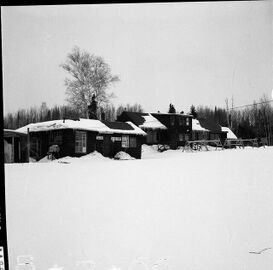 Lodge buildings, Little Norway (984.80.575U)
-
 Little Norway announced, Aug. 1963
-
 "Local Clubs Geared For Snow", Nov. 1963
-
 "Skiing Commencing This Weekend", Nov. 1963
-
 A-frame going up, Dec. 1963
-
 "Little Norway Progressing Well", Feb. 1964
-
 "Little Norway In Operation", Feb. 1964
-
 Little Norway advertisement, Mar. 1964
-
 Spring Fever Open Downhill, Apr. 1964
-
 "Big Plans Ahead For Skiing Areas", Apr. 1964
-
 "Big Plans" (continued)
-
 Knute Hansen's accident, Apr. 1966
-
 World Cup, Jan. 1980 (1/4)
-
 World Cup, Jan. 1980 (2/4)
-
 World Cup, Jan. 1980 (3/4)
-
 World Cup, Jan. 1980 (4/4)
-
 Falun delegation, Feb. 1993 (1/2)
-
 Falun delegation, Feb. 1993 (2/2)
-
 1995 advertisement and schedule (1/2)
-
 1995 advertisement and schedule (2/2)
-
 "Big Thunder ski jumps an instant hit" (1/2)
-
 "Big Thunder ski jumps an instant hit" (2/2)
-
 "A Nordic festival" (1/2)
-
 "A Nordic festival" (2/2)
-
 "Mother Nature serves up glitch"
-
 "Three nations in women's event"
-
 "Russian star strikes for third gold"
-
 "Canadians impressive in final relay event"
-
 "Canadian women continue to struggle"
-
 "Russia sweeps gold"
-
 "Norwegian phenom wins"
-
 "Jumper hits hill record in K120"
-
 "Nordics were a Thunder Bay success story"
-
 "Ski program helps masters", Jan. 1998
-
 "Firm has big plans for Big Thunder", Jan. 1998


Earlier ski-history clippings from the same folder (the Port Arthur Ski Club at Strathcona, 1937–40; the 1939 Dominion championships; Moose Mountain; Centennial Park; Trowbridge Falls; and others) are shown in History of skiing in Thunder Bay.
Governance, money and operations
Governance and ownership
Short answers.
- Who owned it? After the 1983–1985 purchase (or, in John Beals's words, "expropriation"), the land and buildings belonged to the Province of Ontario.[15][14][1] Wikipedia says the Ministry of Tourism and Recreation bought the site in 1985.[1] In 1992 the library's index files the province's dealings with Big Thunder under that ministry.[18]
- Crown agency or independent not-for-profit? The evidence points to a provincial agency with a board appointed by the province, not an independent charity that merely received grants. The Lakehead business case says that after the early 1980s Big Thunder "operated as an agency of the Ontario Provincial Government" under the culture and recreation ministry, which kept an office in Thunder Bay.[16] In 1993 the headlines read "Appointments coming for Big Thunder Board" (20 April), "Big Thunder board members replaced" (1 May) and "Challenge at Big Thunder [new board chairman promoting teamwork]" (6 May). That autumn an audit "blasted" the "former board".[24] Inference: a board that the province could appoint and replace in one step was a provincial body. Not found: the order-in-council or statute that created it, and its legal name. The index calls it the "Big Thunder Ski Training Centre", and by late 1995 headlines call it "Big Thunder Sports Park".[24][19]
- Who ran it? Rob McCormack was the site's manager; the November 1993 audit "throws doubt on McCormack as manager (severance package questioned)".[24] He was also named chief executive of the 1995 Nordic World Ski Championships in September 1992.[18] A 2005 TV retrospective calls him "the man who spearheaded it all"; he recalled a goal "we all thought about in 1981". The same report says John Hatton and a second official were "in charge of Big Thunder during the championships and in the years leading up to 1995".[5] Not confirmed: that Hatton's title was "chairman"; no source found gives it. In November 1995 "Nordics boss files lawsuit [alleges breach of contract by Big Thunder management]", and in February 1996 "Big Thunder criticizes McCormack's work as head of sports park, Nordics".[19][31]
- Did the City of Thunder Bay own or fund it? Not that any source shows. The city owned the watershed land next door: the Big Thunder board negotiated access to about 17,000 acres of it for trails.[16] The city's money and liability were tied to the 1995 championships, not to the training centre's operating budget. In January 1992 the CJ reported "Games: city to have final say on spending above $14.3 million". In 1993 council voted for a "Nordics audit" and repeatedly demanded financial reports. City employees acted as tour guides during the event.[18][24][19] Not found: any city operating grant to Big Thunder.
- Was there a plan for the city to replace the provincial money? There was talk but no takeover. In 1996 the city formed an ad hoc advisory committee ("City has hope for Big Thunder", 13 February; "New committee looks at ways to save Big Thunder facility", 21 February). Lakehead University looked at a takeover ("LU looks to takeover of Big Thunder", 12 March; Lake Superior Magazine: "Big Thunder changing hands? Lakehead U. looks at a hill of a deal", June). In July developers presented two plans and "want city as partner". In August the CJ called it "Time for action on Big Thunder".[31] Not found: any council vote to fund operations. The province instead decided to sell: "Big Thunder to remain idle until suitable buyer found" (28 December 1996).[31]
| Period | Owner of land and buildings | Operator | Main funders found | Sources |
|---|---|---|---|---|
| 1963–1969 | Knute and Tor Hansen (Little Norway) | The Hansens | Private | [1][6] |
| 1969–1977 | Unnamed buyer (Mt. Norway); extra land leased | Mt. Norway Ski Area | Private; the province paid for the main twin jumps (completed 1974) | [1] |
| 1977–1983 | John Beals (Sundance Northwest Resorts Ltd.) | Sundance, a public ski resort | Lift tickets and events (private); province redevelops the jumps from 1981 | [14][1][89] |
| 1983/85–30 June 1996 | Province of Ontario (Ministry of Tourism and Recreation; earlier the culture and recreation ministry) | Big Thunder board and staff, a provincial agency; manager Rob McCormack | Province (operating subsidy and capital); one-time federal money for the 1995 Worlds; event income | [1][16][18][24][23] |
| 1990–1996 (event only) | – | 1995 Nordic World Ski Championships organizing committee (CEO McCormack) | Province $5 million, federal $2 million, sponsors (over a $3 million target), TV and other income; the city had a say on spending above $14.3 million | [23][21][18][19] |
| On site, not owners | – | Big Thunder Nordic Ski Club (non-profit, incorporated in the 1980s); Friends of Big Thunder (fundraising and promotion) | Members and volunteers | [43][16] |
| 1996–2012 | Province of Ontario (closed) | Ontario Realty Corporation (by 2005); Ministry of Tourism (2010) | Province pays upkeep, "six figures" a year | [5][17][36] |
| 2012–today | Province of Ontario | Infrastructure Ontario; movable assets to the Ministry of Natural Resources and Forestry in 2015 | Province | [32][3] |
Funding and the federal–provincial split
"Isn't Olympic funding federal?" Yes, for athletes and national teams. Ottawa, through Sport Canada, pays national sport organizations and the Athlete Assistance Program ("carding"). In 1995 the top carded athlete's monthly stipend rose from $650 to $810.[30][90] But buildings and sites are mostly not federal. Big Thunder was owned and run by Ontario, so its operating money came from Queen's Park. When Ontario cut its subsidy, nobody else was obliged to pay the bills, and the site closed even though Olympic funding is federal. Ottawa's only payment to the site found so far is one-time money for the 1995 championships.[23][22]
Did the federal cuts contribute too? Probably yes, indirectly. The 2005 retrospective says Big Thunder "was hit with a double whammy": "the federal government cut funding for Nordic sports and then the province cut its subsidies".[5] The federal cuts are described below. By 1998 ski jumping and Nordic combined were among the Olympic sports that received no federal funding.[91] Inference: once the national jumping programme lost federal money, and its remaining support came mainly from Calgary's CODA,[42] Ontario was being asked to subsidize a national training centre for a sport that Ottawa no longer funded. That made it an easier cut.
Big Thunder money by year and source (what has been found)
| Year | Item | Amount | Paid by | Notes | Sources |
|---|---|---|---|---|---|
| 1974 | Main twin jumps (70 m and 90 m) | Not found | Province | Built while the site was privately owned (Mt. Norway) | [1] |
| 1981–1985 | Redevelopment as a national training centre | Not found | Province | Begun in 1981 | [1] |
| 1983 | Purchase of Sundance | $540,000 | Province | Year conflict: 1983/1984/1985 | [15] |
| 1985–1990 | K-64 and Little Thunder K-10, K-20, K-37 jumps, two with porcelain in-runs and plastic for summer | Not found | Province (ministry) | [1] | |
| 1988 | Audit | – | – | "Big Thunder was warned of problems in '88 audit" (CJ, 16 November 1993) | [24] |
| 1990 | 1995 Worlds commitment | "Up to $5 million" | Province (Ministry of Tourism and Recreation) | Announced in the Legislature, 28 May 1990 | [21] |
| 1990 | 1995 Worlds commitment | $2 million | Federal government | "Feds ante $2 million for Nordic Games" | [22][23] |
| 1990 | 1995 Worlds commitment | $1.8 million | Source cut off in the only copy found | The Northern Ontario Business preview ends mid-sentence | [23] |
| 1990 (plan) | Total cost of staging the Worlds | About $20 million (half capital) | All sources | Capital: $6.1 million trails, stadium and media centre; $2.2 million jumps; $2.9 million Nordic combined facilities. The bid cost about $426,000 | [23] |
| 1992 | Annual government operating money | "Less than $800,000 annually" | Government (province) | Headline only, CJ 20 January 1992 | [18] |
| 1992 | Offer to buy | $1 million | A ski association | "Big Thunder head scoffs at $1 million offer" | [18] |
| 1993 | Local funding cut | Not found | Province | "Province slashes local funding" (24 April); later "Swarbrick paves road of goodwill at ski hill [Big Thunder gets money to pave lot]" (30 October) | [24] |
| 1993–1995 | Worlds broadcast and sponsorship | Sponsorship passed a $3 million target (February 1995) | CTV (broadcaster), Bell and other sponsors | "CTV to broadcast Nordics" (December 1993); a 1993 lottery fell 1,400 tickets short | [24][19] |
| 1995–96 | Worlds result | Surplus of $27,480 | – | CJ, 25 June 1996 | [31] |
| October 1995 | Operating subsidy | Not found | Province | "Funding slashed for Big Thunder" (7 October); "Big Thunder struggles with debt" (21 October) | [19] |
| 1996–2018 | Upkeep of the closed site | "Six figures" / "several hundred thousand dollars" a year | Province | [17][4][1] | |
| 1988–2005 | National ski jumping and Nordic combined teams (not Big Thunder) | More than $10 million in total; at least $700,000 a year | CODA (Calgary) | About 80% of the teams' funding | [42] |
Not found: Big Thunder's full annual budget, its revenue, user-fee income, or the provincial share of revenue in any year. The business case says only that management "came to depend on a great deal of Government support".[16] Inference: if government money was just under $800,000 in 1992, and the site sold few lift tickets (see below), the province probably paid most of the running costs. This is not a measured share.
Federal sport cuts, 1990–1998
This answers Michael's question about which sports were cut.
- Peak. Federal spending on sport and fitness peaked at $66.7 million in 1987, helped by the "Best Ever" programmes for the 1988 Calgary Olympics.[30]
- Reviews. After the Ben Johnson scandal came the Dubin Inquiry (1990), the minister's task force report Sport: The Way Ahead (1992) and J. Cal Best's Report of the Core Sport Commissioner (1994).[92] In 1993 Prime Minister Kim Campbell abolished the post of Minister of State for Fitness and Amateur Sport and moved Sport Canada into the new Department of Canadian Heritage. A "core business" review recommended funding only selected sports, those doing well internationally.[92]
- Cuts. In the early 1990s federal contributions to national sport organizations fell by about 25%.[30]
- The framework. The Sport Funding and Accountability Framework (SFAF) was "first introduced in 1995–1996"; one history dates its adoption to 1996.[93][92] It cut the number of "core sports" eligible for full carding from 60 to 38. "Eight Olympic sports previously funded by Sport Canada no longer receive any funds."[30]
- Which sports? Neither the committee report nor any other source found lists all eight. The best evidence is the testimony of the Non-Federally Funded Olympic Sport Organizations to the Commons sub-committee on 11 February 1998.[91] Their spokesman was James Bandolla, executive director of Ski Jumping Canada. He said ten Olympic sports then had no federal funding, three winter and seven summer.
- Winter: "Ski jumping, snowboarding, and Nordic combined".
- Summer (named in the record): triathlon, modern pentathlon, rhythmic sportive gymnastics, shooting and archery. The other two summer sports were listed in a handout that is not in the transcript.
- Inference: the "eight previously funded" are these ten minus the two new Olympic sports, triathlon and snowboarding, which had never been funded. The committee noted triathlon "has never been funded", and Bandolla called both "new Olympic sports". If so, ski jumping and Nordic combined were among the eight Olympic sports that lost all federal funding, along with modern pentathlon, rhythmic gymnastics, shooting, archery and two unnamed summer sports.
- What losing core status meant. Athletes from non-core sports were carded only if they ranked in the world's top eight. Athletes from core sports could rank below 75th and still be carded. Bandolla's example was "a ski jumper who's ranked ninth in the world". Non-core athletes also got fewer services at national training centres. Rhythmic gymnastics and shooting had both won Olympic gold for Canada in the 1980s.[91] Lacrosse was cut and then funded again under a separate "domestic sport pilot project", along with football, ringette and five-pin bowling.[91]
- Partial reversal. In early 1998 Ottawa promised an extra $10 million a year for high-performance sport from 1998–99 to 2002–03.[30] Ski Jumping Canada was recognized under the framework, and Sport Canada became a funding partner, only in 2016.[94]
Did it move to Alberta? Not the facility, and not all of its programmes. What went where:
- Calgary: the national ski jumping and Nordic combined programmes. Calgary's Canada Olympic Park opened for the 1988 Olympics, and CODA paid about 80% of those teams' costs from 1988 to 2005.[42] Thunder Bay-born Nordic combined Olympian Jason Myslicki lived in Calgary and skied for Calgary's Altius Nordic Ski Club.[95][96]
- Ottawa: in 1985 Thunder Bay's national-team jumpers were told to move to a training centre in Ottawa. Collins refused.[12]
- Stayed in Thunder Bay: cross-country. Big Thunder Nordic moved to Kamview in 1996, and the city later had a National Team Development Centre.[43][97]
So Michael's "it moved to Calgary" is right for jumping, partly wrong in its timing (the shift began in 1988, not 1996), and wrong for cross-country.
Why Ottawa cut, and how other countries compared
Michael asked whether the federal cut to ski jumping in the mid-1990s was simply part of general austerity, given how little money was involved and how much national prestige was at stake. The short answer from the sources: austerity was the trigger, but the cut also came from a deliberate decision to fund fewer sports, and ski jumping and Nordic combined fell below the line. No source found states how much Ottawa actually saved on these two sports.
Why Ottawa cut
- Deficit politics. A University of Ottawa Press history says the early-1990s rethink of sport policy came "at a time of significant economic restraint where reducing the financial deficit became the primary political objective" of the Progressive Conservative government, and that funding only "core sports" "aligned neatly with the federal government's interest in reducing public spending". The Core Sport Commission was set up in June 1993. Its 1994 report, the Best report, proposed funding criteria such as "value to Canadian society".[98]
- Post-Dubin doubts. After the 1988 Ben Johnson scandal and the Dubin Inquiry (1990), several federal reports questioned the government's "(over)emphasis on international results for athletes". They also asked what role government should play in high-performance sport.[92] Inference: this weakened the prestige argument for funding every Olympic sport just as the money ran short.
- Paul Martin's 1995 budget. The Liberal budget of February 1995 implemented Program Review: "$25.3 billion of cumulative spending reductions" over three years. Canadian Heritage, which was responsible for "amateur sport", was to cut spending by $676 million over three years. Its spending would fall from $2,897 million in 1994–95 to $2,221 million in 1997–98, about 23% (Curriepedia's arithmetic). The budget named cuts at the CBC, Telefilm, the NFB and Parks Canada but gave no separate figure for Sport Canada.[99] Federal contributions to national sport organizations had already fallen by about 25% in the early 1990s. The Commons sub-committee said the SFAF "followed severe financial reductions at Sport Canada".[30]
- The scoring rules. To be funded for 1996–2001, a national sport organization first had to meet prerequisites: sound accounting, plus Sport Canada policy on gender, official languages, drug use and tobacco sponsorship. It then had to score above a threshold in three categories:[30]
- high performance: athletes' results, coaching, training and athlete monitoring;
- sport development: athletes, coaches and officials, scored partly on membership and participation in national and provincial championships and the Canada Games;
- management practices: finances and service capacity.
- Inference: a small sport with few clubs and members, such as ski jumping, would score poorly on development whatever its World Cup record. No published SFAF score for Ski Jumping Canada or Nordic combined was found.
- Results had slipped. Canada's best Olympic ski-jumping result was Horst Bulau's 7th at Calgary in 1988, and no Canadian matched it at Albertville in 1992.[52]
What it saved, in dollars
- Not found: Ski Jumping Canada's or Nordic combined's federal grant before or after the cut. No source found gives either figure.
- Best proxy: the Commons sub-committee costed the fix in December 1998:[30]
- a $100,000-a-year minimum for each of "the 10 Olympic sports organizations not currently funded" would "cost $1 million a year";
- carding their national-team athletes would cost "around $650,000 annually".
- Curriepedia's arithmetic: $1 million is about 0.05% of Canadian Heritage's planned 1997–98 spending of $2,221 million.[99] Inference: Michael is right that the amounts were trivial next to the department's cuts. The decision was about which sports to back, not about the size of the saving.
- For scale:
- CODA's spending on the two sports was at least $700,000 a year to 2005: $300,000 for programmes and $400,000 for facilities.[42]
- In 2024–25 Sport Canada gave Ski Jumping Canada $397,500 through its core programme, plus $137,412 in athlete assistance. Alpine Canada received $5,495,280 through the same programme.[100]
What people said at the time
- James Bandolla of Ski Jumping Canada, speaking for the unfunded Olympic sports on 11 February 1998:[91]
- "The criteria are too restrictive. There are some Olympic sports that will never be mass participation sports."
- "There has been a de facto abandonment of non-core sports. It appears it is the government's plan to let these sports die out, because they do not figure into the current sports plan."
- On the government's studies: "These studies look at 38 sports only. A few years ago Sport Canada was funding 60 sports. What happened to the other 22?" The chairman replied, "Good point."
- The sub-committee's report, chaired by Dennis Mills (Sport in Canada: Everybody's Business, December 1998), quoted the "de facto abandonment" line.[30][101] It recommended:
- that "the number of national sport organizations eligible for federal funding be increased";
- a $100,000 minimum for each Olympic sport organization;
- carding for "all qualified national team athletes regardless of the funding status of the national sport organization".
- Not found: any minister or MP defending the ski-jumping cut in particular, or comment on it from a Thunder Bay MP.
The reversal, and whether ski jumping benefited
- 1998: Ottawa promised $10 million a year more for high-performance sport from 1998–99 to 2002–03.[30] Ski jumping stayed outside the funded group.[94]
- 2002–03: the Canadian Sport Policy (May 2002) set four priorities: participation, excellence, capacity and interaction. The Physical Activity and Sport Act followed in March 2003.[92]
- 2005: Own the Podium began for Vancouver 2010. Corporate supporters matched federal contributions of $11 million a year, "for a total of $110 million over five years".[102] In the same season CODA said it would stop funding ski jumping and Nordic combined from 31 March 2005, after "more than $10 million" since 1988.[42]
- 2010–2014: Own the Podium did fund the two sports for one cycle, $600,000 over four years by its own count. Curtis Lyon, chairman and high-performance director of both national bodies, said this came as about $200,000, $300,000, $100,000 and then nothing. Own the Podium dropped both sports for 2014–15.[46]
- 2016: Sport Canada became a funding partner of Ski Jumping Canada. As of the Wikipedia article, the sport is not funded by Own the Podium.[94]
- Effect on results: Olympedia lists no Canadian ski jumpers at the 1994, 1998 or 2002 Games, and no Canadian Nordic combined skiers from 1992 to 2002. Both returned in 2006.[103][104] Canada's first Olympic ski-jumping podium came in 2022.[51]
- Inference: the gap matches the years without federal money. However, CODA kept paying for the teams until 2005, so federal policy was not the only cause.
How other countries compared While Ottawa narrowed its list, the leading ski-jumping nations kept permanent systems in place, and Australia raised its targeted spending. The table counts Olympic ski jumping and Nordic combined medals from 1994 to 2006 (25 events), tallied from Olympedia.[105] "Not found" means no figure turned up in this research.
| Country | Funding model | National centre or school | Mid-1990s to 2000s | SJ + NC medals 1994–2006 | Gold |
|---|---|---|---|---|---|
| Canada | Federal Sport Canada funds only the "core" sports that pass the SFAF (from 1995–96). Ski jumping and Nordic combined unfunded federally until 2016. CODA paid about 80% of team and facility costs until 2005.[30][42][94] | Canada Olympic Park, Calgary (CODA). Big Thunder closed 1996. | No Olympic ski jumpers 1994–2002; no Nordic combined 1992–2002.[103][104] | 0 | 0 |
| Norway | Olympiatoppen (1988), part of the national sports confederation. Created with "financial state support but without legislation" at arm's length. Goal: a top-3 ranking in Winter Olympic sports.[106] | Olympiatoppen, "Norway's national high-performance center".[107] | Created after Norway won no gold at Calgary 1988 and was awarded the 1994 Lillehammer Games.[106] 1990s budget: not found. | 14 | 5 |
| Austria | Ski Federation (ÖSV) plus state-subsidized ski boarding schools. At Stams, families pay about €4,000 a year, "about 25 percent of the actual cost"; provincial and federal governments subsidize about 75%.[108] | Schigymnasium Stams, founded 1967, the first school of its kind.[109] "Most of Austria's great ski jumpers" came through this system.[108] | 1990s budget: not found. | 13 | 4 |
| Finland | State and federation funding. A recent study puts Finland's direct state elite-sport funding at about €29 million, among the lowest in the Nordic countries (modern figure).[106] | Lahti Ski Jumping Centre, named national training centre for ski jumping and Nordic combined (with Kuopio) in 2026.[110] | 1990s budget: not found. | 13 | 4 |
| Germany | The army (Bundeswehr) employs athletes as "sport soldiers". About 740 posts, about 185 of them for Olympic winter sports; about €27 million in 2003.[111] | Federation and army sport-support groups. | At Salt Lake City 2002, Bundeswehr athletes won 25 of Germany's 35 medals.[111] | 11 | 4 |
| Japan | Host-nation spending for Nagano 1998. About $1.17 billion in Olympic facility projects (US dollars, 1997 report).[112] Athlete funding model: not found. | Hakuba Ski Jumping Stadium; construction began in 1990 "as the centerpiece of the Olympic bid".[113] | Hosted 1998. | 7 | 3 |
| Slovenia | National funding model in the 1990s: not found. | Planica; the Planica Nordic Centre was rebuilt 2011–2015 for about €40 million.[114] | 1990s figures: not found. | 1 | 0 |
| United States | National federation (USSA) plus state-funded venues. Utah's 1989 referendum allowed taxpayer money for a winter sports park; its jumps opened in 1992–93 and got a $48 million upgrade plan in 1997.[115] New York State created ORDA after 1980 to run Lake Placid's venues.[116] | Utah Olympic Park (Park City); Lake Placid. | USSA stopped funding ski jumping as a national team after 2010. Nordic combined lost about $3 million per four-year cycle in 2014.[117] | 0 | 0 |
| Australia (parallel model) | Targeted federal funding through the Australian Institute of Sport (1981) and the Australian Sports Commission. Government funding rose from A$63.4 million (1993–94) to A$85.9 million (1994–95). An Olympic Athlete Program of A$135 million (ending at A$140 million) over six years prepared athletes for Sydney 2000.[118][119] | AIS, Canberra. | The Australian government sought "value for money" in Olympic funding.[119] | n/a | n/a |
What the comparison shows (inference from the sources above)
- The same logic, opposite direction. Australia, like Canada, targeted its money. But in 1994–95 it raised its total while Ottawa cut, so targeting there did not mean dropping Olympic sports to save money.[118][99]
- Failure was answered differently. Norway answered its 1988 failure by building a central elite-sport body. Canada answered its post-1988 crisis (Dubin, then the deficit) by funding fewer sports.[106][98]
- Permanent support. The nations that won most jumping and Nordic combined medals paid athletes or schools year after year: the German army posts and the subsidized Stams school.[111][108]
- The closest parallel is the United States. It built good public venues but left ski jumping largely to its own fundraising, and it won no ski jumping or Nordic combined Olympic medals from 1994 to 2006.[117][105]
- Not found: 1990s budgets for Olympiatoppen, the ÖSV, the Finnish and Slovenian federations, or Japan's ski-jumping programme; the cost of the Hakuba hills; and Canada's pre-cut grant to Ski Jumping Canada.
Hockey by comparison
Michael asked how Canada's funding of small Olympic sports compares with its funding of hockey, at every level of government. The short answer: Ottawa gives Hockey Canada only a few million dollars a year, a small share of its budget. Ontario gives the provincial hockey body no grant that appears in its accounts. The real public money for hockey is local: cities build, run and subsidize the arenas. Thunder Bay alone loses about $1 million a year running its rinks, more than the province spent each year on Big Thunder.
Federal
- Core funding, recent years: Hockey Canada received:
- $5.65 million in Sport Canada operating grants in fiscal 2021, part of "$14 million in federal government support in 2020 and 2021, including $3.4 million in emergency COVID-19 subsidies";[120]
- $7.7 million in fiscal 2022, about seven per cent of its revenue.[121][122] Sportsnet put government funding at "six per cent of its annual budget".[123]
- in 2024–25: $4,057,600 in core (Sport Support Program) funding, $1,955,652 in athlete assistance and $50,000 in hosting money. Ski Jumping Canada received $397,500 and $137,412.[100]
- Freeze and restoration: Ottawa froze Hockey Canada's funding in June 2022, after its handling of a sexual-assault settlement became public. Funding was restored with conditions in April 2023, after about 10 months.[122][124]
- Carding: athletes under contract in the National Hockey League are not eligible for the Athlete Assistance Program.[125] Inference: Hockey Canada's athlete-assistance money mostly supports players outside the NHL, such as the women's and para teams. No breakdown was found.
- 1990s: not found. No figure turned up for the Canadian Amateur Hockey Association's (CAHA) federal grant before the 1994 merger, or for Hockey Canada's in the late 1990s.
- Arenas: federal infrastructure programmes pay for rinks:
- Recreational Infrastructure Canada (2009): "$500 million over the next two years", covering up to 50% of a project's cost.[126]
- The Investing in Canada Infrastructure Program's community, culture and recreation stream, which covers "arenas, pools" and other facilities: about $1.3 billion through bilateral agreements.[127]
- In Thunder Bay, Ottawa put "over $2.35 million" into the Fort William Gardens in 2023 (Green and Inclusive Community Buildings program), with $644,895 from the city.[128]
- Tax measures: not researched for this section.
Provincial
- Ontario Hockey Federation: its 2024–25 audited statements show $9.8 million in revenue. Most of it ($7.4 million) is Hockey Canada insurance and assessment money passing through, and there is no line for provincial grants.[129] Inference: Ontario gives the provincial hockey body little or no direct funding. Not found: any figure for Hockey Northwestern Ontario.
- Ontario sport overall: Ontario said it spent "more than $25 million in 2015–16" on amateur sport, up from $8.78 million in 2003. Sport Priority Funding for 15 provincial and multi-sport organizations was "almost $985,000".[130]
- Arena capital: in April 2026 the Northern Ontario Heritage Fund put $2 million into Thunder Bay's Delaney Arena. The money pays for a new rink slab, ice plant, boards, scoreboard and seating.[131]
- Not found: Ontario's 1990s arena grants, the effect of Ontario's 1995–96 cuts on arenas, and any provincial funding for the Ontario Hockey League.
Municipal (the largest share)
- Nationally: a census by Hockey Canada, Natural Resources Canada and the Canadian Recreation Facilities Council counted 1,847 arenas. About 73% were built before 1980.[132] The federal Future of Sport commission notes that municipalities fund and maintain "arenas, pools, and recreation centres, while often also subsidizing local programming".[127] Not found: a national total for municipal arena subsidies.
- Thunder Bay running costs: the city's six indoor rinks cost taxpayers "about $1.01 million a year" in net operating losses in 2019. The Fort William Gardens lost $462,300 on a gross operating cost of $802,300. All six lost money.[133] A 2025 report gave a similar figure: "around $1 million" for the six rinks "so far this year".[134]
- Thunder Bay capital:
- In 2021 the city proposed adding $400,000 a year to its capital budget for the Gardens and other recreation buildings.[135]
- It owns seven arenas, all "decades old". The Gardens dates from 1951 and the Tournament Centre (1995) is the newest; a 15-year arena strategy is due in 2027.[136]
- The proposed Thunder Bay Event and Convention Centre, a 5,700-seat hockey arena, was costed at $114.7 million in 2015, with 40% from the city.[137][136] It was shelved in 2015 when Ottawa said it was ineligible for federal funding. The city had set aside $23 million for it.[138]
- Compared with Big Thunder: Thunder Bay's yearly arena operating loss (about $1.01 million in 2019) is larger than the government money Big Thunder received ("less than $800,000 annually" in 1992).[133][18] The figures are 27 years apart and not adjusted for inflation. The arena figure is also before capital spending, and the Big Thunder figure is total government money.
NHL arenas (context)
- Edmonton, Rogers Place: cost $483.5 million. The city contributed $226 million; another $125 million came from a ticket surcharge; the Katz Group paid $132.5 million, most of it as rent over 35 years.[139]
- Calgary, Scotia Place: $926.4 million for the first phase. The City of Calgary is paying $515.3 million, Alberta $55.1 million, and the Flames' owner (CSEC) $356 million.[140]
- For scale: the city's share of Scotia Place alone is about 1,300 times Ski Jumping Canada's 2024–25 federal core grant (Curriepedia's arithmetic).[140][100]
Per participant
- Hockey: Hockey Canada had "more than 615,000 players" registered in 2025–26.[141] Its 2024–25 core federal grant works out to about $6.60 per registered player (Curriepedia's arithmetic).
- Ski jumping: Ski Jumping Canada's registered membership was not found, so a per-participant figure cannot be given.
- Inference: Ski Jumping Canada's whole federal core grant is about a tenth of Hockey Canada's, for a sport with a tiny fraction of hockey's participants. Per participant, Ottawa probably gives ski jumping more than hockey. The real difference is local. Hockey has a publicly built and publicly subsidized rink in almost every town. Ski jumping lost its Ontario training centre when the province stopped paying for Big Thunder, and the city did not take over its funding (see Governance and ownership).
How Big Thunder operated
- Training centre or public ski hill? Mainly a training and events centre after the province took over. Skier 72 says that in 1984 the provincial government acquired it "to be a training centre for provincial ski teams, closing it to the public" as an alpine area.[142][143] The Lakehead business case, quoting FIS judge Ernie Marchiori, lists more uses before 1996. These include alpine, cross-country, freestyle (moguls and ballet) and natural-luge competitions, Canada Winter Games and Ontario Cup events, "snow-cross" in the stadium, and summer competitions and concerts. It also lists "Downhill Skiing", mountain biking, hiking and snowshoeing among the facilities.[16] Conflict: whether ordinary day-ticket downhill skiing continued after 1984 is not settled. The 1992 headlines "Truce in Thunder Bay's ski hills battle" and "Big Thunder tabbed as regional ski centre" suggest some overlap with the private hills.[18] The Walleye wrote that it was "mired in controversy as a publicly funded facility competing with private businesses".[3] A chairlift was added in the 1990 upgrade.[1][32]
- Clubs and youth. The Big Thunder Nordic Ski Club (incorporated as a non-profit in the 1980s) was based on the site and hosted World Cup races in 1989 and 1994 and the 1995 Worlds.[43] Little Thunder's K-10, K-20 and K-37 hills were small jumps alongside the big hills.[1] Freestyle skiers used the summer water ramps: Amber Peterson started there in 1993 and competed in the Lake Superior Ski Division.[144][145] The Kardas brothers say they were "more or less raised" at the site, where their father coached.[2] The national cross-country development squad was based there in 1993 ("Nats ski team at Big Thunder").[24]
- Memberships, day passes and user fees. Not found for the training centre itself. Club programmes were paid through club membership.[43]
- Research. Lakehead University built a biomechanics lab on site. In 1993 the Nordic Games committee and Lakehead set up a testing centre.[3][24]
- Event, sponsorship and TV money. This went mainly to the 1995 championships' organizers, not to Big Thunder's own budget. CTV was picked as broadcaster in December 1993. Sponsorship passed its $3 million target in February 1995. The 2005 report says there "wasn't much national TV coverage here in Canada" but "plenty in Japan and Europe".[24][19][5] Summer concerts were tried: The Tragically Hip's Another Roadside Attraction tour played Big Thunder on 21 July 1993, and the index calls that rock event "a test case".[146][24]
- Staff. Not found: any staff count. One former employee says he worked there for about a decade, from about 1988, rising from general labourer to assistant operations manager. His mother also worked there "shovelling snow off the ski jump".[3]
Volunteers. Much of the jumping ran on volunteers. Jeff Thingstad told Bayview that around 1979 Frank Gartrell and Rob McCormack asked him to help with the ski jumping events they were hosting at the Little Norway jump; one job was carrying a computer up to the judging tower, "nearly half-way up hill". He went on to lead a volunteer grounds crew of about 24 people who still worked the Sleeping Giant Loppet and events at Lappe and Kamview in 2016.[147] Gartrell, a member of Canada's 1964 Olympic jumping team, sat on the Big Thunder ski jumping centre's board of directors, coached, and helped maintain the hills; he was also a CBC commentator at the 1988 and 1992 Olympics.[148][149][150] The Northwestern Ontario Sports Hall of Fame once treated delegates to a national convention of sports halls of fame to helicopter rides over Big Thunder.[151]
Legacy in numbers
| Measure | Figure | Status | Sources |
|---|---|---|---|
| Ski jumping World Cup events | 29 (1980–1994; one round, usually two jumps, every season 1980–1991, then the March 1994 pre-Worlds) | Counted from Wikipedia's results table. The Walleye says "39 World Cups" (probably all disciplines) | [1][3] |
| Other World Cups | Nordic combined in 1989 and 1994; cross-country in 1989 and 1994 | Reported | [1][43] |
| National championships | "50 National Championships" | Reported, one source | [3] |
| World Championships | 1 (9–19 March 1995) | Reported | [1] |
| Spectators, 1995 Worlds | "Between 60 and 80,000" in total; more than 11,000 at the night team jumping event (16 March) | Reported (2005 TV; CJ) | [5][19] |
| Volunteers, 1995 Worlds | 2,000 (2005 TV report) or 1,500 (Wikipedia) | Conflict | [5][152] |
| Athletes, 1995 Worlds | About 370 from 27–30 countries expected (1990 forecast) | Estimate (forecast) | [23] |
| Athletes who trained there, all years | Not found | – | – |
| Staff, all years | Not found | – | – |
| Day visitors / skier visits | Not found | – | – |
Olympians and national-team skiers from Thunder Bay
Amber Peterson is an Olympian, but she was a freestyle aerials skier, not a ski jumper. Olympedia spells her name Amber Peterson. She placed 15th in women's aerials at Turin 2006, won a World Cup silver at Lake Placid in 2006, and won four straight Canadian senior aerials titles.[153][144] She did train at Big Thunder: on its freestyle water ramp from the summer of 1993 until it closed in 1996, then at Loch Lomond.[145][144] The Northwestern Ontario Sports Hall of Fame calls her the first female Olympic skier from Northwestern Ontario.[144]
The table covers all skiing and snowboarding Olympians that Olympedia lists as born in Thunder Bay or Fort William, plus others with a sourced Thunder Bay connection.[154][155] Click a column heading to sort.
| Athlete | Discipline | Games and placings | Thunder Bay link | Big Thunder link | Sources |
|---|---|---|---|---|---|
| Bob Lymburne | Ski jumping | 1932: 19th | Born Fort William, 1909; raised in Revelstoke, B.C. | None (before Big Thunder) | [156] |
| Martti Rautio | Cross-country | 1964: 15 km 65th, 30 km 52nd, relay 15th | Long Lac Club, Port Arthur; died in Thunder Bay | None found (before Big Thunder) | [157] |
| Frank Gartrell | Ski jumping | Named to the 1964 team; injured on the Olympic hill two days before the Games and did not compete | Fort William; later FIS judge, national jumping chairman and TV commentator at the 1988 and 1992 Olympics | Officiated at Big Thunder events | [158] |
| Dave Irwin | Alpine (downhill) | 1976: 8th; 1980: 11th | Born Thunder Bay; learned at Loch Lomond; "Crazy Canucks" | None found | [159][160] |
| Reijo Puiras | Cross-country | 1976: 30 km 56th | Born Chapleau; lived in Thunder Bay; built Lappe Nordic Centre | None found | [161] |
| Steve Collins | Ski jumping | 1980: normal hill 28th, large hill 9th; 1984: 25th, 36th; 1988: 13th, 35th, team 9th | Born Thunder Bay; Fort William First Nation | Yes: home hill; 3rd in a World Cup there on 21 February 1981 | [162][1][54] |
| David Brown | Ski jumping | 1984: normal hill 51st, large hill 47th | Born Thunder Bay, 1965 | Not documented | [163] |
| Todd Gillman | Ski jumping | 1988: normal hill 42nd, large hill 54th, team 9th | Listed among Northwestern Ontario Olympians; Olympedia gives his birthplace as Winnipeg | Not documented | [164][160] |
| Ron (Rob) Rautio | Ski jumping | Alternate in 1988; did not compete | Son of Martti Rautio; Northern Ontario Travel lists "Rob Rautio" | Not documented | [157][160] |
| David Walker | Freestyle (ballet, a demonstration event) | 1988: 12th; 1992: 12th | Born Thunder Bay, 1964 | Not documented; the site did host ballet competitions | [165][16] |
| Ryan Wedding | Snowboard (parallel giant slalom) | 2002: 24th; 2001 junior world silver | Born Thunder Bay; grandparents owned Mount Baldy. Later convicted (2010) of trying to buy cocaine from a U.S. government agent, and accused in 2024 of running a drug-trafficking ring | None found | [166] |
| Glynn Pedersen | Ski jumping (for Great Britain) | 2002: normal hill 43rd, large hill 48th | Born Thunder Bay, 1981 | Not documented | [167] |
| Sean Crooks | Cross-country (earlier Nordic combined and jumping) | 2006: sprint 32nd, relay 11th | Born Thunder Bay; Big Thunder Nordic Ski Club | The club was based at Big Thunder until 1996; site training not documented | [168][169][43] |
| Amber Peterson | Freestyle (aerials) | 2006: 15th | Born Thunder Bay | Yes: water ramp 1993–96 | [153][145] |
| Jason Myslicki | Nordic combined | 2006: individual 41st, sprint 41st; 2010: 45th, 44th | Born Thunder Bay; lived in Calgary | Not documented | [96][95] |
| Max Hollmann | Cross-country | 2026: 10 km 23rd, skiathlon 27th | Born Thunder Bay, 2002; Big Thunder Nordic Ski Club, Kamview and Lappe | None (born after the closure) | [170][97] |
Officials. Ernie Marchiori, born in Fort William, judged ski jumping and Nordic combined at the 1988 Olympics.[171] Not Thunder Bay athletes: Horst Bulau and Ron Richards, who appear in the athletes table above, were Ontario jumpers from elsewhere. Not found: a Thunder Bay-born Olympic biathlete. Many national-team and junior athletes are not in this table because no source with placings was found.
Why did ski culture decline in the 1990s?
This section weighs the causes Michael proposed against the evidence. "Decline" needs care: in the United States total skier visits did not fall in the 1990s, while Canadian visits and participation did.
What the numbers show. Canadian skier visits averaged about 21 million a year in 1990–93. The number of Canadians skiing or snowboarding was 4.7–4.9 million in the mid-1990s, then fell every year to 3.6 million around 2000.[172] Statistics Canada found that regular sport participation of any kind fell from 45% of adults in 1992 to 34% in 1998 and 28% in 2005. By 2005 only 490,000 adults downhill skied regularly (1.9%) and 197,000 cross-country skied (0.8%).[173] A thesis citing Statistics Canada gives downhill participation falling from 14% in 1992 to 6% in 2010 (a broader measure).[174] Researchers described Canada's ski industry in 2000 as facing "flattening market demand and declining revenues and profitability since the early 1990s".[175] In the US, visits stayed flat at roughly 50–55 million through the 1990s.[176] The number of US ski areas fell from well over 600 in the late 1980s to about 480 today.[177][178]
| Cause | Evidence | Weight |
|---|---|---|
| Government austerity and sport funding cuts | Federal NSO funding cut about 25% in the early 1990s; the new funding framework cut core sports from 60 to 38, and eight Olympic sports lost all funding.[30] Ontario cut nearly $2 billion in July 1995 and $6.3 billion in November 1995.[28][29] | High for Nordic and jumping, and for Big Thunder directly. Elite Nordic sport depended on public money, and the closure followed the funding cut within months.[19][5] |
| Snowboarding drawing youth away from skis | About 7% of US areas allowed it in 1985 and most did by 1990; US snowboard visits went from 1.8 million to 6.3 million in the ten years to 2002/03. In 2006/07, 59% of 15–17-year-olds at US resorts snowboarded.[179][180][181] | High for "ski" culture and clubs, low for total slope use. Boards replaced skis rather than replacing the slopes. Loch Lomond and Candy Mountain had snowboarding by 1990.[142] |
| Aging baby boomers and demographics | StatCan names an aging population as one of the main reasons sport participation fell; 35-and-overs' participation went from 36% (1992) to 22% (2005).[173] But a 2004 analysis found boomers "lingering on the slopes longer than expected".[182] | Medium. Real, but slow, and it explains the 2000s more than a sharp early-1990s break. |
| Cost of tickets and equipment | Canadian studies from Williams and Basford (1992) onward keep finding cost a key barrier to skiing.[174] Inflation-adjusted day-ticket prices in New England are up 60% since the 1990s.[183] | Medium. Mostly a long-run cause; it bites hardest on beginners and families. |
| Consolidation and loss of small community hills | Intrawest bought Tremblant (1991) and Panorama (1993); American Skiing Company was founded in 1994 and at one point owned 11 resorts; Vail bought Breckenridge in 1997.[184][185][186] "In the 1990s, ski resorts began buying other ski resorts."[187] Thunder Bay went from five alpine areas to two.[188][142] | Medium. Consolidation followed the closure of small hills more than it caused it. It changed where people skied. |
| Insurance and liability | In the mid-1980s liability crisis, some US ski areas faced premium increases of up to 400% and raised tickets by $2–3 a day.[189] At Big Thunder itself, the 1980 tube race injury led to Crocker v. Sundance (Supreme Court of Canada, 1988).[89][15] Jump insurance was estimated at $300,000 a year in 2011 and was called "astronomical" in 2005.[16][5] | High for jumping and for any sale of Big Thunder; medium elsewhere. |
| Climate and snow variability | New Hampshire winters warmed about 2.1 °C in the 20th century; small low-elevation areas fell steeply after 1970, and chairlift areas fell after 1980.[190] The 1995 Worlds were hit by +10 C weather that turned the snow to "water and mud".[5] | Low to medium for Thunder Bay, which keeps snow well (see History of skiing in Thunder Bay). Higher for southern hills. |
| Competing leisure (TV, video games, indoor activities) | Putnam (1995) called television "the most obvious and probably the most powerful" force privatizing leisure.[191] StatCan lists TV and the internet among the reasons for lower sport participation.[173] | Medium, mostly inference. No ski-specific study separates this effect. |
| Shift from club culture to commercial resorts; "Bowling Alone" | Between 1980 and 1993 the number of American bowlers rose 10% while league bowling fell 40%.[191] Ski clubs were "graying" and "in a state of turbulence" by 2002.[192] Locally, jumping and Nordic were club and volunteer sports. | Medium-high for Nordic and jumping. The pattern fits Putnam's: people kept skiing but stopped joining. |
| Early-1990s recession | US skier visits fell in 1989/90 and 1990/91.[176] Ontario's $10.6 billion deficit in 1995 was the stated reason for the cuts.[28] | Medium, mainly through government budgets. |
Conclusion. The evidence points to two different declines.
- Nordic skiing, jumping and the club culture fell mainly because of public money: federal sport cuts (1990s, 1995), Ontario's 1995 austerity, then CODA (2005) and Own the Podium (2014). Liability costs made jumping hills almost impossible to run privately. Club life weakened in the way Putnam described. Big Thunder is a clear case of all three.
- Recreational alpine skiing did not collapse. In the US it went flat, and in Canada it shrank. The main drivers were demographics and cost, with snowboarding moving young people from skis to boards. Consolidation and climate mostly decided which hills survived.
Inference: Snowboarding drew in teenagers in the early 1990s at the same time as public funding was withdrawn from Nordic sport. Together those two changes probably explain why "ski culture" in Thunder Bay felt like it collapsed in the mid-1990s, even though people kept skiing at Loch Lomond and Mount Baldy.
References
- ↑ 1.00 1.01 1.02 1.03 1.04 1.05 1.06 1.07 1.08 1.09 1.10 1.11 1.12 1.13 1.14 1.15 1.16 1.17 1.18 1.19 1.20 1.21 1.22 1.23 1.24 "Big Thunder Ski Jumping Center". Wikipedia (drawing on Marion, J.-P., "Big Thunder frozen in time", Superior Outdoors, Winter 2009, pp. 26–30).
- ↑ 2.0 2.1 2.2 "Former Big Thunder ski jumpers lament closure of championship-hosting hill". CBC News, 17 October 2017.
- ↑ 3.00 3.01 3.02 3.03 3.04 3.05 3.06 3.07 3.08 3.09 3.10 3.11 3.12 3.13 3.14 3.15 McChristie, Darren. "Big Boondoggle: Will Ford finally unload Big Thunder?". The Walleye (c. 2018).
- ↑ 4.0 4.1 4.2 4.3 4.4 4.5 4.6 Vis, Matt. "Twenty years after Nordic Games, Big Thunder remains aging and forgotten relic". TBNewsWatch, 9 March 2015.
- ↑ 5.00 5.01 5.02 5.03 5.04 5.05 5.06 5.07 5.08 5.09 5.10 5.11 5.12 5.13 Wilson, Jonathan. "TBT News lookback to the 1995 World Nordics" (two-part TV news series, March 2005; YouTube transcript).
- ↑ 6.0 6.1 "Tor Hansen" (obituary). TBNewsWatch, 27 July 2016.
- ↑ "Kim Hansen" (obituary). TBNewsWatch, 27 December 2019.
- ↑ 8.0 8.1 8.2 Patola, Roger. "On the Slopes: Local Clubs Geared For Snow". Port Arthur News-Chronicle, 23 November 1963; clipping from the Thunder Bay Museum archives, supplied by Emma Hurley Warren (archival assistant) in an email to Michael Currie, 26 October 2026 (personal communication). Scan.
- ↑ 9.0 9.1 9.2 9.3 "'Little Norway' In Operation". Port Arthur News-Chronicle, 28 February 1964; clipping from the Thunder Bay Museum archives, supplied by Emma Hurley Warren (archival assistant) in an email to Michael Currie, 26 October 2026 (personal communication). Scan.
- ↑ 10.0 10.1 10.2 "'Little Norway' To Hold Race". Port Arthur News-Chronicle, 3 April 1964; clipping from the Thunder Bay Museum archives, supplied by Emma Hurley Warren (archival assistant) in an email to Michael Currie, 26 October 2026 (personal communication). Scan.
- ↑ "Big Thunder Ski Jumping Center, Thunder Bay". Ski Jumping Hill Archive (skisprungschanzen.com).
- ↑ 12.0 12.1 12.2 Imrie, Diane. "Collins was a star on the hills". The Chronicle-Journal, 6 December 2018.
- ↑ Imrie, Diane. "High flying". Bayview Magazine, November 2017.
- ↑ 14.0 14.1 14.2 14.3 14.4 "2026 Election Candidate Profiles": John Warren Beals (Neebing Ward). City of Thunder Bay, 2026. Profile supplied by the candidate and posted verbatim by the City Clerk.
- ↑ 15.0 15.1 15.2 15.3 15.4 "Whatever happened to ... Crocker vs. Sundance". LawNow (University of Calgary PRISM repository); cites The Globe and Mail, "Ontario purchases ski-jumping hill", 11 May 1983.
- ↑ 16.00 16.01 16.02 16.03 16.04 16.05 16.06 16.07 16.08 16.09 16.10 16.11 16.12 16.13 Poulin, Bryan; Ng, Douglas. Big Thunder Sports and Recreation Park: Business Case for Reopening of Big Thunder. Lakehead University Knowledge Commons (final version dated 12 December 2012; prepared with Friends of Big Thunder).
- ↑ 17.0 17.1 17.2 17.3 17.4 17.5 Dunick, Leith. "Big chance for Big Thunder". TBNewsWatch, 8 February 2010.
- ↑ 18.00 18.01 18.02 18.03 18.04 18.05 18.06 18.07 18.08 18.09 18.10 18.11 18.12 Thunder Bay Public Library. Thunder Bay Index 1992 (subject index of the Chronicle-Journal (CJ), Thunder Bay Post (TBP) and other local periodicals), entries under "Big Thunder Ski Training Centre" and "Skiing". Index entries (headline, paper, date, page) only; the articles themselves have not been read.
- ↑ 19.00 19.01 19.02 19.03 19.04 19.05 19.06 19.07 19.08 19.09 19.10 19.11 Thunder Bay Public Library. Thunder Bay Index 1995 (subject index of the Chronicle-Journal (CJ), Thunder Bay Post (TBP) and other local periodicals), entries under "Big Thunder Ski Training Centre" and "Skiing". Index entries (headline, paper, date, page) only; the articles themselves have not been read.
- ↑ Legislative Assembly of Ontario, Hansard, 8 June 1989 (tribute to James Jessiman).
- ↑ 21.0 21.1 21.2 Legislative Assembly of Ontario, Hansard, 28 May 1990 (statement by Mr Kozyra, "Ski Championship").
- ↑ 22.0 22.1 22.2 22.3 Thunder Bay Public Library. Thunder Bay Index 1990 (subject index of the Chronicle-Journal (CJ), Thunder Bay Post (TBP) and other local periodicals), entries under "Big Thunder Ski Training Centre" and "Skiing". Index entries (headline, paper, date, page) only; the articles themselves have not been read.
- ↑ 23.0 23.1 23.2 23.3 23.4 23.5 23.6 23.7 Bickford, Paul. "Prestigious international championships will cost about $20 million to stage". Northern Ontario Business 11 (2), 1 November 1990 (preview via vLex).
- ↑ 24.00 24.01 24.02 24.03 24.04 24.05 24.06 24.07 24.08 24.09 24.10 24.11 24.12 24.13 Thunder Bay Public Library. Thunder Bay Index 1993 (subject index of the Chronicle-Journal (CJ), Thunder Bay Post (TBP) and other local periodicals), entries under "Big Thunder Ski Training Centre" and "Skiing". Index entries (headline, paper, date, page) only; the articles themselves have not been read.
- ↑ Imrie, Diane. "50 years of memorable moments in local sports". Bayview Magazine, November 2020.
- ↑ "A life devoted to dance". Bayview Magazine, September 2023.
- ↑ "Evolution of a City - part 2". Bayview Magazine, June 2016.
- ↑ 28.0 28.1 28.2 McDonald, Marci. "Ontario Cuts Back". Maclean's, 31 July 1995 (via The Canadian Encyclopedia).
- ↑ 29.0 29.1 Kaihla, Paul. "Ontario Slashes Spending". Maclean's, 11 December 1995 (via The Canadian Encyclopedia).
- ↑ 30.00 30.01 30.02 30.03 30.04 30.05 30.06 30.07 30.08 30.09 30.10 30.11 30.12 Sport in Canada: Everybody's Business (Sub-Committee on the Study of Sport in Canada, Report 6, 36th Parliament, 1998). House of Commons of Canada.
- ↑ 31.0 31.1 31.2 31.3 31.4 31.5 31.6 31.7 Thunder Bay Public Library. Thunder Bay Index 1996 (subject index of the Chronicle-Journal (CJ), Thunder Bay Post (TBP) and other local periodicals), entries under "Big Thunder Ski Training Centre" and "Skiing". Index entries (headline, paper, date, page) only; the articles themselves have not been read.
- ↑ 32.0 32.1 32.2 32.3 32.4 32.5 "Friends of Big Thunder hope former ski jump and nordic area can be saved". CBC News, 16 October 2017.
- ↑ Thunder Bay Public Library. Thunder Bay Index 1998 (subject index of the Chronicle-Journal (CJ), Thunder Bay Post (TBP) and other local periodicals), entries under "Big Thunder Ski Training Centre" and "Skiing". Index entries (headline, paper, date, page) only; the articles themselves have not been read.
- ↑ 34.0 34.1 34.2 Kelly, Jim. "Firm has big plans for Big Thunder". The Chronicle-Journal, 23 January 1998; clipping from the Thunder Bay Museum archives, supplied by Emma Hurley Warren (archival assistant) in an email to Michael Currie, 26 October 2026 (personal communication). Scan.
- ↑ Thunder Bay Public Library. Thunder Bay Index 1999 (subject index of the Chronicle-Journal (CJ), Thunder Bay Post (TBP) and other local periodicals), entries under "Big Thunder Ski Training Centre" and "Skiing". Index entries (headline, paper, date, page) only; the articles themselves have not been read.
- ↑ 36.0 36.1 36.2 Labine, Jeff. "Rejected". TBNewsWatch, 21 July 2010.
- ↑ 37.0 37.1 "Big plans for Big Thunder Ski Hill". Anishinabek News, September 2015.
- ↑ Wandel, Matthias. "'Big Thunder' abandoned ski jump" (photo essay, about 2007).
- ↑ "The Fort William Boundary Claim". Government of Ontario backgrounder (2011).
- ↑ "Fort William First Nation settles 17-year-old land claim". CBC News (2016).
- ↑ 41.0 41.1 "Former ski jumping star on a mission to revive his sport among his First Nation". Team Canada (Canadian Olympic Committee), 21 June 2022.
- ↑ 42.0 42.1 42.2 42.3 42.4 42.5 42.6 42.7 "Canada's nordic combined and jumping programs lose major source of funding". Ski Racing (2005), reporting a CODA announcement.
- ↑ 43.0 43.1 43.2 43.3 43.4 43.5 43.6 "History". Big Thunder Nordic Ski Club.
- ↑ "Lakehead Nordic Skiing National Champions". Lakehead University, 2006.
- ↑ "Thunder Bay". Wikipedia (amalgamation; climate box, Thunder Bay Airport 1991–2020 normals).
- ↑ 46.0 46.1 "For Canadian NoCo and Jumping, No OTP Funding Closes 'Every Other Door'". FasterSkier, August 2014.
- ↑ 47.0 47.1 47.2 "Catching up with Canadian ski jumping legend Horst Bulau". Toronto Sun, 17 October 2013.
- ↑ "Ski Jumps at Canada Olympic Park Slated to be Dismantled?". SkiTrax, 5 November 2018.
- ↑ "Canada Olympic Park". Wikipedia (citing The Gauntlet, 23 December 2018, and WinSport).
- ↑ Barnes, Dan. "Canada's self-funded ski jumpers persist against all odds". National Post, 5 February 2022.
- ↑ 51.0 51.1 "Olympic success highlights glaring absence of ski jump facilities in Canada". CBC News Calgary (February 2022).
- ↑ 52.0 52.1 Bailey, Patricia G.; Shaw, Murray C. "Ski Jumping". The Canadian Encyclopedia.
- ↑ "Our History". Ski Jumping Canada.
- ↑ 54.0 54.1 "Steve Collins". Canadian Ski Hall of Fame and Museum.
- ↑ "Peaks and valleys: A ski-jumping legend ponders Thunder Bay's past and present". The Globe and Mail (c. 2018).
- ↑ "Former Olympic ski jumper hopes to revive ski jumping in Thunder Bay and Ontario". CBC News Thunder Bay (c. 2020).
- ↑ 57.0 57.1 "Horst Bulau". Canadian Ski Hall of Fame and Museum.
- ↑ "Horst Bulau". Wikipedia (World Cup wins table).
- ↑ 59.0 59.1 "Ron Richards (ski jumper)". Wikipedia.
- ↑ "Brotherly help: Ron Richards ... and his brother, Randy ... head up Big Thunder run at Thunder Bay". Toronto Star photograph (1983), Toronto Public Library Digital Archive.
- ↑ "Ron Richards Sr.". Canadian Ski Hall of Fame and Museum.
- ↑ 62.0 62.1 62.2 62.3 Warren, Emma Hurley (Archival Assistant, Thunder Bay Museum). Email to Michael Currie, "Re: Big Thunder", 26 October 2026, 8:18 PM Bangkok time (personal communication; Cc Michael deJong, curator). The email shared a Hightail folder, "Big Thunder Resources", of about 80 files: newspaper clippings from 1937 to 1998 and museum photographs.
- ↑ Thunder Bay Museum photographs 984.53.1018.a, .e, .h and .n, "1939 meet, Strathcona Heights, Port Arthur Ski Club", supplied by Emma Hurley Warren, email to Michael Currie, 26 October 2026 (personal communication).
- ↑ Imrie, Diane (Northwestern Ontario Sports Hall of Fame). Article in Lakehead Living, 1987, as summarised by Emma Hurley Warren, Thunder Bay Museum, email to Michael Currie, 26 October 2026 (personal communication). The 1987 article itself has not been seen.
- ↑ 65.0 65.1 65.2 "Port Arthur Girls Entered In Ski Events". Port Arthur News-Chronicle, 23 February 1939, p. 1 (continued p. 12); clipping from the Thunder Bay Museum archives, supplied by Emma Hurley Warren (archival assistant) in an email to Michael Currie, 26 October 2026 (personal communication). Scan.
- ↑ 66.0 66.1 66.2 Sports column ("A new ski resort is in the making..."). Port Arthur News-Chronicle, 29 August 1963; clipping from the Thunder Bay Museum archives, supplied by Emma Hurley Warren (archival assistant) in an email to Michael Currie, 26 October 2026 (personal communication). Scan.
- ↑ 67.0 67.1 Patola, Roger. "On the Slopes: Skiing Commencing This Weekend". Port Arthur News-Chronicle, 29 November 1963; clipping from the Thunder Bay Museum archives, supplied by Emma Hurley Warren (archival assistant) in an email to Michael Currie, 26 October 2026 (personal communication). Scan.
- ↑ 68.0 68.1 "Ski Club Progressing" (staff photo). Port Arthur News-Chronicle, 10 December 1963; clipping from the Thunder Bay Museum archives, supplied by Emma Hurley Warren (archival assistant) in an email to Michael Currie, 26 October 2026 (personal communication). Scan.
- ↑ 69.0 69.1 69.2 "'Little Norway' Progressing Well". Port Arthur News-Chronicle, 8 February 1964; clipping from the Thunder Bay Museum archives, supplied by Emma Hurley Warren (archival assistant) in an email to Michael Currie, 26 October 2026 (personal communication). Scan.
- ↑ 70.0 70.1 70.2 Advertisement, "Skiing is great at Little Norway Ski Resort". Port Arthur News-Chronicle, 6 March 1964; clipping from the Thunder Bay Museum archives, supplied by Emma Hurley Warren (archival assistant) in an email to Michael Currie, 26 October 2026 (personal communication). Scan.
- ↑ 71.0 71.1 Patola, Roger. "Big Plans Ahead For Skiing Areas". Port Arthur News-Chronicle, 28 April 1964; clipping from the Thunder Bay Museum archives, supplied by Emma Hurley Warren (archival assistant) in an email to Michael Currie, 26 October 2026 (personal communication). Scan.
- ↑ 72.0 72.1 "Legs Broken In Ski Mishap". Port Arthur News-Chronicle, 1 April 1966, p. 2; clipping from the Thunder Bay Museum archives, supplied by Emma Hurley Warren (archival assistant) in an email to Michael Currie, 26 October 2026 (personal communication). Scan.
- ↑ Thunder Bay Museum photographs 984.80.575B, D, F, R and U, Little Norway ski area, dated by the museum to about the mid-to-late 1960s, supplied by Emma Hurley Warren, email to Michael Currie, 26 October 2026 (personal communication).
- ↑ 74.00 74.01 74.02 74.03 74.04 74.05 74.06 74.07 74.08 74.09 74.10 Tolman, Bud. "Big Thunder ski jumps an instant hit". The Chronicle-Journal, "Countdown to the Nordics" supplement, 1 March 1995; clipping from the Thunder Bay Museum archives, supplied by Emma Hurley Warren (archival assistant) in an email to Michael Currie, 26 October 2026 (personal communication). Scan.
- ↑ 75.0 75.1 "Fans, jumpers enjoy World Cup" and "Busy season for jumpers" (staff photos by Doug Shanks). The Chronicle-Journal, 29 January 1980; clipping from the Thunder Bay Museum archives, supplied by Emma Hurley Warren (archival assistant) in an email to Michael Currie, 26 October 2026 (personal communication). Scan.
- ↑ 76.0 76.1 76.2 Olofsson, Anders. "Nordic party scotches rumors". Saturday section (probably The Chronicle-Journal), 27 February 1993; clipping from the Thunder Bay Museum archives, supplied by Emma Hurley Warren (archival assistant) in an email to Michael Currie, 26 October 2026 (personal communication). Scan.
- ↑ 77.0 77.1 "1995 Nordic World Ski Championships" (advertisement and schedule). The Chronicle-Journal, 17 February 1995; clipping from the Thunder Bay Museum archives, supplied by Emma Hurley Warren (archival assistant) in an email to Michael Currie, 26 October 2026 (personal communication). Scan.
- ↑ 78.0 78.1 Doetzel, Nancy. "A Nordic festival: thousands turn out for opening ceremonies". Thunder Bay Post, 14 March 1995; clipping from the Thunder Bay Museum archives, supplied by Emma Hurley Warren (archival assistant) in an email to Michael Currie, 26 October 2026 (personal communication). Scan.
- ↑ 79.0 79.1 79.2 79.3 79.4 79.5 79.6 Kelly, Jim. "Nordics were a Thunder Bay success story". undated clipping from a Thunder Bay Museum scrapbook (ref. A106-1-13); the museum notes that the paper name and exact date were not recorded, but it is probably The Chronicle-Journal, March 1995; clipping from the Thunder Bay Museum archives, supplied by Emma Hurley Warren (archival assistant) in an email to Michael Currie, 26 October 2026 (personal communication). Scan.
- ↑ 80.0 80.1 80.2 80.3 "Mother Nature serves up glitch". undated clipping from a Thunder Bay Museum scrapbook (ref. A106-1-13); the museum notes that the paper name and exact date were not recorded, but it is probably The Chronicle-Journal, March 1995; clipping from the Thunder Bay Museum archives, supplied by Emma Hurley Warren (archival assistant) in an email to Michael Currie, 26 October 2026 (personal communication). Scan.
- ↑ 81.0 81.1 Tolman, Bud. "Norwegian phenom wins". undated clipping from a Thunder Bay Museum scrapbook (ref. A106-1-13); the museum notes that the paper name and exact date were not recorded, but it is probably The Chronicle-Journal, March 1995; clipping from the Thunder Bay Museum archives, supplied by Emma Hurley Warren (archival assistant) in an email to Michael Currie, 26 October 2026 (personal communication). Scan.
- ↑ 82.0 82.1 82.2 82.3 "Jumper hits hill record in K120". undated clipping from a Thunder Bay Museum scrapbook (ref. A106-1-13); the museum notes that the paper name and exact date were not recorded, but it is probably The Chronicle-Journal, March 1995; clipping from the Thunder Bay Museum archives, supplied by Emma Hurley Warren (archival assistant) in an email to Michael Currie, 26 October 2026 (personal communication). Scan.
- ↑ 83.0 83.1 83.2 MacKinnon, Jeff. "Canadian women continue to struggle" (with Canadian Press results, 18 March 1995). undated clipping from a Thunder Bay Museum scrapbook (ref. A106-1-13); the museum notes that the paper name and exact date were not recorded, but it is probably The Chronicle-Journal, March 1995; clipping from the Thunder Bay Museum archives, supplied by Emma Hurley Warren (archival assistant) in an email to Michael Currie, 26 October 2026 (personal communication). Scan.
- ↑ 84.0 84.1 Tolman, Bud. "Three nations in women's event". undated clipping from a Thunder Bay Museum scrapbook (ref. A106-1-13); the museum notes that the paper name and exact date were not recorded, but it is probably The Chronicle-Journal, March 1995; clipping from the Thunder Bay Museum archives, supplied by Emma Hurley Warren (archival assistant) in an email to Michael Currie, 26 October 2026 (personal communication). Scan.
- ↑ 85.0 85.1 85.2 "Russian star strikes for third gold". undated clipping from a Thunder Bay Museum scrapbook (ref. A106-1-13); the museum notes that the paper name and exact date were not recorded, but it is probably The Chronicle-Journal, March 1995; clipping from the Thunder Bay Museum archives, supplied by Emma Hurley Warren (archival assistant) in an email to Michael Currie, 26 October 2026 (personal communication). Scan.
- ↑ 86.0 86.1 MacKinnon, Jeff. "Russia sweeps gold: Vaelbe wins 30-km to extend win streak". undated clipping from a Thunder Bay Museum scrapbook (ref. A106-1-13); the museum notes that the paper name and exact date were not recorded, but it is probably The Chronicle-Journal, March 1995; clipping from the Thunder Bay Museum archives, supplied by Emma Hurley Warren (archival assistant) in an email to Michael Currie, 26 October 2026 (personal communication). Scan.
- ↑ 87.0 87.1 Knight, Stephen. "Canadians impressive in final relay event". undated clipping from a Thunder Bay Museum scrapbook (ref. A106-1-13); the museum notes that the paper name and exact date were not recorded, but it is probably The Chronicle-Journal, March 1995; clipping from the Thunder Bay Museum archives, supplied by Emma Hurley Warren (archival assistant) in an email to Michael Currie, 26 October 2026 (personal communication). Scan.
- ↑ 88.0 88.1 Bailey, Jim. "Ski program helps masters" ("Around the Trails" column). The Chronicle-Journal, 17 January 1998; clipping from the Thunder Bay Museum archives, supplied by Emma Hurley Warren (archival assistant) in an email to Michael Currie, 26 October 2026 (personal communication). Scan.
- ↑ 89.0 89.1 Crocker v. Sundance Northwest Resorts Ltd., 1988 CanLII 45 (SCC), [1988 1 SCR 1186].
- ↑ Master's thesis on the financial status of Canadian high-performance athletes (Library and Archives Canada, Theses Canada MR46575), citing Thibault & Babiak (2005).
- ↑ 91.0 91.1 91.2 91.3 91.4 Evidence, Meeting No. 6, 11 February 1998 (witnesses: Triathlon Canada; Non-Federally Funded Olympic Sport Organizations; AthletesCAN). Sub-Committee on the Study of Sport in Canada, House of Commons of Canada.
- ↑ 92.0 92.1 92.2 92.3 92.4 "Chapter I. The Evolution of Federal Sport Policy from 1960 to Today". In Thibault, Lucie; Harvey, Jean (eds.), Sport Policy in Canada. University of Ottawa Press, 2013 (OpenEdition).
- ↑ "Sport Funding and Accountability Framework". Canadian Heritage (page dated 1 February 2007, archived by Library and Archives Canada).
- ↑ 94.0 94.1 94.2 94.3 "Ski Jumping Canada". Wikipedia.
- ↑ 95.0 95.1 "Jason Myslicki". Team Canada (Canadian Olympic Committee).
- ↑ 96.0 96.1 "Jason Myslicki". Olympedia.
- ↑ 97.0 97.1 "Hard work, gold medals and generous hometown fans: meet the Thunder Bay skier chasing his Olympic dream". Nordiq Canada.
- ↑ 98.0 98.1 "Chapter IV. Contemporary Policy Issues in High Performance Sport". In Thibault, Lucie; Harvey, Jean (eds.), Sport Policy in Canada. University of Ottawa Press, 2013 (OpenEdition).
- ↑ 99.0 99.1 99.2 Department of Finance Canada. Budget Plan (Budget 1995, February 1995), Table 1.2 and "Profile of federal departmental spending: Canadian Heritage", p. 104.
- ↑ 100.0 100.1 100.2 "National Sport Organizations – 2024/2025 Funding". Canadian Heritage, Government of Canada.
- ↑ "Sport and Health". Dennis Mills (summary of the December 1998 sub-committee report Sport in Canada: Everybody's Business – Leadership, Partnership and Accountability).
- ↑ "Timeline". Own the Podium.
- ↑ 103.0 103.1 "Canada in Ski Jumping". Olympedia.
- ↑ 104.0 104.1 "Canada in Nordic Combined". Olympedia.
- ↑ 105.0 105.1 Olympedia event pages: ski jumping 1994, 1998, 2002, 2006; Nordic combined 1994, 1998, 2002, 2006. Medal counts tallied by Curriepedia from these pages (25 events, 66 medals).
- ↑ 106.0 106.1 106.2 106.3 Nielsen, Klaus; Storm, Rasmus K. "Elite sport in the Nordic countries: A comparative analysis of Denmark, Finland, Norway, and Sweden". In Sæther, S. A.; Høigaard, R. (eds.), Toppidrett i Skandinavia, ch. 1, pp. 15–50. Cappelen Damm Akademisk, 2026. doi:10.23865/cdf.282.ch1.
- ↑ "How We're Killing the Norwegian Model". Ski Racing.
- ↑ 108.0 108.1 108.2 "Ski Academies Are A Vital Part Of Success On The Slopes: The Stams Example". Ski Canada / Alpine Canada (skicanada.org).
- ↑ "Internatsschule für SchisportlerInnen Stams". German Wikipedia.
- ↑ "Lahti named national training centre for ski jumping as growth agreement is signed". City of Lahti, 16 April 2026.
- ↑ 111.0 111.1 111.2 Kramp. "High Level Sport in the German Armed Forces" (presentation, c. 2004; refers to the 2004 defence budget and 2005 draft). milsport.one.
- ↑ "Japan asks: what price Olympics?". Chicago Tribune, 3 March 1997.
- ↑ "Planica Nordic Centre". Wikipedia.
- ↑ "Utah Olympic Park". Wikipedia.
- ↑ "The History of Ski Jumping in Lake Placid". New York State Olympic Regional Development Authority, 3 February 2023.
- ↑ 117.0 117.1 "U.S. Nordic Combined Keeps on Plugging; USSA's Bodensteiner Explains Decision". FasterSkier, April 2014.
- ↑ 118.0 118.1 "Australian Sports Commission Historical Budget Information". Australian Sport Reflections (updated September 2026).
- ↑ 119.0 119.1 "The Relationship between the Australian Olympic Committee and the Australian Sports Commission". Australian Sport Reflections.
- ↑ Gatehouse, Jonathon; Leung, Albert. "Documents reveal Hockey Canada received $14M in federal funds over the past 2 years". CBC News, 2022.
- ↑ "The rest of the story" (Hockey Canada's 2022 annual report). Charity Intelligence Canada.
- ↑ 122.0 122.1 "Federal government says it will restore funding to Hockey Canada – with conditions". CBC News, April 2023.
- ↑ "Hockey Canada responds to federal funding freeze, says it must do more". Sportsnet, June 2022.
- ↑ "The Government of Canada reinstates funding to Hockey Canada" (Question Period note PCH-2023-QP-00032, received 17 April 2023). Canadian Heritage, Open Government.
- ↑ "Chapter 5: Funding in the sport system". Future of Sport in Canada Commission, interim report. Government of Canada.
- ↑ "RInC program funds community facilities". Daily Commercial News, 2009.
- ↑ 127.0 127.1 "Chapter 15: Building the future: investing in sport and physical activity". Future of Sport in Canada Commission, final report. Government of Canada.
- ↑ "Greener days ahead for Thunder Bay's iconic Fort William Gardens". Housing, Infrastructure and Communities Canada, 15 November 2023.
- ↑ Ontario Hockey Federation, audited financial statements for the year ended 30 April 2025 (statement of operations).
- ↑ "Ontario Launches Sport Plan to Help Athletes Excel" (Government of Ontario release, 2015, reposted by Golf Ontario).
- ↑ "Ontario Investing $2 Million to Upgrade Arena in Thunder Bay". Northern Ontario Heritage Fund Corporation, 23 April 2026.
- ↑ "Arena Infrastructure in Canada". Hockey Canada (National Arena Census with Natural Resources Canada and the Canadian Recreation Facilities Council).
- ↑ 133.0 133.1 Dunick, Leith. "Indoor rinks cost taxpayers $1M in operating losses in 2019". TBNewsWatch, 2019.
- ↑ "City Arenas Cost $1M". Your ThunderBay (Acadia Broadcasting), updated 2 July 2025.
- ↑ "City recommends reinvestment in Fort William Gardens". TBNewsWatch, 4 October 2021.
- ↑ 136.0 136.1 Ketonen, Kris. "Long-term arena strategy coming for Thunder Bay". CBC News, 2026.
- ↑ "Report Recommends to Council Proceed with Full-Scale Event & Convention Centre". City of Thunder Bay, 18 March 2015.
- ↑ "Thunder Bay event centre funds should go to new arena: Joe Virdiramo". CBC News, 2015.
- ↑ "Building Rogers Place and ICE District". City of Edmonton.
- ↑ 140.0 140.1 "Scotia Place – Financial contributions". City of Calgary.
- ↑ "Five straight years of growth for Hockey Canada player registration". Hockey Canada, 30 June 2026.
- ↑ 142.0 142.1 142.2 "Candy Mountain". Skier 72, The Lost Resorts.
- ↑ "Candy Mountain – The Lost Resorts, Episode 35". Skier 72 (YouTube transcript).
- ↑ 144.0 144.1 144.2 144.3 "Amber Peterson". Northwestern Ontario Sports Hall of Fame (inducted 2014).
- ↑ 145.0 145.1 145.2 "Amber Peterson 2014 Inductee Northwestern Ontario Sports Hall of Fame". Northwestern Ontario Sports Hall of Fame induction video, posted 3 October 2014 (YouTube transcript).
- ↑ "The Tragically Hip at Big Thunder, Thunder Bay, 21 July 1993". setlist.fm.
- ↑ Angus, Nancy. "The Community Crew". Bayview Magazine, September 2016.
- ↑ "Frank Gartrell". Olympedia.
- ↑ "Frank Gartrell" (athlete profile, inducted 26 September 1992). Northwestern Ontario Sports Hall of Fame.
- ↑ "Frank De Witt Gartrell" (obituary). Dana L. Sweeny Funeral Home, Lunenburg, NS, November 2019.
- ↑ Imrie, Diane. "Keeping the memory of sport alive". Bayview Magazine, September 2026.
- ↑ "FIS Nordic World Ski Championships 1995". Wikipedia.
- ↑ 153.0 153.1 "Amber Peterson". Olympedia.
- ↑ "Thunder Bay, Ontario (CAN)". Olympedia (Olympians born or died in Thunder Bay).
- ↑ "Fort William, Ontario (CAN)". Olympedia.
- ↑ "Bob Lymburne". Olympedia.
- ↑ 157.0 157.1 "Martti Rautio". Olympedia.
- ↑ "Frank Gartrell". Northwestern Ontario Sports Hall of Fame (inducted 1992).
- ↑ "Dave Irwin". Olympedia.
- ↑ 160.0 160.1 160.2 "Olympic Athletes from Northwest Ontario". Northern Ontario Travel (Sunset Country).
- ↑ "Reijo Puiras". Olympedia.
- ↑ "Steve Collins". Olympedia.
- ↑ "David Brown". Olympedia.
- ↑ "Todd Gillman". Olympedia.
- ↑ "David Walker". Olympedia.
- ↑ "Ryan Wedding". Olympedia.
- ↑ "Glynn Pedersen". Olympedia.
- ↑ "Sean Crooks". Olympedia.
- ↑ "Sean Crooks Inducted into Northwestern Ontario Sports Hall of Fame". Skitrax, 28 September 2015.
- ↑ "Max Hollmann". Olympedia.
- ↑ "Ernie Marchiori". Olympedia.
- ↑ "The numbers game – part 1". Pique Newsmagazine (2001), citing Canadian Ski Council figures.
- ↑ 173.0 173.1 173.2 Ifedi, Fidelis. Sport Participation in Canada, 2005. Statistics Canada, Catalogue no. 81-595-MIE2008060 (2008); summary in The Daily, 7 February 2008.
- ↑ 174.0 174.1 Yang, Yiqi. Factors Affecting Downhill Skiing Participation of Canadian Consumers (MA thesis, University of Ottawa, 2019), citing Statistics Canada (2013) and Williams and Basford (1992).
- ↑ Williams, Peter W.; Fidgeon, Paul R. "Addressing participation constraint: a case study of potential skiers". Tourism Management 21 (4) (2000): 379–393 (abstract).
- ↑ 176.0 176.1 "Historical Skier Visits 1978/79 – 2022/23". National Ski Areas Association (NSAA).
- ↑ "What State has the Most Ski Resorts?". OnTheSnow (citing NSAA counts).
- ↑ Paper O06.6 (economics of US ski areas and climate). Proceedings, International Snow Science Workshop 2018, Innsbruck.
- ↑ "Snowboarding". Wikipedia.
- ↑ "Snowboarders, once shunned, now coveted by ski industry". Summit Daily (c. 2005), citing NSAA.
- ↑ Condon, Scott. "Snowboarding stalls after a decade of rapid growth". Aspen Times (2007), citing NSAA.
- ↑ Best, Allen. "Demographics finally favouring ski industry". Pique Newsmagazine (c. 2004).
- ↑ "Increasing Concentration in the Era of Epic and Ikon: Are Skiers and Boarders Better or Worse Off?". Kem C. Gardner Policy Institute / Marriner S. Eccles Institute, University of Utah.
- ↑ "The Intrawest Corporation". Company-Histories.com.
- ↑ "American Skiing Company". Company-Histories.com.
- ↑ "U.S. Ski Area Consolidation Explained in 11 (more) Charts & Timelines". The Storm Skiing Journal.
- ↑ "How the Ski Business Got Too Big for Its Boots". The Atlantic, 12 January 2025.
- ↑ Davis, Jacqui. "Ghost Ski Hills: The Rise and Fall of Ontario's Ski Landscape". SnowBrains (2026).
- ↑ Gill, David. Liability Insurance. Fraser Institute, 1987.
- ↑ Hamilton, Lawrence C., et al. "Warming winters and New Hampshire's lost ski areas: an integrated case study". International Journal of Sociology and Social Policy 23 (10) (2003) (abstract).
- ↑ 191.0 191.1 Putnam, Robert D. "Bowling Alone: America's Declining Social Capital". Journal of Democracy 6 (1) (January 1995): 65–78.
- ↑ Engle, Jane. "Graying Membership Puts a Chill on Ski Clubs". Los Angeles Times, 10 February 2002.
