
History of skiing in Thunder Bay
The history of skiing in Thunder Bay covers winter travel and sport at the Lakehead from Anishinaabe snowshoe travel and the fur-trade era at Fort William, through the Scandinavian and Finnish ski clubs of the early twentieth century, the alpine ski areas of the post-war boom, the Big Thunder National Training Center and the FIS Nordic World Ski Championships 1995, to the two alpine areas and several Nordic centres that operate today.
Thunder Bay's ski history runs in two distinct streams. Nordic skiing (cross-country racing and touring, and ski jumping) arrived with Norwegian, Swedish and above all Finnish immigrants and has produced most of the city's international results: the 1995 World Championships, Olympians Steve Collins and Reijo Puiras, and a national cross-country training centre.[1][2][3][4] Alpine (downhill) skiing grew out of the same clubs in the 1930s, peaked with five operating areas in the mid-1980s, and has since consolidated to Loch Lomond and Mount Baldy.[5][6] This article keeps the two apart wherever the sources allow.
The article is organised as follows: a three-lane timeline table (Thunder Bay, skiing worldwide, ski technology); separate histories of Nordic and alpine skiing with per-site ownership; a table of every known ski site; analyses of peak popularity and of geography and climate; and, at the end, source conflicts and questions for the Thunder Bay Museum.
Timeline
The table runs in three lanes. The Discipline column tags the Thunder Bay entry: Nordic (cross-country), Nordic (jump) (ski jumping), Alpine (downhill), Both, or Snowshoe for the pre-ski era. Empty cells mean nothing relevant was found for that lane in that period.
| Year | Discipline | Thunder Bay (openings, closings, clubs, events) | Skiing worldwide | Ski technology |
|---|---|---|---|---|
| c. 3000–4000 BCE | Skiing has a history of at least eight millennia, with origins disputed between Scandinavia and the Altai; Norwegian rock carvings of skiers date to roughly 3000–4000 BCE.[7] | Early skis are long wooden boards with simple toe straps; one long pole is used for braking and steering.[7][8] | ||
| Time immemorial | Snowshoe | Anishinaabe peoples at the Lakehead travel and hunt on snowshoes (ash or birch frames, rawhide babiche lacing); an 1835 artwork records the Ojibwe Snowshoe Dance held at the first snowfall each year.[9] | Snowshoe design varies by snow type: long narrow frames for open country, round "bear paw" frames for bush.[9] | |
| 1803–1821 | Snowshoe | The North West Company builds its depot at the mouth of the Kaministiquia (named Fort William in 1807); winter travel by fur traders and voyageurs depends on Indigenous snowshoes and clothing.[10][9] | Recorded ski jumping begins in Norway: Olaf Rye jumps 9.5 m in 1808.[11] | |
| 1821–1883 | The NWC merges with the Hudson's Bay Company (1821); the Fort William post closes in 1883.[10] Recreational snowshoe clubs spread in Canada from the mid-1800s.[9] | Norwegian immigrants bring skiing to the US Midwest from 1836; "Snowshoe" Thompson carries mail across the Sierra Nevada on skis (1856–1869).[7][12] | c. 1850: Telemark artisans invent the cambered ski; Sondre Norheim develops heel-binding withies and the Telemark turn, and jumps 19.5 m in 1868.[7][13] | |
| 1861–1892 | First ski clubs in Norway (1861). First large jumping competition at Husebyrennet, Christiania (1875), moved to Holmenkollen in 1892.[7][11] First recorded ski trip in Canada, Montreal to Quebec City (1879).[12] | |||
| 1890s | Cross-country skiing is introduced to Canada in the 1890s.[14] | 1894: Fritz Huitfeldt's toe-iron binding.[15] | ||
| 1902 | Nordic | Finnish-Canadian pioneer Uno Korpi recalls ski races in the area as early as 1902, with 11 men and seven women. (Single oral-history source.)[1] | ||
| 1904–1910 | Montreal Ski Club founded (1904); clubs follow in Quebec City and Toronto (1908) and Ottawa (1910).[12] | |||
| 1907 | Nordic (jump) | About 200 people watch a skiing exhibition near the old Shuniah Mine; a ski hut and jumping scaffold there are used into the early 1920s.[5] | ||
| 1908 | First surface ski lift, at Schollach, Germany.[16] | |||
| 1912–1913 | Nordic (jump) | Fort William skiers use King George's Park (1912) and hold their first competition there (1913); the south-facing slope holds snow poorly.[5] | ||
| 1910s–1920s | Nordic (jump) | Fort William jumping moves to the prison (jail) farm.[5] Scandinavian immigrant jumpers popularise the sport across Canada; the Canadian Encyclopedia names Andy Ohlgren "(the Lakehead)".[12] | Nels Nelsen starts annual jumping at Revelstoke, BC (1915).[11] | 1915: Thorleif Haug's steel toe plates.[14] |
| 1920 | Nordic | The Finnish Nahjus athletic club is founded (active to the mid-1950s).[17] | ||
| 1924–1925 | FIS founded and the first Winter Olympics held at Chamonix with jumping and cross-country (1924); first FIS Nordic World Ski Championships (1925).[7][11] | |||
| 1925–1935 | Nordic | The Finnish-Canadian Workers Sports Federation (1925) makes cross-country racing a mass sport in Northern Ontario; it peaks at about 40 clubs and 2,000 members in 1935.[1] Archive photos show skiing at Kaministiquia (1930) and Gunnard Wilen (1928).[18] | CPR "ski trains" to the Laurentians make cross-country a recreation (1927).[14] | 1927: Rottefella three-pin Nordic binding.[15] 1928: steel edges invented in Austria.[8] |
| 1929 | Both | Port Arthur Ski Club founded; log trestle jump and clubhouse at Strathcona Heights above Strathcona Golf Course, reachable by trolley.[19][5] Fort William Ski Club formed at Hawke's Farm.[5] | 1929: Guido Reuge's Kandahar cable binding holds the heel down for downhill control.[15][14] | |
| 1930s | Nordic | Finnish Nousu athletic club skis at Alppila.[17] PASC builds a new jump and installs electric lights.[5] | c. 1930: steel edges spread in Canada.[14] | |
| 1932 | Both | After Hawke's Farm is sold, the Fort William Ski Club leases land near Mount McKay from the Fort William First Nation; it stays more than 50 years.[5] | First North American rope tow at Shawbridge, Quebec (1932; Wikipedia says 1933).[12][16] | 1933: laminated skis appear.[8] |
| 1933–1936 | Alpine | PASC members start developing Mount Baldy (winter 1933–34); first downhill run cut 1935, slalom trail 1936.[5] | Downhill racing joins the Olympics and the first chairlift opens at Sun Valley, Idaho (1936).[7][20] | 1934: Ernst Constam's J-bar and T-bar; Bert Irwin (Bill Irwin's father) builds Canada's first cable-handle rope tow at Amber, Princeton, BC.[16][21] |
| 1937 | Saf-Ski, an early release binding.[15] | |||
| 1938 | Alpine | 25 Dec: Duluth News Tribune headline "First electric tow in Canada: Fort Bill Ski Club Improves Layout".[22] New PASC clubhouse at Strathcona.[23] Eric Larson helps start a ski hill on the east side of the Nipigon River.[24] | Mont Tremblant opens Canada's first chairlift.[14] | |
| 1939 | Nordic (jump) | Fort William Ski Club hosts the area's first Canadian Ski Championships with a new 165 m jump and a tow; the Toronto Star Weekly calls Fort William "the future St. Moritz of Canada".[5] PASC clubhouse burns in December.[23] | ||
| 1946–1947 | Alpine | PASC takes over Mount Baldy, builds a road and a long rope tow (1946); civic officials officially open it on 13 January 1947.[5][25][26] | First lighted cross-country trail ("lysløype") in Norway (1946).[27] | |
| 1948 | Both | Bill Irwin skis six events (slalom, giant slalom, downhill, cross-country, Nordic combined, jumping) at the St. Moritz Olympics.[28][21] | ||
| 1949 | Nordic | Irwins move to Fort William; Dominion Ski Championships (19–20 Feb) at the Fort William Ski Club.[28][29] | ||
| 1950–1952 | Alpine | "White Falcon" programme buses Fort William children to Mount McKay for lessons at 25 cents a week (1950s).[29] | Grossinger's, New York, installs the first major commercial snowmaking (1952).[30] | 1950: snow cannon invented; Head Standard aluminium-sandwich ski; Look Nevada and Cubco release bindings.[30][7][15] |
| 1951 | Alpine | PASC hosts the Central Canadian Championships at Mount Baldy.[5] | ||
| 1954 | Alpine | PASC hosts the National Junior Ski Championships at Mount Baldy (1954).[5] | ||
| 1955 | Nordic | Finnish Reipas Athletic Club founded (disbanded 2011).[17] | Stretch pants, buckle boots, polyethylene bases and metal skis start skiing's mass popularity in Canada.[12] | |
| 1956 | Alpine | 17 March: Bill and Mary Irwin open Loch Lomond Ski Area with five home-built T-bars.[21][28] Archive photo of Isku club skiers.[18] | 1956: Hans Martin's buckle ski boot.[31] | |
| 1959–1960 | Alpine | Superior Country claims Mount Baldy opened "the first chairlift in Ontario" in 1959; chairlift.org dates a Poma chair at Mount McKay to 1960. (Both contested; see Conflicts.)[32][33] | Blue Mountain's South chair is built in 1959 and opens in January 1960, also claimed as Ontario's first.[34] | 1960: Bombardier introduces the Ski-Doo snowmobile, later the standard tool for setting Nordic tracks.[35] |
| 1960 | Nordic | Reipas hosts the Canadian cross-country championships at Intola.[5] | ||
| 1960s | Nordic | Peter Crooks recalls that "about 99 per cent" of local cross-country skiers in the 1960s were recent Finnish immigrants.[36] Reipas develops the Tapiola trails.[37] | Fibreglass skis enter production (1961); Rossignol's first fibreglass ski follows (1964).[8] | |
| 1962 | Alpine | 14 January: Moose Mountain at Beardmore opens (375 ft vertical).[22] | ||
| 1963–1964 | Both | Knute and Tor Hansen open Little (Lille) Norway on Mount McRae as a training centre for downhill skiers and jumpers (1963; the Midwest Lost Ski Areas Project says 1964).[38][39][22] Trowbridge Falls pictured as "future site of ski jump" (Dec 1964).[23] | 1964–66: Bob Lange's plastic ski boot.[31] | |
| 1965 | Nordic | Reipas hosts the cross-country nationals at Boulevard Lake.[5] | First snowboard ("Snurfer") developed in the US.[40] | |
| 1966 | Alpine | 20 February: the Centennial Park ski hill officially opens.[23] | ||
| 1967 | Nordic | Centennial skiers cover 160 km from Montreal to Ottawa, the origin of the Canadian Ski Marathon.[14] | ||
| 1969 | Both | Little Norway is sold and renamed Mt. Norway; the province funds the main twin jumps. Ernie Smith becomes Loch Lomond's general manager.[38][6] | Freestyle competitions begin at Waterville Valley, New Hampshire (1969–71).[41] | |
| 1970 | Nordic | 1 January: Fort William, Port Arthur, Neebing and McIntyre amalgamate as Thunder Bay.[42] Thunder Bay Ski Club (later Big Thunder Nordic) founded at Centennial Park (zone4 says 1972).[43][44] | ||
| 1971–1972 | Alpine | Fort William Ski Club sells Mount McKay to the Fort William band (Ojibway Resorts Ltd.). Candy Mountain opens in January 1972 with a long Poma double and a T-bar.[45][6] | c. 1972: Teflon anti-friction pads start to cut injury rates; plastic three-piece boots on the market.[15][31] | |
| 1973 | Alpine | Mount McKay adds two Poma doubles, a T-bar and night lighting.[45] | ||
| 1974–1975 | Nordic (jump) | 70 m and 90 m jumps (later K-90 and K-120) completed at Mt. Norway (1974); first Canadian Ski Jumping Championships there (Feb 1975).[38][46] Reijo Puiras, 1974 Falun world championships skier, arrives and starts cutting trails at Lappe (1975).[3][47] | 1975: torsion-box ski construction.[8] | |
| 1976 | Both | Bill Irwin takes Candy Mountain and offers a joint ticket with Loch Lomond. Dave Irwin, a "Crazy Canuck", wins a World Cup downhill at Schladming in the 1975–76 season.[6][28] Puiras skis at the Innsbruck Olympics.[3] | 1977: Burton Snowboards founded.[40] | |
| 1978 | Nordic | First Thunder Bay Ski Tour in Sibley (Sleeping Giant) Provincial Park; renamed Sibley Ski Tour (1982), Sleeping Giant Loppet (2009).[48] Mt. Norway becomes Sundance Northwest Resort (1977 per owner John Beals; c. 1978 per Wikipedia).[49][38] | From 1978 racers use the half-skate (marathon skate).[50] | |
| 1979 | Both | Ward Bond buys Loch Lomond and Candy Mountain from Bill Irwin.[28][6] Lappe Nordic Centre opens.[47][3] Steve Collins (Fort William First Nation) joins the World Cup at 15.[2] | FIS Ski Jumping World Cup founded (1979–80).[11] | 1979: Salomon SNS Nordic binding.[15] |
| 1980 | Nordic (jump) | 19–20 Jan: first World Cup ski jumping at the twin jumps. Collins wins at Lahti, wins the world junior title and finishes 9th at the Lake Placid Olympics; 15 Dec he jumps 128.5 m at Thunder Bay.[46][2] 22 March: Gary Crocker is paralysed in a tube race on "Hanson Hill" at Sundance.[51] | Freestyle World Cup starts.[41] | |
| 1981 | Both | Province begins redeveloping Sundance as a national training centre; Loch Lomond unveils a $150,000 chairlift.[38][28] Thunder Bay hosts the Canada Games.[39] | First detachable quad chair (Breckenridge, Colorado).[52] | 1981–82: the skating step wins the Engadin Marathon (1981) and the overall cross-country World Cup (1982).[50] |
| 1982 | Both | Mount McKay adds snowmaking; Thunder Bay Nordic Trails (Kamview) incorporated (NetNewsLedger says 1984).[45][53][54] "Pine Top Ski Area" (165 m) on a 1982 Ontario list.[22] | ||
| 1983–1985 | Both | Province buys Sundance: 1983 for $540,000 (Globe and Mail), 1984 (TBNewsWatch 2010) or 1985 (TBNewsWatch 2015). It becomes the Big Thunder National Training Centre.[51][55][56] Isku AC skis and jumps until spring 1985.[37] Five alpine areas operate (mid-1980s).[6] | Only 7% of US ski areas allow snowboarding (1985).[40] | Classic and freestyle (skating) separated in racing (1985–86).[50] |
| 1986–1988 | Both | Big Thunder conversions (1986).[46] Lappe chalet built (1986).[47] Loch Lomond quad (1986 or 1988).[6] Calgary 1988 nearly moves its jumping to Big Thunder because of wind.[57] Mount McKay closes (1988 or 1989).[45] | Freestyle a demonstration sport at Calgary (1988); first skating events at the 1987 Worlds and 1988 Olympics.[41][50] | Jan Boklöv's V-style jumping (mid-1980s).[11] |
| 1989–1990 | Both | Cross-country World Cup at Big Thunder (1989, again 1994).[43] Thunder Bay wins the 1995 Worlds (1990); Big Thunder gets lights, a chairlift and a 50 km stadium network. Canada Cup World Junior Trials at Lappe (1990).[38][3] Snowboarding at Loch and Candy by 1990.[6] | Canadian visits average 21 million a year (1990–93).[58] | |
| 1991–1994 | Both | Allison Carroll sets the women's K-64 record (52.5 m, 1991). Big Thunder conversions (1992). Candy builds a halfpipe (1993). Pre-World World Cup (March 1994).[46][6] Collins's career ends in 1992.[59] | Moguls (1992) and aerials (1994) become Olympic events.[41] | 1993: Elan SCX shaped (carving) ski.[8] |
| 1995 | Nordic | 9–19 March: FIS Nordic World Ski Championships at Big Thunder, the second outside Europe; 13,000 at the opening ceremony near −30 C, about 600 athletes, 1,500 volunteers; record 137 m by Tommy Ingebrigtsen.[60][61][62][46] The Harris government decides to close the site.[56] | ||
| 1996–1999 | Both | Big Thunder closes on 30 June 1996; Big Thunder Nordic moves to Kamview.[46][43] Candy Mountain leased to Abe Buckle, closes by 1999.[6] | Snowboarding becomes an Olympic sport (Nagano 1998).[40] | Twin-tip ski boards from Line (1995); Salomon's mass-produced 1080 twin tip (1998).[8] |
| 2002 | Alpine | Candy Mountain's private-club plan fails; its snowmaking goes to Loch Lomond, leaving only Loch and Baldy.[63][64] | Snowboard visits reach 6.3 million a year in the US (2002–03).[65] | |
| 2005–2006 | Both | Candy land sold to Charlie Clare (by 2005).[6] Lappe hosts the Canadian Colleges and Universities championships (March 2006); Lakehead wins men's and women's titles.[66] | ||
| 2010 | Nordic (jump) | Friends of Big Thunder seek to reopen the site; the province invites letters of intent.[38][55] | Snowboarding peaks at 33% of US visits (2009–10).[67] | 88% of NSAA resorts have snowmaking (2009–10).[30] |
| 2012–2015 | Both | Big Thunder: six proposals rejected, three buildings demolished (2012).[68] World Junior/U23 Trials at Lappe (2013).[47] Skico buys Loch Lomond (Sept 2014).[69] Lappe hosts the Ski Nationals (2015).[47] | Women's ski jumping enters the Olympics (2014).[11] | |
| 2016–2017 | Both | Kardas brothers buy Mount Baldy from Craig Spiess (reported 3 October 2016; Northern Ontario Travel: November).[70][71] Reijo Puiras dies (2017).[4] | ||
| 2018–2020 | Nordic | Calgary's jumps close (2018).[72] Tapiola trails sold to Arlene Thorn and Joe O'Hearn as Finlandia is liquidated (2020).[73][74] | ||
| 2022–2023 | Both | Graham Ritchie, who trains with the Thunder Bay NTDC, places 5th in the Olympic team sprint (2022).[4] Baldy's "Stanislav Express" quad opens (Jan 2023).[75] | Canada ski jumping bronze (2022); record visits: Canada 21.07 million, US 65.4 million (2022–23).[72][76][77] | |
| 2024–2026 | Both | 2024 Loppet cancelled for low snow; 46th Loppet in 2026.[48] | US visits 60.4 million in 2023–24 (fifth best).[78] |
Before skis: snowshoes, the fur trade and leisure
For most of the Lakehead's human history, winter travel meant snowshoes, not skis. Indigenous peoples across most of Canada built snowshoes of ash or birch laced with rawhide babiche, shaped to the snow and terrain, and an 1835 artwork records the Ojibwe Snowshoe Dance held at the first snowfall each year.[9] Voyageurs, explorers and fur traders adopted Indigenous snowshoes, clothing and techniques for winter work.[9] The North West Company built its depot at the mouth of the Kaministiquia in 1803, named Fort William in 1807; the company held its summer rendezvous there until its 1821 merger with the Hudson's Bay Company, and the post closed in 1883.[10]
Snowshoeing became a recreational pastime in Canada from the mid-1800s.[9] Skiing reached Canada later: the first recorded ski trip was in 1879, and cross-country skiing was introduced to Canada in the 1890s.[12][14] At the Lakehead, organised skiing appears only after the railway and immigration boom brought Scandinavian and Finnish settlers, who gave farming districts such as Intola, Lappe and Alppila their Finnish names.[37][79] No source found so far documents skiing (as opposed to snowshoeing) by Anishinaabe people at the Lakehead before settlement. Fort William First Nation's Chief Peter Collins said in 2015 that "we had a ski jumping site in our community too at one time", and the Mount McKay ski area operated on reserve land.[80][5]
Nordic skiing: cross-country and jumping
Early club sites (1907–1940s)
| Site | Operator | Dates | Notes | Source |
|---|---|---|---|---|
| Shuniah Mine | Local skiers (club not named) | 1907 – early 1920s | Exhibition watched by about 200 people; ski hut and jumping scaffold | [5] |
| King George's Park | Fort William skiers | 1912 – c. 1913 | First competition 1913; south-facing slope held snow poorly | [5] |
| Prison (jail) farm | Fort William skiers | 1910s/1920s | Jumping | [5] |
| Hawke's Farm | Fort William Ski Club | 1929 – 1932 | Club formed here; left when the property was sold | [5] |
| Strathcona Heights | Port Arthur Ski Club (founded 1929) | 1929 – at least 1940 | Log trestle jump, clubhouse reachable by trolley; new jump and electric lights in the 1930s; clubhouses of 1938 and 1940 (the first burned in December 1939) | [19][5][23] |
| Mount McKay | Fort William Ski Club | 1932 – 1971 | Leased from Fort William First Nation; 165 m jump and tow for the 1939 Canadian championships; see Mount McKay | [5][45] |
The Port Arthur Ski Club continues today as an alpine racing club based at Mount Baldy.[82] Night hikes on the Strathcona trails were lit by coal-oil torches, and the jump stood beside one of the golf course's fairways; the club stayed there until the 1940s before moving permanently to Mount Baldy.[5][83] The prison-farm jumps were reportedly designed with help from a prisoner who had been an expert skier.[5]
Newspaper accounts: the Port Arthur Ski Club at Strathcona, 1937–1940
The Port Arthur News-Chronicle clippings below, from the Thunder Bay Museum, are transcribed in full from the scans. See also the summary in the museum section.


YOUNGER SET ENJOY THRILLS AND SPILLS AT PORT ARTHUR SKI CLUB
[Caption]
THE Port Arthur Ski Club on the hills of the Strathcona Golf Links has become a rendezvous for the younger set of the city, and in the upper photo are shown a group of feminine enthusiasts. In the center picture, the men prepare for the trail, while below is shown the clubhouse nestling in the trees.
—News-Chronicle Photo— "Younger Set Enjoy Thrills and Spills at Port Arthur Ski Club". Port Arthur News-Chronicle, 23 January 1937, p. 5.[84]Transcription note: Photo layout with three photographs (upper photo: a group of women skiers on a slope; centre: men with skis; lower: the clubhouse). The clipping repeats part of the clubhouse photo where the two scans overlap.


[Banner headline, photo page]
PORT ARTHUR SKI CLUB OPENS NEW CLUB HOUSE TUESDAYPORT ARTHUR SKIERS GET NEW CLUB HOUSE
[Caption]
A new boost for the Port Arthur Ski Club was the erection this year of a fine new club house below the jump at the Strathcona golf course. In the upper picture above is an outside view of the club house, surrounded by tall trees. The lower picture shows an interior view, facing the kitchen section.—News-Chronicle Staff Photos.[Article]
NEW SKI CLUB HOUSE OPENED AFTER MANY YEARS OF EFFORTSkiers' Headquarters Opened Yesterday is as Well Lighted and Equipped in Many Respects as Any Modern Home — Has Basement and Furnace
Object of many patient years of effort, the Port Arthur Ski Club's shining new clubhouse was formally opened for public inspection yesterday. Work on the palatial structure was begun early in September and completed less than two weeks ago. It stands on practically the same site as the old building, facing Lake Superior and overlooking the fifth hole of the Strathcona Golf Club course.
The building, plans for which were drafted by Hartvick Os, is fifty-four feet long and twenty-four feet in width, exclusive of a vestibule at the front and an adjoining committee room at the rear.
With a main room forty-six feet by twenty-four feet, the clubhouse features as well a hot-air heating system from a pipe-less furnace installed in a fourteen feet by twelve feet cement basement. Entrance to the furnace room is through the vestibule.
In all there are four rooms, including a kitchen located at the west end of the building and separated from the main room only by a counter. The kitchen is twenty-four feet by eight feet and is equipped with a stove, a sink and several cupboards, closed as well as open.
The committee room, shut off from the rest of the building by folding doors and reserved especially for business meetings, is situated at the north or back end of the clubhouse, directly opposite the entrance.
Maximum height of the building is sixteen feet from the main floor to the peak of the roof, the minimum height eight feet. The roof, peaked in structure, is covered with good grade rubberoid. There is no ceiling, only beams and rafters.
The main floor, free of any such encumberances as a stove, is floored with hard wood maple and stained with lineoil, designed to preserve the natural state of the wood and at the same time give it a glossy, shiny appearance.
The building frame itself is of log siding on the inside and out, oil-stained on the inside. Fourteen windows lighten the interior during the day with a dozen electric lights to shed lighting for nocturnal activities. Six of the lights are installed in the large main room.
The vestibule is fourteen feet by ten feet and may be utilized for locker accommodations. Outside, the vestibule is reached by climbing four steps and stepping onto a spacious landing immediately in front of the vestibule. You enter the vestibule through double swing doors.
WHITE BESIDE BLACK
Comparing the new with the old in the case of the Port Arthur Ski Club's new "home" is like placing white alongside black. The old clubhouse, long since torn down, was scarcely better than a lean-to when contrasted with the beauty and comforts of the new building.
While the old had no lighting system outside of oil lamps and candles, and derived its warmth from a stove situated awkwardly a few yards from the entrance, the new clubhouse is as well lit as any modern home and is absolutely free of such objects as stoves and pieces of firewood. Only evidences of a heating system are the gratings through which the hot and cold air passes on its way to and from the furnace, located out of sight, in a well build and roomy basement.
There is also a complete absence of pipes, the warm air entering the room directly from the furnace through one large register, and receiving its cold air supply by means of several smaller registers located at regular intervals in the floor of the main room.
A man is to be hired to look after the furnace, to stoke up early enough each day to have the building nicely warm for the arrival of the skiers.
HAVE COMMITTEE ROOM
The main room needs only a few decorations to pass for a clean and roomy dance hall, with the kitchen at one end adding to rather than taking from the general effect. Only articles to break the expanse of the floor are new benches arranged about the sides of the room, leaving a maximum amount of open floor. The committee room, if it should be desired, is so constructed that it could readily become part of the main floor. The large folding doors make this possible.
The kitchen would meet with the approval of the most particular housewife. In the centre and not visible from the main floor, is a range in good condition, equipped with a baking oven and warming oven. A good box has been constructed to keep it neat and clean, and cupboards, well made and nicely finished, are located high and low, in view and out of sight.
Several electric plug fixtures have been installed in the walls of the kitchen for use when electric plates are secured. The counter presents something new in service, durability and beauty. Covering the surface is a layer of battleship linoleum, a sort of hard rubber substance that is supposed to last indefinitely. This lineoleum, reddish in color, also covers the drain boards on each side of the sink.
Another feature of the interior is the combined bulletin board and motion picture screen, situated on a partition, about four feet in width, which blocks from view the pipe from the furnace and also the kitchen range. For pictures a white sheet will be pinned over its surface.
[Advertisement on the same page]
Make EATON'S Your Headquarters for SKIS . . . Equipment and Accessories
We've assembled a wide array of selected . . . Imported and Canadian made Skis, Poles, Boots . . . Everything to outfit you correctly, comfortably and inexpensively!
IMPORTED "ATTENHOFER" Super-selected hickory skis. Pair 20.00
NORWEGIAN "IMPORTED" Hickory Skis. Pair 15.00
HARVEY E. DODD'S CHALET SUPER Hickory Skis with steel strip edge. Full round dome model with bakelite finished top and natural bottoms 16.75
CHALET SUPER HICKORY SKIS—Plain edge 11.95
PETERBOROUGH SUPER HICKORY SKIS—Plain edge $11.95
SUPER MAPLE SKIS—Full round dome top with natural finished bottoms. Bakelite finished top. 6 ft. 6 in. to 7 ft. 3 in. $7.75
SLALOM MODEL DOME TOP MAPLE SKIS—Bakelite tops and bottoms $5.75
SKI HARNESS
GEZE-FIX KANDAHAR—Popular slalom model top set ski harness, complete with sole plates, etc. $4.95
CHALET TOP SET HARNESS—With genuine Bilstein heel springs. Complete set $3.95
Men's Imported Ski Boots
Two-tone all leather inset straps, steel supports, brass sole protectors, use with cable bindings. Sizes 8, 9, 10, 11. Pair 16.50
"SWISS" MODEL SKI BOOTS—Oil tanned leather—two toned dark brown and russet. All leather lined and double stitched sole with steel shank—recommended for use with cable binding. Per pair $8.95
The Ski Shop Features . . . . PENGUIN CLOTH JACKETS Exclusive With EATON'S in Canada
Eaton's own renowned Penguin cloth, windproof and waterproof, is becoming more popular with ski and sport enthusiasts for its feather-light weight and sturdy resistance to the elements. There are several styles from which to choose, from the shorter Cossack type with zippered front and pockets to the hip length, belted hunting jacket. Sizes 14 to 20. Colors pillar box red, iceberg, biscuit, white, gold and royal blue. Each 6.95 to 10.95
Gabardine Ski Slacks
The wool gabardine classics that skied to fame on the slopes of Switzerland—warm, snowproof and long wearing! Styled with zipper closing at one side, two pockets, one of which closes with a zipper, warmly lined with flannelette. Navy blue only. Sizes 14 to 20. Pair 7.95
Ski Shop, Second Floor.
THE T. EATON CO LIMITED BRANCH STORE— "Port Arthur Ski Club Opens New Club House Tuesday; New Ski Club House Opened After Many Years of Effort". Port Arthur News-Chronicle, 5 December 1938, p. 10.[85]Transcription note: Scan B repeats the top of the article where two scans overlap; the repeated lines are given once.

FIRE DESTROYS SKI CLUBHOUSE
Fine Building of Port Arthur Organization is a Total Loss
Centre of activities for hundreds of Port Arthur skiers, the clubhouse of the Port Arthur Ski Club, built late last Fall after years of preparation, campaigning and voluntary labor on the part of club members, was totally destroyed by fire early Sunday morning.
Unnoticed for some time and fanned by high winds, the blaze levelled the retreat situated behind the Strathcona golk links, so that today nothing is left standing but a cement foundation and a brick chimney.
Treasurer Bob Eakins said today building and contents, valued at approximately $2,500, were covered by insurance to the extent of $2,000. Cause of the fire has not been determined.
The alarm was received at the fire department at 6 o'clock yesterday morning from the home of Arthur Marshall, 746 Hodder Avenue. Mr. Marshall said he had seen no sign of a blaze when returning from work at 5 o'clock. An hour later he was awakened by a man who had noticed the clubhouse burning from the North Branch Road.
When the fire department arrived, however, the roof had caved in and the walls were honeycombed.
The building was cleaned Saturday morning following a dance Friday night, and no one is known to have entered since that time.
Contents of the building, a thoroughly modern 54-by-24-foot clubhouse, included kitchen utensils, a heater, ski equipment, benches, tables, chairs and other equipment.
Members of the club and others who had seen the amount of effort put into the construction of the clubhouse, received word of the loss as a shock.
However, plans for the rebuilding of the club are already underway. The executive of the Ski Club will meet tonight at 7.30 in the Chamber of Commerce board room to determine whether it will be possible to reconstruct the building before the Winter skiing season.
Officials of the club feel certain a new building will be erected in order to carry out previous arrangements for the holding of the district ski meet this Winter under auspices of the Port Arthur club.
— "Fire Destroys Ski Clubhouse". Port Arthur News-Chronicle, 4 December 1939, p. 1.[86]Transcription note: The scan repeats one paragraph where two pieces of the column overlap; it is given once. "golk links" is as printed (for "golf links").

CLUBHOUSE ALMOST READY—WAITS FOR SNOW
[Caption]
WITH their new clubhouse rapidly nearing completion, members of the Port Arthur Ski Club are anxiously awaiting the season's first heavy fall of snow. They hope it will arrive before the building is completed the middle of the week. Above is shown the new structure, almost identically the same as the one destroyed last Fall by fire. One of the few differences can been seen in the picture. The door of the new building is single, whereas the old one was double. —News-Chronicle Staff Photo.— "Clubhouse Almost Ready—Waits For Snow". Port Arthur News-Chronicle, 8 January 1940, p. 9.[87]Transcription note: Photograph with caption. "can been seen" is as printed.
The Finnish clubs (1902–2011)
Karl Kinanen's history of Finnish-Canadian ski racing records the recollection of pioneer Uno Korpi that ski races were held in the Thunder Bay area as early as 1902, with 11 men and seven women.[1] The Finnish-Canadian Workers Sports Federation, formed in 1925, made cross-country racing a mass sport in Northern Ontario through the 1920s and 1930s; it peaked at about 40 clubs and 2,000 members in 1935.[1]
Lakehead University Archives hold the records of several of these clubs. The Nahjus athletic club ran from 1920 to the mid-1950s; Nousu AC was based at Alppila in the 1930s; and the Reipas Athletic Club started in 1955 and disbanded in 2011.[17] The archives' photographs include skiing at Kaministiquia in 1930, Gunnard Wilen in 1928, Isku club skiers in 1956, a Mount Baldy ski meet in the 1950s, Martti Rautio at Centennial Park, and Isku Park.[18] Another News-Chronicle photograph shows Thunder Bay Skiing Association winners of the Pohjanpirtti cross-country race.[88] Lana Puumala's Lakehead thesis on Finnish settlement records that Port Arthur's Isku Athletic Club did cross-country and ski jumping until spring 1985; Reipas still held the Tapiola Invitational race; and Finnish skiers used Lappe, Tapiola, Kamview, Sibley and the Big Thunder Sports Park.[37]
Kamview manager Peter Crooks told the Globe and Mail that in the 1960s "about 99 per cent" of local cross-country skiers were recent Finnish immigrants.[36] Reipas hosted the Canadian cross-country championships at Intola in 1960 and at Boulevard Lake in 1965.[5]
Tapiola
The Tapiola trails off Government Road began as a Reipas complex and were long owned by the Finlandia Association of Thunder Bay, whose volunteers maintained them.[37][73] When Finlandia was dissolved in 2020 after missing a mortgage payment, Arlene Thorn and Joe O'Hearn, founders of the Northern Lights School, bought the 13-acre property by mortgaging their home; they took over the lease of the adjoining city-owned land where the trails run. "The Finnish community has always maintained those trails," Thorn told CBC.[73][74] Former Finlandia members and trail volunteers formed the Tapiola Association to keep the trails and events going; volunteer Aaltomaa, who had skied Tapiola for about 40 years, said "the parking lot is full lots of times".[74]
Thunder Bay Ski Club / Big Thunder Nordic
The Thunder Bay Ski Club was founded in 1970 with trails at Centennial Park; the zone4 club directory gives 1972.[43][44] The club hosted national senior championships, Olympic trials and North American championships at Centennial Park, and ran the area's first Jackrabbit programme.[43] In 1976–77 it moved to Centennial Golf Course and began trails at Retto Lake on Spruce River Road; it later used Big Thunder and hosted cross-country World Cup races there in 1989 and 1994, and it moved to Kamview when Big Thunder closed in 1996.[43]
Newspaper account: "Martti's Masters", 1998

SKI PROGRAM HELPS MASTERS
[Column sig, with photo: AROUND THE TRAILS — JIM BAILEY]
ON a typical Thursday evening at Thunder Bay's Kamview Nordic Centre, the Big Thunder Nordic Ski Club has over 70 people taking part in its instruction and coaching programs.
One of these programs is "Martti's Masters."
Run by coaches Martti Puumala and Dave Chony, Martti says this is the fourth year of the program and sessions concentrate on improving the skiing of people over 30.
"We concentrate on the basics of good skiing technique," explains Martti, "Skiers in the group have a wide range of abilities from beginner to more advanced, an even split between men and women, and a wide range of ages including skiers over 50 years of age."
Martti set a maximum group size of 25 persons, but points out the group is getting a little too much interest as there are now 27 registered participants.
He isn't the only one who thinks the group has been successful. Lee-Anne Facey-Crowther was part of the group when it started at Big Thunder and says, "This group is fantastic for recreational skiers. Martti welcomes people of all ability levels and motivates everyone to become better skiers. No one feels left out."
Lee-Anne should know, at a recent Canadian Masters Championship she came away a medalist.
Martti notes several common aspects of technique which skiers could work on.
"In classic technique its balance. Skiers take their weight off the gliding ski too soon. This is why a slapping sound can be heard when weight is transferred too early to the trailing ski. You have to work towards maximum glide on the leading ski alone, with no weight on the trailing ski.
In skating people use offset technique (the technique used by most skiers for climbing) too much. Watch a tape of some of the top World Cup skiers. Offset is now being used on only the steepest climbs.
With offset your poles are not pushing in the direction of the gliding ski. Almost all skiers who have learned to skate on their own use only offset. Some of the very top masters skiers in Thunder Bay use offset exclusively, even on the flats.
If you're just skiing offset, no matter how fast you are, you're not skiing anywhere near your potential. Just as in classic, using a range of techniques will allow you to ski faster and more efficiently. Depending on the terrain, there are several techniques to choose from which are now standard practice at the higher levels of the sport."
Martti started skiing at the age of 5 in Veteli, Finland and is one of those skiers who really did ski to school. Next fall Martti will have coached in Thunder Bay for over 25 years, all of them with the Big Thunder Nordic Ski Club, formerly Thunder Bay Ski Club.
"I enjoy seeing people become better skiers," says Martti, "Its nice to see young people having fun and doing well. Skiing doesn't just keep young people out of trouble, staying fit helps with school as well."
The Big Thunder Club motto is "ski for life," but due to Martti's involvement "skiing for everyone," might be just as strong a theme.
After helping countless numbers of people become better skiers, myself included, Martti is one of the persons who has helped to make skiing in Thunder Bay the great sport it is today.
Jim Bailey is a skiing enthusiast. His column appears Saturdays.
— "Ski program helps masters", Around the Trails, by Jim Bailey. The Chronicle-Journal, 17 January 1998.[89]Transcription note: The closing quotation marks in the Martti and Lee-Anne quotes are missing or misplaced as printed. "its balance" is as printed. A black box (a blank photo area) fills the lower right.
Lappe Nordic Centre (1975/1979–present)
Reijo Puiras skied for Canada's national team from 1974 to 1977, raced the 1974 world championships at Falun and the 1976 Innsbruck Olympics, won nine national medals and ten consecutive city championships.[3][47] He arrived in Thunder Bay in 1975 and began cutting trails on his farm at Lappe, about 20 km north-west of the city up Dog Lake Road; the original loop was 3 km.[47][90] The Lappe Nordic Centre opened in 1979 and, by his Hall of Fame induction in 1993, had more than 11 km of trails and 700 members.[3] A chalet followed in 1986: a converted school-bus garage.[47][4]
Lappe hosted the Canada Cup World Junior Trials in 1990, a citizens' race during the 1995 World Championships, the 2006 Canadian Colleges and Universities Championships (with Lakehead winning both titles), the 2013 World Junior/U23 trials and the 2015 Ski Nationals.[3][47][66] Puiras died in 2017 aged 65; his wife Tuija and son Timo, head coach of the National Team Development Centre (NTDC) Thunder Bay, carry on. NTDC athlete Graham Ritchie placed fifth in the team sprint at the 2022 Olympics.[4] Today Lappe grooms about 12 km, with 4.6 km lit according to Northern Ontario Travel; the XC Ontario notice gives over 14 km with 7 km lit.[90][47]
Kamview Nordic Centre (Thunder Bay Nordic Trails)
Thunder Bay Nordic Trails was incorporated in 1982 (NetNewsLedger gives "established in 1984") and runs Kamview, off Highway 61 and 20th Side Road south of the city.[53][54][91] It grooms 32 km at Kamview, with 6.9 km lit and 20 km of snowshoe trails, and has more than 1,700 members; its programmes include Jackrabbits, Big Thunder Nordic and the Lake Superior Biathlon Bears.[91][53] In 2013 it groomed more than 100 km at Kamview, Kakabeka Falls Provincial Park and Sleeping Giant Provincial Park, and received a $37,000 Ontario Trillium Foundation grant for grooming snowmobiles.[54]
Sleeping Giant Loppet
The first Thunder Bay Ski Tour was held in Sibley Provincial Park in 1978; it became the Sibley Ski Tour in 1982 and the Sleeping Giant Loppet in 2009.[48] The Globe and Mail described it as one of the last wilderness loppets: about 1,000 skiers, with a 50 km race around Pickerel and Burma lakes.[36] The 2021 and 2022 events were cancelled for COVID-19, and 2024's for lack of snow; 2026 was the 46th annual event.[48] Sleeping Giant Provincial Park grooms about 50 km of cross-country trails, and Kakabeka Falls Provincial Park also has winter trails.[92][93]
Universities and national training
Lakehead University's varsity team won both the men's and women's national university titles in 2005 and 2006. Coach Lisa Patterson credited "the tightly knit ski community here in Thunder Bay" and the National Team Development Centre: "Every weekend, it seems, there is a high-quality race to attend right here in town."[66] Wikipedia lists the National Development Centre – Thunder Bay as an elite cross-country team that attracts many of Canada's best junior and U-23 skiers.[42]
Ski jumping
Ski jumping was Thunder Bay's first spectator ski sport. About 200 people watched a skiing exhibition near the old Shuniah Mine in 1907, where a jumping scaffold stood into the early 1920s; Fort William skiers jumped at King George's Park from 1912 and later at the prison farm.[5] The Canadian Encyclopedia names Andy Ohlgren "(the Lakehead)" among the Scandinavian immigrant jumpers who popularised the sport in Canada.[12] The Port Arthur Ski Club built a log trestle jump at Strathcona Heights in 1929.[5] The Fort William Ski Club's new 165 m jump at Mount McKay hosted the 1939 Canadian championships.[5] A December 1964 photo shows Trowbridge Falls as the "future site of ski jump".[23] The accompanying article proposed an international-standard jump there for the February 1965 Canadian cross-country championships.[94] Knute Hansen's 155-foot leap at Mount McKay in 1939 was reported as a hill and Ontario record.[95]
- Main article: Big Thunder National Training Center (closure, sale attempts, the land, athletes, and why ski culture declined in the 1990s).
Little Norway to Big Thunder. Tor Hansen, born in Oslo in 1921, emigrated at six and grew up in Fort William; he was the father of the theatre director Kim Hansen, born in Fort William in 1953 to June and Tor Hansen.[96] His obituary says that "in the early 1960's, together with his brother Knute, Tor established the Little Norway ski hill", meant as a training centre for downhill skiers and jumpers.[39] The hill, on Mount McRae, opened in 1963 according to Wikipedia and TBNewsWatch.[38][56] After financial trouble it was sold in 1969 and renamed Mt. Norway; the province funded the main twin jumps, completed in 1974, and the first Canadian Ski Jumping Championships were held there in February 1975.[38][46] John Beals, who ran the food concession there, says he acquired Mount Norway in 1977 and made it Sundance Ski Resort (Wikipedia: around 1978); no source found names the 1969 buyer.[49][38] Big Thunder held 29 World Cup and 50 Canadian championship events from 1975 to 1995, starting with World Cup rounds on 19–20 January 1980, in the circuit's first season.[38][46]
The site was on "originally Fort William lands", about 3 km west of the First Nation's south-western boundary.[80] Its hills, per the Ski Jumping Hill Archive: K-120 (HS136, 130 m in-run), K-90 (HS103), K-64, K-37, K-20 and K-10. The province added the K-64 and the "Little Thunder" K-10, K-20 and K-37 hills after 1985, the two largest with porcelain in-runs and plastic landings for summer use.[46][38] The site also had a freestyle water ramp and pool. Kristof Kardas called it "a three million dollar pool right here in our backyard" that "never got opened", while Thunder Bay's freestyle team had to go to Montreal for their flip licences. The Kardas brothers grew up at Big Thunder, where their father coached visiting jumpers.[97]
Records. K-120: Tommy Ingebrigtsen 137 m (18 March 1995), Andreas Goldberger 136 m (15 March 1995), Armin Kogler 128.5 m (1982), Steve Collins 128 m (1980). K-90: Takanobu Okabe 108 m (11 March 1995), Horst Bulau 93 m (1983). Women: Heather Zilkowsky 66.5 m on the K-90 (17 March 1985) and Allison Carroll 52.5 m on the K-64 (8 March 1991).[46]
Steve Collins. Collins, of Fort William First Nation, started jumping at 11 on snow jumps at Mount McKay in the 1970s.[72][98] He joined the World Cup at 15 in 1979–80. In 1980 he won at Lahti, won the world junior title and the ski-flying event at Harrachov, and placed ninth at the Lake Placid Olympics. On 15 December 1980 he jumped 128.5 m on the Thunder Bay hill; the Ski Jumping Hill Archive gives 128.0 m.[2][46] He won the 1979 Tom Longboat Award and was third for the 1980 Lou Marsh Trophy, behind Terry Fox and Wayne Gretzky.[59] He went to three Olympics (1980, 1984, 1988), retired in 1992, lit the flame at the 1995 Worlds, and entered the Northwestern Ontario Sports Hall of Fame (1994) and the Canadian Ski Hall of Fame (1995).[2][59][80] He now builds 20 m snow jumps at Mount Baldy as part of a mission to revive the sport, including in his own First Nation.[72]
1988 and 1995. Big Thunder was nearly the 1988 Calgary Olympic jumping venue when high winds threatened the Calgary hills; Thunder Bay's Rob McCormack was chief of competition, according to Diane Imrie.[57] Thunder Bay needed at least three bids to win the 1995 FIS Nordic World Ski Championships; co-chair Sue Prodaniuk recalled it was "10 years from the time we started". Organiser Jack Mallon recalled lobbying at BC Place, helped by 800 cases of Molson beer.[62] When the bid was won in 1990, bid chair Allan Laakkonen put the cost of staging the event at about $20 million, half for capital projects. The bid itself cost about $426,000. Commitments included $6.1 million for cross-country trails, a media centre and a stadium, $2.2 million for the 120 m and 90 m jumps and $2.9 million for Nordic combined facilities, with $5 million from the province and $2 million from Ottawa.[99] The championships ran 9–19 March 1995, only the second held outside Europe, with about 600 athletes and 1,500 volunteers. About 13,000 people attended the opening ceremony in temperatures near −30 C; record warmth followed, and the organisers stabilised the trails with paper-mill woodchips and chemicals.[60][56][62][61]
'Closure and afterlife. The province had questioned Big Thunder's future well before 1995. In January 1992 a ski association offered $1 million for it and government funding was reported at under $800,000 a year. In 1993 the Chronicle-Journal ran "Province may sell Big Thunder", and an audit "blasted" the former board's management.[100][101] During the 1995 Ontario election campaign Mike Harris called Big Thunder a "cash cow"; after the Progressive Conservatives won, the province decided to close it.[102][56] "Funding slashed for Big Thunder" ran on the Chronicle-Journals front page on 7 October 1995, seven months after the World Championships. It came as Ontario cut nearly $2 billion in July and $6.3 billion in November 1995, and as federal sport funding was cut.[103][104][105][106] A city committee, a rally, a Lakehead University takeover idea and a last-minute rescue bid failed. The last competition was held on 3 March 1996 and the gates were locked on 30 June 1996.[107][38][102] An Alabama company agreed to buy the site in 1998, but the deal "goes bust" that August. New bids in 1999 also came to nothing.[108][109] "The whole ski community after that somewhat died," Kristof Kardas said; he and his brother, both coaches, moved west to work at Lake Louise for 10 to 12 years. Daniel Kardas later coached at the 2002 Olympics.[97] After Big Thunder closed, Calgary was the only Canadian training venue until its jumps closed in 2018.[72] That is only partly a move "to Calgary". The Calgary Olympic Development Association had paid for most of the national jumping and Nordic combined programme since 1988, and in 1985 Thunder Bay's national-team jumpers had been told to relocate to Ottawa. Cross-country stayed in Thunder Bay, at Kamview.[110][111][43] Canada's national jumping team now trains in Slovenia.[112]
Who owned it, who paid, and the federal cuts. From 1983–85 the Province of Ontario owned the land and buildings. Big Thunder was run as a provincial agency with a board the province appointed and replaced (1993), under the tourism and recreation ministry; the City of Thunder Bay owned neighbouring watershed land used for trails, but no city operating grant has been found.[113][101][38] Olympic athlete funding is federal, but the site itself was a provincial asset (a 1992 headline put its government funding at "less than $800,000 annually"), so the provincial cut closed it; Ottawa's only payment found is $2 million for the 1995 Worlds.[100][99] The federal Sport Funding and Accountability Framework (1995–96) cut fully funded sports from 60 to 38. By 1998, ski jumping and Nordic combined were among the Olympic sports with no federal funding at all.[106][114] Thunder Bay-born skiing Olympians include Steve Collins, David Brown, Dave Irwin, Sean Crooks, Jason Myslicki, Max Hollmann and freestyle aerialist Amber Peterson (15th at Turin 2006), who trained on Big Thunder's water ramp from 1993 to 1996.[115][116] Details, tables and sources: Big Thunder National Training Center.
Why Ottawa cut, and how others compared. The federal cut grew out of deficit-cutting (Paul Martin's 1995 budget planned to cut Canadian Heritage, which ran amateur sport, by $676 million over three years) and a post-Dubin decision to fund only "core sports". In 1998 a Commons sub-committee estimated that restoring $100,000 a year to each of the ten unfunded Olympic sports would cost only "$1 million a year".[117][118][106] Canada sent no Olympic ski jumpers in 1994, 1998 or 2002, while Norway (Olympiatoppen, 1988), Austria (the subsidized Stams ski school), Germany (army-funded athletes) and Australia (which raised its targeted funding in 1994–95) kept or increased their support.[119][120][121][122][123] Details and a comparison table: Why Ottawa cut, and how other countries compared.
Hockey by comparison. Federal money is a small part of hockey's public support: Hockey Canada received $4.06 million in Sport Canada core funding in 2024–25, against $397,500 for Ski Jumping Canada. Most public spending on hockey is municipal: Thunder Bay's six city rinks lost about $1.01 million a year to operate in 2019, more than Big Thunder's yearly government funding in the early 1990s.[124][125] Details: Hockey by comparison.
In February 2010 the province invited letters of intent, with a 4 March cutoff, while Ski Jumping Canada was seeking an Ontario facility.[55] On 9 July 2010 the Ministry of Tourism rejected all six proposals it had received and kept the property.[126] Friends of Big Thunder announced its letter of intent on 1 March 2010.[38] In 2012 six proposals were received and none accepted, three unsafe buildings were demolished, and the groomers and snowmaking equipment were moved off site.[68] In 2015 MPP Bill Mauro said the province was still spending a six-figure sum a year on the site.[56] That August, Fort William First Nation Chief Peter Collins briefed provincial officials on a redevelopment plan with the city, Neebing, Lakehead University, Confederation College and Friends of Big Thunder.[80] In 2017 Friends of Big Thunder co-chair Paul DeGiacomo put full restoration at $30 million. European teams had once rented the 90 m jump for training, and Infrastructure Ontario said it was interested in disposing of the property.[68]
Volunteers and the 1995 Worlds in Bayview. Much of the jumping ran on volunteers. Jeff Thingstad told Bayview Magazine that around 1979 Frank Gartrell and Rob McCormack asked him to help with the ski jumping events they were hosting at the Little Norway jump; one job was carrying a computer up to the judging tower, "nearly half-way up hill".[127] Gartrell, named to Canada's 1964 Olympic jumping team from the Fort William Ski Club, sat on Big Thunder's board, coached, helped maintain the hills, and was a CBC commentator at the 1988 and 1992 Olympics.[128][129] Bayview describes the 1995 Worlds as the first held in a Canadian city and only the second held outside Europe, with cross-country, jumping and Nordic combined events at Big Thunder;[130] the opening and closing ceremonies were choreographed by Gina Almgren.[131] A 2016 Bayview retrospective on the amalgamated city links the Worlds to Thunder Bay's new airport ("along with it came our new airport"); no other source found makes that connection.[132]
Newspaper accounts: ski jumping, 1964–1995
Pre-1970 clippings are quoted in full; later ones are excerpted, with full transcriptions in the Big Thunder article.

TROWBRIDGE FALLS SKI JUMP SITE
[Caption]
This tree laden hill at Trowbridge Falls will be a well-publicized site next February. A swath will be cut down the slope of this 200 foot high hill for a major ski jump to be erected in time for the Canadian cross country ski championships scheduled for the Trowbridge Falls — Boulevard Lake area in February. The suggested jump hill, overlooking the falls will meet International standards and will be located on city-parks property.
—Staff Photo— "Trowbridge Falls Ski Jump Site". Port Arthur News-Chronicle, 12 December 1964, p. 2.[94]Transcription note: Photograph of the wooded hill (picnic tables in the foreground) with caption. Adjacent unrelated stories ("Beck is Back In Home Town Given Parole"; "Lord Rootes, 70, Dies in London") are not transcribed.


FANS, JUMPERS ENJOY WORLD CUP
[…]
BUSY SEASON FOR JUMPERS
Two World Cup competitions at Big Thunder Jan. 19-20 drew the largest crowd (an estimated 20,000 on the final day) ever for a Thunder Bay sports event and that was only the beginning of a busy ski jumping season.
Canadian jumpers, with local competitors figuring prominently, started the season in December and they won't hang up their skis until late March. Some of the events will be major international competitions.
Following World Cup competition, with Thunder Bay's Tauno Kayhko and Steve Collins, Ottawa's Horst Bulau and Randy Richards of Oshawa on the Canuck squad, in Europe, Japan and Thunder Bay, three groups of Canadian skiers competed in two U.S. meets and one at Devon, Alta. last weekend.
[…]
National teams from Canada and the U.S. have had a major rivalry for the Canadian crown the past few years and the major reason is the world-class jumping facilities in Thunder Bay. Those two jumps have gained fame internationally as perhaps the best in the world.
They have drawn the U.S. teams here each year since they were opened for competition in 1975 and the rivalry developed quickly between the Yanks and Canucks.
[…]
Then, in mid-March, it's back to the Big Thunder jumps for the 1980 International Invitational. That should again draw a strong field of the world's top jumpers.
— "Fans, jumpers enjoy World Cup (photo spread); Busy season for jumpers". The Chronicle-Journal, Tuesday, 29 January 1980, pp. 10–11.[133] Excerpt; full transcription in the Big Thunder article.


BIG THUNDER SKI JUMPS AN INSTANT HIT
By BUD TOLMAN, Of Our Staff
FOR the top European competitors it was love at first sight with the Big Thunder ski jumps.
They were the biggest and the safest of any in the world. The top European skiers could stretch out and soar on these jumps and remain confident of a safe landing.
Karl Martisch of Toronto designed the two jumps — a 70-metre and 90-metre — now relabelled to 90 and 120 to match the K-point (point on the landing hill where the jumper can land most safely).
The big jump was then the biggest in the world and still is, since the FIS (International Ski Federation) put limits on hill size following completion of the facilities in Thunder Bay.
The Europeans were unanimous in praising the two jumps, especially the big one, from the time of the first international competition.
It was the design, by Martisch, that drew rave reviews. Besides being the biggest jump in the world, it was also rated the safest.
The transition from the top of the 120-metre to the lip of the in-run (edge of the jumping ramp) to the end of the out-run allowed competitors to stretch their jumps to maximum. The site selection was also a major factor.
"One reason the site was chosen (at what was then Mount Norway), was that the hill blocked the winds," says Rob McCormack, who was the Big Thunder manager and who has overseen most of the continuing development of the facilities.
"The skiers could jump without a wind problem, making it a superb training hill. It was very protected."
Switzerland's Walter Steiner was the first world-class skier to test the hills in the inaugural International in 1975. He won that event and, along with several top skiers from Germany and Austria, took the word back to Europe that these facilities were, indeed, very good.
[…]
— "Big Thunder ski jumps an instant hit", by Bud Tolman, Of Our Staff. The Chronicle-Journal, "Countdown to the Nordics" supplement ("1995 Nordic World Ski Championships — Nordics" page banner), 1 March 1995, p. 7.[134] Excerpt; full transcription in the Big Thunder article.Transcription note: The article runs in columns across both scans; it is given in reading order. The lower scan also carries an advertisement, "Nordic Nights . . . and days at the Thunder Bay Community Auditorium", summarised at the end.

[Photo: the Swedish team waving flags in front of the Big Thunder stands. Credit: BRENT LINTON/STAFF]
[Caption:] The Swedish women's ski jumping team was in a flag-waving mood as they prepared to compete in the Nordic World Championships WednesdayTHREE NATIONS IN WOMEN'S EVENT
Field of 44 will ski jump on two Big Thunder hillsBy BUD TOLMAN, Of Our Staff
IT'S labelled as a demonstration event and they won't be on the big hills, but 44 young pioneers will be competing just as hard as the men in women's ski jumping Wednesday.
They'll be competing on Big Thunder Sports Park's 37.5 and 64-metre hills.
[gap]
but mostly a group of girls from Alberta, Quebec and Ontario, here for this event.
The 16-member American contingent is mostly the same — a group from Minnesota, Utah and Vermont.
[…]
— "Three nations in women's event", by Bud Tolman, Of Our Staff. Thunder Bay Museum scrapbook A106-1-13 (masthead and date not kept; probably The Chronicle-Journal, 14 or 15 March 1995).[135] Excerpt; full transcription in the Big Thunder article.Transcription note: The scrapbook kept only the top of each of the four columns, so text is missing between columns (marked [gap]) and after the last line. Another clipping is folded over the top-left corner of the photo. "accomodation" is as printed.

[Kicker: DA[illegible]0]
JUMPER HITS HILL RECORD IN K120
Norway's Tommy Ingebrigsten surprised the field and the 7,000 spectators at Saturday's K120 jumping final.
The 17-year-old jumped a hill record 137.5 metres to win gold in the final jumping event of the games.
The young ski star has in the past had trouble putting two strong jumps togther, but on this day, he took his first-round lead, and cemented the win with his record-setting performance.
[…]
— "Jumper hits hill record in K120". Thunder Bay Museum scrapbook A106-1-13 (masthead and date not kept; probably The Chronicle-Journal, 19 or 20 March 1995).[136] Excerpt; full transcription in the Big Thunder article.Transcription note: "togther" is as printed. The photo (Brent Linton/Staff) shows a smiling jumper in a "Sponsor Service" cap beside a "Thunder Bay '95" banner, but its caption names Brook Latimer.
Ski hills of Thunder Bay and area
This is the master list of every downhill and ski-jumping hill found so far in and around Thunder Bay. Cross-country centres and minor early sites are in #Every ski site in and around Thunder Bay. Coordinates come from the cited source or from OpenStreetMap. The landform and bedrock column summarises the geology section; the bedrock unit is the one shown at that point on the Ontario Geological Survey's 1:250,000 bedrock map.[137][138]
| Hill | Other names | Coordinates (approx.) | Landform and bedrock | Vertical | Years | Status today |
|---|---|---|---|---|---|---|
| Strathcona Heights | Port Arthur Ski Club hill | North edge of Port Arthur (no source coordinates) | Low ridge; Gunflint Formation (Animikie sediments) | Jump and slopes; no figure | 1929 – ? | No longer a ski site[5][26] |
| Mount McKay | Fort William Ski Club; Mount McKay Ski Area; Anemki Wajiw | 48.344°N, 89.299°W (ski base) | North face of the northernmost Nor'Wester mesa: 60 m Logan diabase sill over Rove shale; ski base on Animikie (Gunflint) rocks at about 210 m | Summit 483–489 m | 1932 – 1988/89 | Closed; lifts derelict, lodge used, base used for paintball[22][139][45][138] |
| Mount Baldy | Mt. Baldy | 48.526°N, 89.128°W (375 Mount Baldy Road, Shuniah) | Granite upland north-east of the city: Archean Mackenzie Granite; not a diabase mesa | 145 m | 1933–34 (first trails); opened 13 January 1947 – present | Operating; Kardas brothers[137][140][138][141][26] |
| Loch Lomond | Loch Lomond Ski Area | 48.294°N, 89.347°W (1800 Loch Lomond Road, Neebing) | North-facing escarpment of a Nor'Wester mesa: Logan diabase cap (about 434–451 m) over Animikie sediments; base at about 255 m | 229 m (skiresort.info: 179 m) | 17 March 1956 – present | Operating; Skico Development Inc.[137][138][28][142] |
| Moose Mountain | — | Beardmore, about 3 miles east of Highway 11 | Not checked | 375 ft (114 m) | 14 January 1962 – ? | Closed; date unknown[22] |
| Little Norway / Mt. Norway / Sundance Northwest / Big Thunder | Big Thunder National Ski Training Centre; Big Thunder Sports Park | 48.284°N, 89.386°W (jumps) | Mount McRae, a named Nor'Wester peak: Logan diabase cap (about 385–441 m) over Animikie sediments; jumps on its north-east face | Jumps up to K-120 | 1963 – 30 June 1996 | Closed; Province of Ontario (Infrastructure Ontario)[46][143][138][102] |
| Centennial Park ski hill | — | Centennial Park, Current River | Current River valley; Logan diabase sill on the map | Small | 20 February 1966 – ? | Toboggan hill[23][144][138] |
| Pine Top | Pine Top Ski Area | "Thunder Bay"; site not identified | Unknown | 165 m (listed) | 1970 map; 1982 list | Unknown[22][145] |
| Candy Mountain | — | 48.323°N, 89.521°W (Candy Mountain Drive, Oliver Paipoonge) | North-facing escarpment about 13 km west of Loch Lomond; mapped as Gunflint Formation (Animikie) with no diabase cap at 1:250,000; top about 415 m, base about 255 m | 218 m (MWLSAP: 225 m) | January 1972 – 2002 | Closed; residential, ski shop now a house[22][138][6][146] |
| Nipigon ski hill | — | 48.992°N, 88.328°W (east side of the Nipigon River) | Archean metasediments | Not recorded | 1938 – ? | Abandoned; T-bar remains[24][22][138] |
| Mount Fairweather | — | Atikokan (regional) | Not checked | 106 m | ? | Operating[32] |
| Trestle Ridge | — | Terrace Bay (regional) | Not checked | ? | ? | Operating[32] |
Count: 12 hills. Eight are in or next to Thunder Bay: Strathcona Heights, Mount McKay, Mount Baldy, Loch Lomond, Little Norway/Big Thunder, Centennial Park, Pine Top and Candy Mountain. Moose Mountain and Nipigon are in the district, and Mount Fairweather and Trestle Ridge are regional. Little Norway, Mt. Norway, Sundance Northwest and Big Thunder are one site under four names, not four hills. Only Mount Baldy and Loch Lomond still operate in the Thunder Bay area. No source found so far describes a "Sundance" separate from the Little Norway site.
How complete the ownership timelines are. The Loch Lomond chain is complete from founding to today. Mount Baldy and Candy Mountain are complete except for conflicting dates. Mount McKay has a gap before 1932 (who ran the Fort William Ski Club's earliest years). Big Thunder has a gap from 1969 to 1977: no source found names who bought Little Norway from the Hansens (John Beals says he acquired Mount Norway in 1977).[49] Strathcona Heights, Centennial Park, Moose Mountain, Nipigon and Pine Top have only fragments.
Owners in common. The Fort William First Nation owned the land under Mount McKay throughout and ran the ski area from 1971.[45] The Irwins, then Ward Bond, owned Loch Lomond and Candy Mountain together from 1976 to 2002.[6][28] The Port Arthur Ski Club ran Strathcona Heights and then Mount Baldy before the Spiess family took Baldy over.[5]
The sections below give each hill's founding, every ownership transfer found, and its current owner or closing date. "?" marks a gap in the sources.
Alpine (downhill) skiing
Downhill skiing at the Lakehead grew out of the ski clubs. The Port Arthur Ski Club began developing Mount Baldy in the winter of 1933–34, and the Fort William Ski Club added a tow at Mount McKay by 1939.[5] The worldwide shift to lift-served skiing came with the rope tow (Shawbridge, Quebec, 1932/33), Constam's T-bar (1934) and the chairlift (Sun Valley 1936; Mont Tremblant 1938, the first in Canada).[12][16][20][14] Locally, Bert Irwin, father of Loch Lomond founder Bill Irwin, built Canada's first cable-handle rope tow at Amber, near Princeton, BC, in 1934.[21] The post-war boom brought stretch pants, buckle boots, polyethylene bases and metal skis from about 1955, which made skiing a mass sport in Canada.[12] Thunder Bay's alpine count rose from one area (Baldy, 1947) to five in the mid-1980s and fell to two by 2002.[25][6][64]
Mount Baldy (development 1933–34; opened 1947 – present)
| Date | Event | Owner / operator afterwards | Source |
|---|---|---|---|
| Winter 1933–34 | Port Arthur Ski Club members start developing a burned-over hill five miles north of Strathcona, cutting a trail from Strathcona Heights | Port Arthur Ski Club members (informal) | [5][26] |
| 1935–1936 | First downhill run (1935), then a slalom trail (1936); a tar-paper shack and then a log clubhouse | Port Arthur Ski Club members | [5] |
| 1946 | PASC formally takes over operation, builds a road and a long rope tow | Port Arthur Ski Club | [5] |
| 13 January 1947 | Civic officials officially open Mt. Baldy | Port Arthur Ski Club | [26] |
| 1959 (claimed) | Superior Country: Baldy "opened the first chairlift in Ontario in 1959" (contested; see Conflicts) | Port Arthur Ski Club | [32] |
| 1960s (c. 1967–69) | The Spiess family takes over, a legacy started by Craig Spiess's father; the Port Arthur Ski Club's own history also says "during the 1960s". Craig was 13 when the family took over and became an instructor in 1971 aged 17, which points to about 1967 (an inference). The Chronicle-Journal dates the hill's "beginnings" under Spiess to 1969; Northern Ontario Travel says the family owned it from 1988 (see Conflicts) | Spiess family | [5][147][148][149][71][70] |
| 1992 | Craig Spiess, after coaching the national women's team (1988–92), becomes area manager and technical director | Spiess family (Craig Spiess) | [148] |
| Late September/early October 2016 | Craig Spiess sells to brothers Kristof, Daniel and Jason Kardas, owners of the Ski Exchange; a gravel-pit buyer had also been interested. Spiess stays on three or four years to help (Northern Ontario Travel: November 2016). The brothers are sons of Slavomir Kardas (1945–2021), a Polish Olympic ski jumper who coached Canada's national jumping team from 1970 | Kristof, Daniel and Jason Kardas | [70][71][150][151] |
| 2016–2023 | Magic carpet replaces a 40-year-old rope tow; tubing; cross-country trails. The old chairlift, which the owners called the oldest in Canada, could not be repaired; a used quad, the Stanislav Express, opens in January 2023 after nearly three years' work | Kardas brothers | [71][149][75] |
| 2024 – present | Weddings for up to 200, goats, plans for 10 condominium lots | Kardas brothers (current owners) | [149] |
- Location and size: 375 Mount Baldy Road, Shuniah, north-east of the city. 145 m vertical; 10 runs (Indy Pass lists 12); longest run 1,609 m; three lifts; annual snowfall "over 187.6 cm".[141][152]
- History: Hosted the Central Canadian Championships (1951) and the National Junior Championships (1954).[5] Superior Country says Baldy "opened the first chairlift in Ontario in 1959", but Blue Mountain's South chair claims the same distinction (built 1959, opened January 1960); see Conflicts.[32][34]
- Kardas era: The brothers bought the hill after Speiss had a gravel-pit buyer interested. They added snowmaking capacity, a magic carpet, tubing and 6 km of cross-country trails, and rebuilt the chalet.[71][150] The new quad chair, the "Stanislav Express", named after their late father, opened in January 2023, about three and a half years after it was announced.[75] Baldy is home to the Port Arthur Ski Club (alpine racing) and the Thunder Bay Freestyle Ski Club, and Steve Collins builds training jumps there.[82][150][72]
Newspaper account: the 1962 Canadian junior championships

VISITORS MAY HAVE TROUBLE WITH BALDY
Port Arthur Ski Club plays host Feb. 23-25 to most of Canada's top junior skiers as they vie for Canadian Junior Championships.
The skiers will face short but tricky runs and not the long runs they are more accustomed to. Commenting on this and the effect it will have on competition is Thor Hansen, a member of the championships executive.
Mr. Hansen's statement follows:
Does Port Arthur's Baldy, the site of the junior Canadian ski championships, come up to CASA standards for downhill racing? If you split hairs it does not. For that matter neither do any of the local ski clubs. CASA standards mean that a hill must be able to completely test the skill of a competitor. The course must have specific widths, no flats, it must be planned with turns and twists, fallaways and what have you.
The design of the course must challenge the mind of the competitor, he must read the course his way and trust his analysis to be the best. Baldy can comply nicely to these rules. What it cannot do (and this applies to other local downhill runs) is offer the racer an all-out endurance test. This is the test which a competitor must face many times in order to reach the top. Endurance is conditioning. Can his legs hold the course when the run is over a two-minute duration. On Baldy the downhill time will average between 40 to 50 seconds. Endurance will not enter the picture here.
What the competitor is confronted with however is split second timing. On these short runs should he slip, tail wag, dig a steel edge into hard-packed snow or fail to wax properly, the time of his or her run could be far from the winning time.
Baldy's Hornet and Vertical runs are an excellent test for short races. Many top junior racers who are accustomed to the big downhill runs in this country could run into big trouble on either of the above-mentioned runs. They may not comply to an all-out endurance test, but they are tricky.
This writer will go out on a limb and say that the local junior skiers will win the downhill events.
— "Visitors May Have Trouble With Baldy". Fort William Daily Times-Journal, 15 February 1962.[153]
Mount McKay (Fort William Ski Club; Mount McKay Ski Area) (1932 – 1988/89)
| Date | Event | Owner / operator afterwards | Source |
|---|---|---|---|
| 1929 – 1932 | Fort William Ski Club skis at King George's Park, the prison farm and Hawke's Farm | Fort William Ski Club | [5][26] |
| 1932 | Club moves to Mount McKay on a long-term lease of Fort William reserve land | Fort William Ski Club (land: Fort William First Nation) | [5][26][45] |
| 1939 | 165 m jump and a tow built; Canadian championships with competitors from Canada, the US and Norway | Fort William Ski Club | [5][26] |
| 1949 | Dominion Ski Championships | Fort William Ski Club | [26][29] |
| 1950s–60s | Rope tows; city lessons; chairlift.org dates a Poma chair to 1960 | Fort William Ski Club | [45][29][33] |
| 1971 | Club sells the operation to the Fort William band, which uses a $200,000 federal grant and a $100,000 loan to build a four-season resort through Ojibway Resorts Ltd. | Fort William band / Ojibway Resorts Ltd. | [45] |
| 1973 | Two parallel Poma doubles and a T-bar; Queen Elizabeth II visits | Ojibway Resorts Ltd. | [45] |
| Late 1970s – 1982 | Third Poma double; snowmaking in 1982 | Ojibway Resorts Ltd. | [45] |
| 1988 or 1989 | Band ends downhill skiing, citing falling numbers and ageing lifts | Fort William First Nation (closed) | [45][6] |
| After 2004 – present | Main Poma double de-tensions; Big Chief chair removed; base lodge still used; base area used for paintball | Fort William First Nation | [45] |
- Location: The north slope of Mount McKay (summit 489 m; the Globe and Mail gives about 480 m), at about 48.344°N, 89.299°W.[139][59][22]
- History: The 165 m jump and a tow were built for the 1939 Canadian championships, and the club hosted the 1949 Dominion Championships.[5][29] In the 1950s the city of Fort William's "White Falcon" programme bused children to lessons at 25 cents a week.[29] A Duluth News Tribune headline of 25 December 1938 reads "First electric tow in Canada: Fort Bill Ski Club Improves Layout"; a 1966 wire story reports "Fort William Club Makes Additions".[22] Chairlift.org dates a Poma chair to 1960; Skier 72 says two parallel Poma doubles, a T-bar and night lighting came in 1973, the year Queen Elizabeth II visited, with a further double in the late 1970s and snowmaking in 1982.[33][45]
- Closure: The band ended downhill skiing in 1988 or 1989, citing falling visits and ageing lifts. The lifts were left to decay; the lodge remains in use and the base has hosted paintball.[45][6]
Newspaper accounts: Mount McKay, 1939 and 1963


PORT ARTHUR GIRLS ENTERED IN SKI EVENTS
Barbara and Susan Ruttan Will be Contestants in Women's Invitation Events
Cross-Country Race Will Open Three-Day Dominion Championships
Four Lakehead feminine stars and possibly more, are expected to meet the challenge of nationally known Canadian contestants in the women's division of the Dominion ski championships, opening at 1:30 tomorrow afternoon on Mount McKay.
The Ruttan sisters, Barbara and Susan, will carry Port Arthur colors into the downhill and slalom events while Elizabeth (Tib) Fuller and Betty Youngs, Fort William's two ranking skiers, will compete for the host club. The women's competitions are not listed as championship events, being purely invitation affairs. The downhill race, to be held over "Deception Run" in the men's division, will be staged on the main hill for the women, and the progress of each runner will be visible for the most part to spectators.
The cross-country race will open the three-day championship meet tomorrow, with the start and finish at the clubhouse. The ladies' downhill, second and final event of the day, is scheduled to get underway at 2 o'clock.
Draws for positions will be made the night before each of the three days, the first to be made tonight.
The men's downhill event will open Saturday's activities at 10 o'clock in the morning, with the men's slalom slated to open at 2 o'clock in the afternoon. The ladies' slalom at 10.30 a.m. and the men's jumping at 2 p.m. will comprise the program for Sunday.
The downhill course is located at the southern end of Mount McKay, a considerable distance from the main hill and may be reached by turning down the Mission Road via the Chippewa Park road.
For transporting skiers and spectators to the meet, special arrangements have been made with taxi companies in Fort William. They will take on passengers from the Royal Edward Hotel to and from the hill. Each car will be equipped with a ski rack.
Parking space for motorists will be available near the clubhouse.
A reception tonight at the home of Mrs. Riley Youngs, 333 Catherine Street, will be the first in a series of entertainments arranged for the visiting skiers. Friday night a dance will be held in the Royal Edward Hotel. Saturday evening a banquet will be held in the same place, with the entertainment moving to the Port Arthur Ski Club the same night.
A special skiers' service in St. Andrew's Presbyterian Church will be held Sunday morning at 9 o'clock.
The Port Arthur Ski Club headquarters will be open for skiing tonight but will be closed the rest of the week excepting Saturday night when the visiting athletes will be entertained at the clubhouse.
The entry list for the Dominion ski championships opening at 1:30 tomorrow afternoon on the slopes of Mount McKay had reached 124 at noon today and more were expected tonight. Additional entries registered up until noon at the meet headquarters, tourist bureau, Fort William City Hall, included:
JUMPING
Archie McLellan, Port Arthur S.C.; Eugene Mosiondz, Port Arthur S.C.; Eddie Hartvickson, Port Arthur S.C.; Dr. Ivan Jackson, Winnipeg S.C.; Earl Gorman, Winnipeg S.C.; Alfred Brenner, Toronto S.C.; Celius Skavaas, Toronto S.C.; Erling Hansen, Fort William S.C.; Alain Almon, Montreal S.C.; Jim Riddell, Montreal S.C.; Punch
(Continued on Page Twelve)
[gap — the first lines of the page 12 continuation are not in the scans]
. . . peg S.C.; John R. Veit, Norland Ski Club, Ottawa; W. G. Bud Clark, Norland Ski Club, Ottawa; Tom McGoey, Toronto S.C.; Alfred Brenner, Toronto S.C.; Ross Wilson, Toronto S.C.; N. G. Putman, Toronto S.C.; Elton Clark, Jr., Toronto S.C.; H. Bruce Carnall, Toronto S.C.; Harry Waggett, Toronto S.C.
SLALOM
John Francis, Port Arthur S. C.; Bill King, Port Arthur S. C.; Dudley Vigars, Port Arthur S. C.; Gordon Lucas, Winnipeg S. C.; John Hamilton, Winnipeg S. C.; E. A. Locke, Winnipeg S. C.; Earl Gorman, Winnipeg S. C.; Rod McGill, Winnipeg S. C.; M. Davies, Winnipeg S. C.; A. Menzies, Winnipeg S. C.; Dr. Ivan Jackson, Winnipeg S. C.; C. Harvey, Winnipeg S. C.; Bert Busby, Winnipeg S. C.; Lundie Lyall, Winnipeg S. C.; John R. Veit, Norland Ski Club, Ottawa; W. G. Clark, Norland Ski Club, Ottawa; John Charnock, Fort William S. C.; Tom McGoey, Toronto S. C.; Alfred Brenner, Toronto S. C.; Ross Wilson, Toronto S. C.; M. G. Putman, Toronto S. C.; Elton Clark Jr., Toronto S. C.; H. Bruce Carnall, Toronto S. C.; Duncan Hariot, Toronto S. C.; Harry Waggett, Toronto S. C.; George R. Youngs, Michigan Tech Ski Club; Alain Almont, Montreal S. C.; Punch Bott, Montreal S. C.
CROSS COUNTRY
Eugene Mosiondz, Port Arthur S. C.; Henry Pahtenpaa, Port Arthur S. C.; Einar Makenen, Port Arthur S. C.; John R. Veit, Norland Ski Club, Ottawa; Alfred Brenner, Toronto S. C.; William Cook, Toronto S. C.; Fred Rolland, Montreal S. C.
— "Port Arthur Girls Entered In Ski Events". Port Arthur News-Chronicle, 23 February 1939, p. 1.[154]Transcription note: The scans do not quite join between B (ending "Punch") and C (beginning "peg S.C."); the missing lines of the jumping entry list are marked [gap]. The jumping list on page 12 and the slalom list both name some of the same skiers; they are given as printed.

WINTER GETS ROUGH AS CARNIVAL OPENS
It appears that Fort William's Winter Carnival may be a little more wintry than anticipated.
The weatherman predicts clear and cold today with occasional snow. A low of 25 degrees will be felt even more because of 30-mile-an-hour gusting winds.
Only slight let-up is seen for Sunday. The high will be -15 degrees and the wind will have slowed to about 15.
Carnival chairman Ted Littleford and parade chairman Joe McCormack decided to cancel the giant parade planned for downtown Fort William today because of the high winds. The officials said some of the floats were fragile and might be damaged.
Plans for the ceremonial fire atop Mount McKay have been cancelled to 12 noon Monday. Originally scheduled for noon today the reported 60-mile-an-hour wind cutting across the mountain top deemed it wise to cancel the fire. Tires were deposited on the site and all is in readiness for the fire which was to have been burning during the carnival parade.
The baptismal ceremonies for the "Nor' Westers" arranged for 7.15 this evening at the Fort William Gardens will proceed following the official opening of Carnival Week. Paterson Park will be the setting of the torch lighting opening ceremony and of the ice palace.
The arrival of Toronto Mayor Donald Summerville, who will take part in the carnival official opening ceremonies tonight, was delayed by about two hours this morning. The flight was expected to come in at about noon.
One event that was apparently not hampered by the cold was the cross-country ski events this morning in Fort William. Erkki Jamsa and Henry Harja were the first in the junior event in that order.
Two teams of Fort William highschool boys began a curl-a-thon at the Fort William curling rink at 12.01 a.m. today as part of winter carnival week activities.
Their target is 40 hours of continuous curling and last report at 11 a.m. indicated the boys were still sweeping vigorously.
[Photo caption]
ERKKI JAMSA, 16, wearing No. 4, and Henry Harja, 15, wearing No. 2, were the first to complete a two mile junior cross country Winter carnival ski event at Fort William this morning. High winds had removed some of the markers on the course, making it harder for them to keep on the right track. —Staff Photo— "Winter Gets Rough As Carnival Opens". Port Arthur News-Chronicle, 2 February 1963, p. 1.[155]Transcription note: Wire-service style text without some punctuation; full stops have been restored where the print dropped them. The skiers' bibs in the photo read "International Cross Country".
Loch Lomond Ski Area (17 March 1956 – present)
| Date | Event | Owner / operator afterwards | Source |
|---|---|---|---|
| Early 1950s | Bill Irwin picks a Nor'Wester mountain about 9 km south of Fort William | Bill and Mary Irwin | [28] |
| 17 March 1956 | Loch Lomond Ski Area and Club opens with T-bars built in the Irwins' basement; Jason Gerry's great-grandfather and great-uncle help build the north T-bar | Bill and Mary Irwin | [28][21][156] |
| 1969 | Ernie Smith becomes general manager | Irwins | [6] |
| 1976 | Irwins also take over Candy Mountain | Irwins | [6] |
| 1978–1979 | Ward Bond assesses the hill for the federal government in 1978 and buys it in 1979 on a profit-participating mortgage, aged 25; 4,500 members shared with Candy (CBC: owner "since the mid-1970s") | Ward Bond | [28][69] |
| 1981 – 2002 | Chairlift (1981); quad chair (1986 or 1988); receives Candy's snowmaking and grooming gear (2002) | Ward Bond | [28][6][64] |
| Summer 2014 | Bond retires and sells to Jason Gerry and Grant Brodeur (Skico Development Inc.); sale reported complete on 6 September 2014 | Skico Development Inc. (Jason Gerry, Grant Brodeur) | [156][69][157] |
| 15 November 2014 – present | Opens on artificial snow; adds trails, tubing, mountain-bike and snowshoe networks | Skico Development Inc. (current owner) | [158][28] |
- Location and size: About 9 km south of the city, in the Nor'Wester Mountains above Loch Lomond lake.[28][143] Vertical figures differ: 229 m (751 ft) per the Ski Hall of Fame and Indy Pass (base 699 ft, summit 1,450 ft); 179 m (base 251 m, top 430 m) per skiresort.info.[28][159][142] In 2014 it had a 290-acre property, 14 runs (Indy Pass now lists 18), three chairlifts, a 30,000 sq ft chalet and the 750 ft "Jolly Giant" double-black run. The "Jolly Giant" was "only consistently skiable in big snow years".[157][159]
- Irwin era: The Irwins opened with five home-built T-bars. Bill Irwin, who moved to the Lakehead in 1949 after teaching Scottish Commandos to ski during the war, won 12 of 16 Dominion of Canada races and competed in six events at the 1948 Olympics. His record also includes a Nordic combined win at Mount McKay and downhill, slalom and combined wins at the Central Canadian Championships in Port Arthur. He was inducted into the Canadian Ski Hall of Fame in 2000.[21] Seven Irwins skied for Canada, among them sons Dan, Doug and Dave; Dave Irwin, one of the "Crazy Canucks", won a World Cup downhill at Schladming in the 1975–76 season. The hill also produced coaches John Ritchie, Lyn McIntosh and Terry Spence, racers Judy Young, Peter Spence, Bev Chambers, Bill French and George and Sally Hunt, and 1983 World Cup moguls champion Bill Keenan.[21][28]
- Bond and Skico eras: Bond bought three double chairs and 11 trails, unveiled a $150,000 chairlift in 1981 and added a Leitner-Poma quad (1986 or 1988). He took over Candy Mountain's snowmaking in 2002.[28][6][64] Gerry's great-grandfather and great-uncle helped build the original north T-bar.[156] Skico opened on 15 November 2014 on artificial snow, added tubing and 20 km of bike trails, and aimed for year-round operation.[158][69][157] In 2022 groomer Josh Szura started Sun Bowl Farm in the ski area's valley.[28]
Candy Mountain (January 1972 – 2002)
| Date | Event | Owner / operator afterwards | Source |
|---|---|---|---|
| 1969–1971 | Ernie Smith leaves Cedar Springs to manage Loch Lomond (1969), then forms his own company and buys land west of the city (1971) | Ernie Smith's company | [6] |
| January 1972 | Fully operating: long Poma double chair and Skyway T-bar | Ernie Smith's company | [6] |
| 1976 | Bill Irwin takes ownership; joint ticket with Loch Lomond | Bill Irwin | [6] |
| 1979 | Ward Bond buys it with Loch Lomond (NOB: mid-1980s) | Ward Bond | [6][28][64] |
| Mid-1990s – 1998 | Leased to Abe Buckle; lessee defaults after the poor 1998 winter | Ward Bond (leased to Abe Buckle) | [6] |
| 2000–2002 | Bond reopens on weekends; last season 2001–02. August 2002 private-club plan fails; October 2002 shut down and snowmaking moved to Loch Lomond | Ward Bond (closed) | [6][63][64] |
| 2004 | Leased to the Thunder Bay Police | Ward Bond | [6] |
| By 2005 – present | Land sold to Charlie Clare; rezoned residential; A-frame ski shop now a home; lifts gradually removed | Charlie Clare (land) | [6][146] |
- Location and size: West of the city, about 20 minutes' drive, at about 48.323°N, 89.521°W; 218 m vertical (the Midwest Lost Ski Areas Project says 225 m).[6][22]
- Facilities: A 1.2 km Poma double chair, billed as Ontario's longest lift, plus a T-bar, a Hall double chair added in the late 1980s, and the double moved from Loch Lomond. Runs included Peppermint, Cracker Jack and Humbug. The hill built its own snowmaking after a warm second winter, allowed snowboarding by 1990 and built a halfpipe in 1993. A spring carnival featured a canoe race down Cracker Jack.[6]
- Closure: After the poor winter of 1998 the lessee defaulted.[6] In August 2002 Bond and Ernie Smith, by then living in Quebec, proposed a private club: $1,000 shares, a $200,000 price plus $400,000 of debt, and a target of 600 members by 30 August.[63] The plan failed, and in October 2002 the hill was shut down and its snowmaking moved to Loch Lomond, leaving only Loch Lomond and Baldy that winter.[64] The A-frame ski shop is now a home.[146]
Little Norway / Mt. Norway / Sundance Northwest / Big Thunder (1963 – 1996)
| Date | Event | Owner / operator afterwards | Source |
|---|---|---|---|
| 1963 | Knute and Tor (Thor) Hansen open Lille (Little) Norway on Mount McRae as a training hill for downhill skiers and jumpers (MWLSAP: 1964) | Knute and Tor Hansen | [38][39][22] |
| 1969 | After financial difficulty the Hansens sell; renamed Mt. Norway Ski Area; more land leased | ? (buyer not named in any source found) | [38] |
| 2 February 1975 | Big Thunder National Ski Training Centre opens with 70 m and 90 m jumps; first Canadian championships held 1–2 February 1975 | Mt. Norway owner (?) | [38][46][111][26] |
| 1977 (Wikipedia: c. 1978) | John Beals, who had run the food concession at Mount Norway, acquires it and turns it into Sundance (Northwest) Ski Resort, according to his own 2026 candidate profile | Sundance Northwest Resorts Ltd. (John Beals) | [49][38][160] |
| 1981 | Province begins redevelopment as a national training centre | Sundance Northwest Resorts Ltd. | [38] |
| 1983 (also given as 1984 or 1985) | Province takes over the site: sold for $540,000 (Globe and Mail, 11 May 1983); Beals calls it a "provincial expropriation" in 1983 | Province of Ontario | [51][49][55][56] |
| 1985–1995 | Little Thunder hills; 1990 upgrade (lights, chairlift, trails, Lakehead University biomechanics lab, 75 by 100 ft aerial pool); 1995 World Championships | Province of Ontario | [38][102] |
| 30 June 1996 | Gates locked after the province ends funding | Province of Ontario (closed) | [102][46] |
| 1997–2017 | Buyer sought; revival attempts in 2002, 2008, 2010, 2012 and 2015; movable assets transferred to the Ministry of Natural Resources and Forestry in 2015 and sold | Province of Ontario (managed by Infrastructure Ontario) | [46][55][68][80][102] |
| Present (latest found c. 2018) | Infrastructure Ontario: the site "is not for sale. It never was" | Province of Ontario | [102] |
Little Norway was planned for downhill skiers as well as jumpers.[39] As Sundance Northwest Resort it ran public skiing and events such as the spring carnival, during which the 1980 inner-tube race on "Hanson Hill" left Gary Crocker quadriplegic. His lawsuit, Crocker v. Sundance Northwest Resorts, was decided by the Supreme Court of Canada in 1988.[51][160] After the province bought it, the site became the closed-to-the-public Big Thunder National Training Centre. A new chairlift came with the 1990 upgrade, and its groomers and snowmaking were removed after 2012.[38][68]
Newspaper accounts: Little Norway to Big Thunder, 1963–1998
The 1963–1966 Port Arthur News-Chronicle clippings are quoted in full. Later clippings are excerpted, except for the two short ones (1995 and 1998), which are given in full. Full transcriptions of all of them are in the Big Thunder article.

FINNS HOPES IN JAVELIN THROW
"The Lakehead area has a large Finnish population and at one time the Finns were the greatest javelin throwers in the world. The javelin event is weak throughout Canada and if it were brought into prominance here you could possibly have a Olympic hopeful." This event should be part of the school program and results might be brought forth.
"Three things which are lacking in field events are first of all a lack of coaches with knowledge in things such as pole vault, javelin, high and broad jumps, etc. Secondly is the fact that track stars are glorified much more by press and radio and field hopefuls overlooked. The third reason is due to lack of equipment in schools and clubs which should be rectified," feels Parker.
Tom went on to say "I had my first sauna (steam bath) and now knows what it feels like in hell — but I like it."
All coaches Phillips, Parker, Grant Standbrook and Fred Taylor emphasized what they called "Supreme Effort", in anything you do and only by putting forth this supreme effort will you move forward.
All coaches made comment on the way everything was handled and as Grant Standbrook put it "You couldn't believe the organization was so precise. Everything was laid out perfectly and the Legion committee deserve much praise and credit."
A NEW SKI resort is in the making. This newest of layouts is a couple of miles south of Loch Lomond Ski Resort on the Scott Highway and its primary purpose is for jumping.
Trails are being cut and a 90 metre Olympic jump hill is going up. The jump at the FW Ski Club is 60 metres. With this new jump, leaps of 300 feet can be obtained and will give Canada's jumping team a real test and bring world greats here.
This development is under the hand of the Hansen brothers Tor and Knut and they've named it Little Norway. These two fellows were once Canada's best in this field and with jumping a real spectator sport they decided to put up something the Lakehead will be noted for.
Their main purpose is the promotion of young jumping hopefuls and want to send more than just Frank Gartrell to the Olympics.
Any interested persons are welcome to come out on the weekends and look around. It's located just past the Industrial Farm and you turn left at the 25th sideroad.
More on this as the days get shorter and the cold winds of fall start to blow.
Don't forget the big football game Sunday at the Fort William Stadium featuring the Elmwood Colts and Fort William Redskins. This is the first game in Intermediate play and the first in the interlocking schedule. Skins are going to be strong again this season but the word out is that the Ponies will trample all opposition.
— "Finns Hopes In Javelin Throw (sports column; the item on Little Norway begins "A NEW SKI resort is in the making")". Port Arthur News-Chronicle, 29 August 1963.[161]Transcription note: The clipping begins part-way through a column about a track-and-field coaching clinic. Full stops dropped by the printing have been restored.

SKI CLUB PROGRESSING
[Caption]
Little Norway, the newest of the Lakehead's ski clubs, is progressing favorably and owners Tor and Knute Hansen are confident operation will commence Jan. 25 [second digit partly broken; probably 5]. In the picture is the huge A frame clubhouse going up with just the roofing left to do. The Hansens report a whole new skiing paradise will be open to the many skiers who will be trying Little Norway's slopes. The new club is located some three miles south of Loch Lomond Ski area.
—Staff Photo— "Ski Club Progressing". Port Arthur News-Chronicle, 10 December 1963.[162]Transcription note: Photograph of the A-frame clubhouse under construction, with caption. The opening date is printed with a broken digit; it reads most likely "Jan. 25".

"LITTLE NORWAY" PROGRESSING WELL
Progress on the Lakehead's newest ski area, "Little Norway" is well underway, and will soon provide local skiers with some exciting new runs. The area is located eight miles west of Fort William on Highway 61, and was initiated by Tor and Knud Hansen, life-long Lakehead residents and well known skiers. A large chalet is now partially completed and is serviced by a small canteen.
Registered ski instructor Bob Morgan, with the assistance of two other instructors presently have a class of 30 pupils on Saturdays and a training class on Sundays. A small rope tow will be in operation this weekend to service the training hill and children's nursery hill, and preparations are underway for the main tow to take skiers to the top.
A run is being prepared which will exceed a mile in length and will provide skiers with variety and scenic beauty. The potential of this area is pointed out by the fact that the vertical drop is 700 feet and the maximum length is 6,000 feet.
Easy access is provided by a well plowed road and parking area at the main lodge.
— ""Little Norway" Progressing Well". Port Arthur News-Chronicle, 8 February 1964.[163]Transcription note: The first letter or two of many lines in the left column are cut off by the clipping's edge; they have been restored where the word is certain. An unrelated advertisement ("Meet . . . Mr. Maurice . . . Parts Manager, McDowell Rambler") on the clipping is not transcribed.

"LITTLE NORWAY" IN OPERATION
Here's a news flash! We've just called Tor Hansen who along with brother Knute have a great little venture going for them in "Little Norway", the fourth and newest ski club in the Lakehead area. He informs us that the rope to the top of the hill should be in operation this weekend to carry interested skiers up their slopes.
We haven't yet ventured to the top but have talked to skiers who have done so and nothing but favorable reports have reached our ears. "Little Norway" is about five minutes drive past Loch Lomond Ski Resort on the Scott Highway, turning left at the 20th side road.
— ""Little Norway" In Operation". Port Arthur News-Chronicle, 28 February 1964.[164]Transcription note: The top of an unrelated headline, "Red Rock Wins", appears on the clipping and is not transcribed.

WE'RE ROUGH BUT READY
SKIING IS GREAT AT
LITTLE NORWAY SKI RESORT8 MILES SOUTH OF FORT WILLIAM ON HIGHWAY 61
Snow conditions are the best with excellent, pure white slopes, so this weekend ski at "Little Norway". The lodge is not finished, but our canteen has available good Norwegian coffee at 10c a cup. Come on out!
TOW FEES $2.00 PER DAY
This entitles you to use of the large tow as well as the small rope tow on the training hill.SKI CLASSES SAT. AND SUN.
Bob Morgan, the Lakehead's only registered ski instructor conducts classes all day Saturday and Sunday. Those taking instruction have free use of the training hill tow. Inquire at the Little Norway Pro Shop about instruction fees.— "We're Rough but Ready: Skiing Is Great at Little Norway Ski Resort". Port Arthur News-Chronicle, 6 March 1964.[165]Transcription note: Display advertisement with a Viking-helmet emblem and a drawing of a skier.

LITTLE NORWAY TO HOLD RACE
Snow conditions are reported good at all four local ski clubs and so much so that a big race has been slated at the new club, Little Norway, Sunday.
Dubbed the Spring Fever Open Downhill the race will be open to senior men, junior boys and junior girls. The prize for the winner of each classification will be a season ticket for Little Norway next season.
The entries close 3.30 Saturday afternoon. For further information contact Tor Hansen, Knute Hansen or Bo' Morgan. Please do not perienced Han- etaoin [sic: misprinted line] register unless you're an experienced, qualified downhill racer.
The race will be held on the Harold run wiht a vertical drop of 700 feet. The descent will exceed 6,000 feet.
— "Little Norway To Hold Race". Port Arthur News-Chronicle, 3 April 1964.[166]Transcription note: The fourth paragraph contains a typesetting error in the original (a stray line "perienced Han- etaoin" — "etaoin" is a Linotype filler slug). It is reproduced as printed. "wiht" is as printed.

LEGS BROKEN IN SKI MISHAP
Following 46 years of accident-free skiing, a Fort William man who was once one of Canada's top jumpers in the sport suffered his first accident Wednesday.
Knute Hansen, 50, of RR 1, Fort William was skiing on one of the main slopes of the Little Norway Ski Resort when he lost control and slid into a tree, breaking both his legs below the knees.
Mr. Hansen co-manager of the resort with his brother, was making a routine check of skiing condition, at 3:20 p.m. when the accident occured.
Packard Ambulance was waiting at the base of the slope to take the injured man to hospital. The trek down the slopes took two hours.
Besides being Canada's representative at many Olympic ski jumping competitions before and after World War 11, Knute was also one of the best in the area at downhill and slalom skiing.
He was reported in good condition at McKellar Hospital.
— "Legs Broken In Ski Mishap". Port Arthur News-Chronicle, 1 April 1966, p. 2.[167]Transcription note: "World War 11" (for II) and "occured" are as printed. A classified-ad notice and an advertisement ("Let Harry Digby Show You How Easy It is to Own a . . .") are not transcribed.


NORDIC PARTY SCOTCHES RUMORS
Committee boosts confidence in plans for games in Thunder Bay
By ANDERS OLOFSSON
Special to SATURDAYFALUN, Sweden — It's been more than pancake breakfasts and dinners with the king for the Thunder Bay delegation at the 1993 Nordic World Ski Championships.
Organizers of the 1995 Games for Thunder Bay have spent much of their effort fending off rumors that the city cannot finance the championships and that the Games may be moved to Calgary, Alta.
"I must say that we have spent considerable time dealing with rumors," said John Russell, co-chairman of marketing and public relations.
"We have been able to counter these rumors and to show that we will be able to put on a world class event similar to what we have witnessed here in Falun."
Thunder Bay Mayor David Hamilton and organizing committee president Andrew Coffey attended a state dinner Friday night hosted by King Carl XVI Gustaf of Sweden for championship delegates. The Thunder Bay delegation also held a media breakfast Friday morning, serving pancakes, maple syrup, sausages — and information on the city's Games plans — to 250 reporters.
Dressed in historical voyageur costumes from Old Fort William, executive assistant Beth Karlstedt and board members Doug Smith and Jack Remus served the food, while Coffey and Hamilton greeted guests with pins from Thunder Bay.
[…]
— "Nordic party scotches rumors — Committee boosts confidence in plans for games in Thunder Bay", by Anders Olofsson, Special to Saturday. The Chronicle-Journal, "Saturday" section (handwritten on the clipping: "C-J SAT. FEB. 27 1993"), Saturday, 27 February 1993, p. front of section.[168] Excerpt; full transcription in the Big Thunder article.Transcription note: The photo caption names "RCMP Const. John Rozdolsky" but the article text names "RCMP Const. Andrew Rozdolsky". Both are given as printed.


1995 NORDIC WORLD SKI CHAMPIONSHIPS • THUNDER BAY, ONTARIO, CANADA
0-60 IN LESS THAN 5 SECONDS
Not bad for a high performance sports car, but we're talking about a cross country skier.
The 1995 Nordic World Ski Championships will feature over 700 elite athletes who will go for the gold in 17 nordic events. Witness the drama and excitement as cross country competitors reach speeds of up to 80km/hr. While the frequent flyers of the hill test their physical and mental limits as they compete in the sport of ski jumping.
For the first time ever Thunder Bay and Canada will host the 1995 Nordic World Ski Championships. From March 9-19, 1995 the World's best will be here to compete in ski jumping, cross country skiing and nordic combined events.
An eleven day festival of sport, culture, food and friends awaits. Thousands of visitors from around the world will be here to celebrate.
Make your plans now to be part of this international spectacle of sport and culture. The 1995 Nordic World Ski Championships.... See The Worlds Best Right Here in Thunder Bay.
[…]
— "1995 Nordic World Ski Championships • Thunder Bay, Ontario, Canada — "0-60 in less than 5 seconds"". The Chronicle-Journal, 17 February 1995.[169] Excerpt; full transcription in the Big Thunder article.Transcription note: The two scans overlap; the text is given once. Photo: a crouching cross-country skier in a Warsteiner hat.


THOUSANDS TURN OUT FOR OPENING CEREMONIES
BY NANCY DOETZEL
Dusk was like an alarm clock at Big Thunder Thursday night, as the world was awakened to the beauty and culture of Thunder Bay.
While the sun was setting and snowflakes were falling on the mountain, the most spectacular, largest ever local celebration was taking place amidst representatives from 36 different countries.
The opening ceremonies of the 1995 Nordic Ski Championships stirred the emotions of citizens and visitors alike. More than 13,000 people assembled at the mountain to catch the spirit of this once in a lifetime event.
A historic voyageur setting and native dancers brought colour and activity to the forefront before a traditional First Nations Wigwam and pipe ceremony was held. During the First Nation's Hoop Dance, special presentations were made to all the athletes.
The parade of nations and dignitaries created a sense of togetherness with people from all walks of life and corners of the world. A circle of unity was formed as various ethnic groups passed on joyous smiles and warm handshakes to the spectators close by. The MacGillivry Pipe Band augmented the festive mood with its piping.
O Canada was sung by the Interlink Choir, made up of 150 seniors and children from Fort Frances, Kenora and Thunder Bay. Dressed in blue, the group stood at the foot of the mountain and belted out the anthem with pride.
Please turn to page 2
OPENING
Continued from page 1As the torch was arriving at Big Thunder, the Nordic Tapestry group was was singing The Nordic Spirit and Steve Collins was at the top of the ski hill preparing to jump.
A colourful, graceful dance routine performed to David Abramski's Nordic theme highlighted the ending of the ceremonies, before a resplendent fireworks display brought the ceremonies to a close.
— "Thousands turn out for opening ceremonies; continuation headed "Opening"", by Nancy Doetzel. Thunder Bay Post, 14 March 1995, p. 1, continued on page 2.[170]Transcription note: The "A Nordic festival" kicker is not visible on the scan. "MacGillivry" and "was was" are as printed.

NORDICS WERE A THUNDER BAY SUCCESS STORY
By JIM KELLY, Of Our Staff
The 1995 Nordic World Ski Championships were as much about Thunder Bay as they were about the superstar cross-country skiers from Kazakhstan and Russia.
They were about a most hospitable community in the heart of Canada where visitors and athletes alike were made to feel as welcome here as in their own homes.
They were about Thunder Bay's Finnish community who turned the Finlandia Club and their homes and saunas into a giant homecoming for their countrymen whether they were competing or cheering.
They were about the city's Ukrainian community who gave gifts of substantial amounts of money to Ukrainian athletes who are strong of body but weak in the wallet.
They were about the local Estonians, Norwegians, Italians, Japanese, Poles, Swedes, Dutch and numerous other nationalities who threw open their homes and their hearts as we welcomed the world into our backyard.
They were about the friendly volunteers who exhibited patience in crowd-crunching situations where it would have been easy to lose one's cool.
The Nordics will be remembered for a spectacular opening ceremonies where more than 13,000 people shivered through a gala of color, glamor and music. The opening of the Thunder Bay games was a historic moment featuring the first-ever lighting of the nordic flame and the biggest fireworks display to ever light up the city's sky.
Yesterday there was an equally exciting and colorful closing ceremonies that featured the First Nations, the athletes' parade and the medal ceremony for the men's 50 km free technique race.
Of course, the Games will be memorable for Russia's Larissa Lazutina and Kazakhstan's Vladimir Smirnov.
[…]
— "Nordics were a Thunder Bay success story", by Jim Kelly, Of Our Staff. Thunder Bay Museum scrapbook A106-1-13 (masthead and date not kept; probably The Chronicle-Journal, Monday 20 March 1995).[171] Excerpt; full transcription in the Big Thunder article.Transcription note: The left edge of the first column is torn. Missing first letters have been restored from context and are not marked. "unforgetable" is as printed.

FIRM HAS BIG PLANS FOR BIG THUNDER
By JIM KELLY, The Chronicle-Journal
An Alabama-based company has big plans for Big Thunder Sports Park, providing it can negotiate a purchase agreement with the province.
Southern Ventures Inc. was the successful bidder for the dormant property which hosted the 1995 Nordic World Ski Championships.
Local ski operator Ward Bond and a group of investors were the only other bidders.
"We saw the video on the Nordics so we know how much Big Thunder means to Thunder Bay," Southern Ventures spokesman David Parsons said Thursday.
"We want to keep everything that's there and add to it," he said in an interview from Southern Ventures Canadian headquarters in Sooke, B.C.
"We want Big Thunder to resume its original mandate and fulfil it better than before,"
That would mean keeping the facility as a national training centre for nordic sports and maintaining the 57 kilometres of cross-country trails which competitors at the Nordics called among the best anywhere.
Accommodations such as hotels and condominiums could also be built on the site.
"Yes, some accommodations are planned because this was missing before. But it won't be anything overwhelming or elaborate."
Parsons cautioned that the purchase agreement has not been signed.
"We are in discussions with the province and a deal is not a deal until it is signed," he said.
Parsons said that could happen within two weeks.
Bond said one of the province's concerns was plans for the property.
He wouldn't comment on what his plans were.
Southern Ventures is a four-year-old venture capital firm which seeks out undervalued projects and companies, and revitalizes them.
— "Firm has big plans for Big Thunder", by Jim Kelly, The Chronicle-Journal. The Chronicle-Journal, 23 January 1998.[172]Transcription note: Read from a 2x enlargement. Every word is legible.
Smaller and regional hills: what is known
- Strathcona Heights (Port Arthur Ski Club), 1929 – ?: the club had 66 members there in 1929. Its members began cutting a trail toward Mount Baldy in 1933–34, and the club concentrated on Baldy from 1946. Closing date unknown.[26][5]
- Centennial Park ski hill, 1966 – ?: officially opened on 20 February 1966 in the city's Centennial Park; a toboggan hill today. 650-foot run with a weekend tow and two warming huts, opened by Mayor Saul Laskin.[173] Operator and closing date unknown.[23][144]
- Moose Mountain, Beardmore, 1962 – ?: officially opened 14 January 1962; 375 ft vertical. Owner and closing date unknown.[22]
- Nipigon ski hill, 1938 – ?: Swedish ski maker Eric Larson, of the Maple Leaf Ski Factory, "was instrumental in starting the ski hill on the east side of the Nipigon River in 1938". A T-bar was later added; the hill is abandoned. Owners and closing date unknown.[24][22]
- Pine Top: a 1970 trail map exists and a 1982 list gives 165 m vertical at "Thunder Bay". Location, owner and dates unknown.[145][22]
- Mount Fairweather (Atikokan) has a 106 m vertical, 10 runs and two lifts; Trestle Ridge (Terrace Bay) is still operating.[32]
Newspaper accounts: the Lakehead ski scene, 1963–1965
Full transcriptions of Port Arthur News-Chronicle clippings from the Thunder Bay Museum.

STYLISH SKIER
Catherine McCormack, a grade 12 student at Port Arthur Collegiate, models the latest in ski fashions. She is an enthusiastic skier who has found clothes are an important aspect of enjoyable skiing. This ensemble, made in Canada, comprises gold ski slacks and a nylon quilted jacket in shades of gold, green and orange. Her shoes are made of Canadian seal skin and her hat is mouton fur dyed gold to match her stretch pants.
—Photo by Stan Jaskinski, PACI Camera Club— "Stylish Skier". Port Arthur News-Chronicle, 8 February 1963, p. 10.[174]Transcription note: Photograph with caption.

ON THE SLOPES
By ROGER PATOLA, Staff Sports WriterLOCAL CLUBS GEARED FOR SNOW
Clubs at the Lakehead have spent thousands of collars over the summer months to improve conditions and local skiers have never had it so good.
Once we do get skiing skiers will notice the excellent shape of slopes which housed tree stumps and rocks not so long ago. With the huge amounts of hay laid just a minimum amount of the white fluffy stuff is needed for local nafatics of the sport to strap on skis and be off into a world all their own.
Skiing is an individal sport and as such the constant pressure of team sports like football, basketball etc. are non existent. It is truly a great way to pass the long winter months—it's a great life and everyone should give it a crack.
LITTLE NORWAY.—A brand new ski area opening up to thousands of Lakehead and American skiers further signifies the rapid growth of skiing in the Fort William-Port Arthur area.
Under the guidance of the two Hansen brothers Tor and Knute the pair got together a crew last April and have been hacking trails out of the dense bushland. The site is just 10 miles from the heart of Fort William.
Besides being an excellent ski area the brothers main purpose is to build a 90 metre jump in accordance with FIS standards and to form a jumping academy. Knute Hansen was once the best jumper in Canada and has never lost his love for this exciting sport. Upon completion they will set up a jumping school immediately and attempt to bring further laurels to Northern Ontario and eventually make it the jump capital of Canada.
A T bar will service skiers along with a pair of rope tows and providing an ample snow fall arrives in time they'll start operations near the end of December. More on this club later.
PORT ARTHUR SKI CLUB.—Extensive work has been completed on bulldozing and widening runs, all hills brushed and cleared of stones and a good tonage of hay spread. A write up on the club was in Wednesday's paper.
The double chair lift, the first at the Lakehead, is awaiting skiers. They've re-arranged the junior rope tow and their previous twisting turning road has been widened and straightened much to the delight of skiers.
— "On the Slopes: Local Clubs Geared For Snow", by Roger Patola, Staff Sports Writer. Port Arthur News-Chronicle, 23 November 1963.[175]Transcription note: Column with the writer's photo. Full stops dropped by the printing have been restored; "collars" (for "dollars") and "nafatics" are as printed.

ON THE SLOPES
By ROGER PATOLA, Staff Sports WriterSKIING COMMENCING THIS WEEKEND
Guess what ? ? ?
It snowed yesterday. Can you imagine that. A sneaky storm from the North East whitened not only the city but mainly ski slopes throughout the Lakehead and District. And says the weather report more is forecast for today.
Things are definitely looking up for anxious skiers. So much so that the Loch Lomond and Fort William Ski Clubs will have limited skiing over the weekend. Should we get additional amounts of the white fluffy stuff skiing will be increased accordingly.
Snow which had fallen earlier didn't disappear from the slopes at the local clubs and as a result some five to six inches covers the ground. The hills have been groomed so well it's now possible to get relatively good skiing.
Bill Irwin out Loch Lomond way will have his T bar in operation and skiing on the Chicken or Beginner run only. Bill is quite certain those attempting the slopes will be pleasantly surprised.
Ernie Marchiori reports that with the present snow conditions the lower slopes are quite safe to ski upon but the upper portions aren't available as yet to skiers. A couple of more inches will see the Fort William Club starting up its chair lift.
Al Thompson out Port Arthur way invites skiers out to the club but only for limbering up purposes on the lower slopes for the PASC feels another three or so inches is needed before the upper hills are skiable.
Little Norway, the new club a couple of miles past Loch Lomond, is in the process of putting up its chalet and a good amount of snow is needed before they swing into operation.
And clubs throughout the district don't be afraid to send in any worthwhile information on how things are going etc. I'd be glad to hear from you.
— "On the Slopes: Skiing Commencing This Weekend", by Roger Patola, Staff Sports Writer. Port Arthur News-Chronicle, 29 November 1963.[176]Transcription note: Full stops dropped by the printing have been restored.


BIG PLANS AHEAD FOR SKIING AREAS
By ROGER PATOLA, Staff Sports Writer
Local tree-tapped maple syrup anyone? Or maybe you'd like to be skiing by the end of October or early November? Or maybe you go for a couple of additional lifts to carry you up your favorite ski slopes? All this and more is in the offing for the skiing populace at the Lakehead.
Fort William's Mount McKay, Loch Lomond and Little Norway plan extensive development throughout the summer months with a general meeting this week to decide just what changes will be planned for Port Arthur's Mount Baldy. Lifts, runs, repairs, the works is being put into clubs to attract the skiing dollar next season.
A big push to get the tourist's dollar will also be undertaken and it is hoped all four clubs will pool their resources on this m[atter — partly illegible]. Skiers in the west and in the east was well as those across the border will be informed of the Lakehead's skiing potential.
Lets' just take a quick glance at what proposals are in the wind.
LITTLE NORWAY — Being the newest of clubs we thought it just to give them priority. Without a word of a lie, Little Norway will be in full operation next season with a 2,300 foot long T-Bar and two rope tows connecting runs on the top of the mountain. Some 13 different runs will be cut out and ready for skiing, from the easiest for the novice to the gruelling expert trails.
Little Norway will have some of the longest runs at the Lakehead with the majority of runs off the right side of the lift to exceed 6,000 feet, with three running a distance of 6,600 feet. Oh, to get those skis on and try out these slopes next season.
Running off to the side of the lift will be the tougher but shorter slopes with distances ranging up to 2,400 feet. Ten of the runs will connect directly with a huge bowl or valley at the top of the mountain. Even now there is still snow in this valley.
Little Norway will have a vertical drop of just under 800 feet, almost the same at Loch Lomond. For those who don't know what the vertical drop is, it is a line running for the highest point of your mountain and not from the tallest tree to the bottom of your hill (and not the bottom of the deepest well). This is the way some of the areas do it down East and even at that they can only get 300 feet or so.
Anyway, the huge A-frame will be completed by the fall with a common room downstairs and lounge designed specifically for grownups upstairs.
They will have their own streamlined ski school under the direction of professional Bob Morgan who has already given numerous lessons at the club this season.
OWN MAPLE SYRUP
Another great big feature of Little Norway is maple trees, hundreds of them, capable of yielding gallons and gallons of maple syrup. Previous to this finding the closest we got to a project like this was to see them eating this maple syrup in the movies or in pictures. This venture in itself will bring revenue to the club.
We tested some of this maple syrup last night and to say the least it was delicious and a real treat.
Thor and Knute Hansen, the big bosses behind this gigantic undertaking are going full blast to make this a dream area for skiers and if present plans are any indication their dream will come true sooner than they think.
FORT WILLIAM — This industrious group out at Mount McKay aren't sparing the bucks to push their club into greater skiing prominence. The club is almost certain of getting costly snow-making machinery in and ready for next season.
Engineers from the John Clifford Company in Ottawa have conducted a survey of the slopes at the club and all that is waited for by local officials is the cost of such a big project.
Club officials feel that this expensive piece of equipment will run in the neighbourhood of $30,000 and will cover all runs excluding the Diamond which needs little snow to get into operation anyway.
Should the club go through with present plans skiers at the Lakehead will be able to strap on skis, depending on the weather, in late October or early November. A temperature drop of just 35 degrees is all that is needed to produce snow with these newest of ski inventions.
INCREASED VERTICAL DROP
Other developments include increasing the vertical drop another 300 feet by cutting out a run higher up the mountain. This run will be some two miles in length, quite an achievement in itself. Their big aim is the top of Mount McKay which has a vertical drop of 1100 feet. They also plan a new run in the front of their clubhouse and also additional lighting, with the B[. . . — word cut off between scans] slalom to be floodlit.
Runs will be bulldozed and groomed, work on the clubhouse and other small but needed items will be looked into.
Yes people, Fort William Ski Club isn't standing still.
LOCH LOMOND — Another T-Bar on the southside, rearranging the Present T Bar on the North and cutting of two new runs and additional lighting will be the projects of Bill Irwin and his crew at Loch Lomond.
The North T-bar will be shifted nearer the clubhouse and a new giant slalom run cut on the right of the T bar going uphill. This lift will be lenghtened and almost double its capacity. On the South Side a longer lift than the present one will be constructed and a new and longer run cut out to service this lift. Runs will be groomed and bulldozed and for next season skiers will have their shangri-la at Loch Lomond.
PORT ARTHUR — A general meeting later this week will decide on just what improvements will be made to the club.
It is almost definite that the Daft and Lookout will be widened with the Lookout re-arranged to cut down on the walking from the botton of the run to the Chairlift. The Vertical will be groomed to prepare it for training of junior racers.
Lighting is also in planning stages for the Gold Run, a definite benefit for night skiers.
The ski patrol have also signified intentions of cutting out a new run behind the hill-top chalet. This run will swing around and connect onto the Lookout and will be the longest run at the club.
So fellow skiers and would-be prospects, everything appears rosy for next season and for many years to come for this, one of the nations fastest growing and most popular sports.
P.S. — I'm not Finnish
— "Big Plans Ahead For Skiing Areas", by Roger Patola, Staff Sports Writer. Port Arthur News-Chronicle, 28 April 1964.[177]Transcription note: The article runs in three columns; the bottom of each column is on the second scan (B). The text is given in reading order. Full stops dropped by the printing have been restored. "Daft" (probably the Draft run), "Thor" and "lenghtened" are as printed. Advertisements on scan B ("See Tomorrow's Paper for Dinty's Anniversary Spectacular"; "Do-It-Now Before Your Car Develops Serious . . .") are not transcribed.


ON NATIONAL SKI TEAM
SKIING AND SCHOOLING COMBINE FOR PORT ARTHUR'S JUDY YOUNG
When the average girl totes her ski equipment back to college she does so with "fingers crossed" and high hopes for the odd week-end skiing.
This is not the case with Miss Judy Young. When Judy left Monday evening for the University of Notre Dame in Nelson, B.C. she took her ski things along knowing that they will have an important place in her daily schedule.
Judy is the daughter of Mr. and Mrs. Gavin H. Young, 136 S. High St. and under the instruction of her parents began to ski at the age of four. In fact, today she claims "Dad taught me everything I know." She progressed steadily winning slalom races in the local area, provincial and Dominion levels until she reached her present spot on the national ski team.
Last week Judy returned from British Columbia where she attended a two weeks ski training course. The course was open to all top junior racers and afforded not only excellent slalom training but an idea of what her winter's schedule will include.
The course was carried out on the snowfields below the Kukanee Glacier, about 50 miles from Nelson. Carrying their own packsacks and equipment, the students had a two hour climb to the cabins which were their homes for two weeks. Daily they had a half hour climb to reach the slopes. For this time of year it was a novel and thrilling experience for our young friend.
A graduate of Port Arthur Collegiate Institute, Judy is entering her first year arts and she is the first girl to enroll at the university and this is the first year of combined education and skiing training there.
Before the snow falls in Nelson she expects to be going up to the glacier every week-end. As winter settles in she will attend classes in the mornings and her afternoons will be taken up with intensive training on nearby slopes.
There is little hope for Judy being home for Christmas since her present plans include a further training program at Kimberley, B.C. from December 18 to January 3.
The main objective of the national ski team is to participate in the 1966 international ski meet to be held in Chile.
— "On National Ski Team: Skiing and Schooling Combine For Port Arthur's Judy Young". Port Arthur News-Chronicle, 8 September 1964, p. 8.[178]Transcription note: Photograph of Judy Young holding her skis. Full stops dropped by the printing have been restored. "Kukanee" (Kokanee) is as printed. Unrelated items on scan B ("Delegate Named At OES Meeting"; "Household Hint") are not transcribed.

LAKEHEAD SKI QUEEN CROWNED
Talented, charming and attractive, Miss Marian Lorraine Bachinski, 19, of Port Arthur, was formally crowned Lakehead Ski Queen for the 1966 season at the annual banquet of the Lakehead Branch, Canadian Lakehead Restaurant Association, last night in the Nor-Shor Hotel.
In her new capacity, Miss Bachinski, will travel on behalf of the ski promotion committee of the Lakehead Chamber of Commerce to Winnipeg, Minneapolis-St. Paul and Duluth-Superior to promote the Lakehead as the finest ski area in the midwest.
Besides skiing, she is interested in almost every sport and is fond of music. Marian was instrumental in forming the Lakeview High School majorette corps and captured a number of medals during baton twirling competitions.
Miss Bachinski was a runner-up to the winner during the recent Miss Lakehead contest, held in conjunction with the Miss Canada pageant. She was selected as the Lakehead ski queen from a number of candidates submitted by members of the Lakehead ski promotion committee. Lil Russak and Gloria Moody assisted in the selection of the queen.
Following her introduction to the guests at the banquet, the queen displayed some of her talents by playing the piano and singing one of her own compositions.
[Photo caption]
SURROUNDING THE Lakehead ski queen, Miss Marian Bachinski, are, left — Paul Drombolis, secretary of the Lakehead Branch of the Canadian Restaurant Association, C. G. Boukydis, vice-president, Canadian Restaurant Association, and Keith Givens, vice-president, Lakehead association.
—Staff Photo.— "Lakehead Ski Queen Crowned". Port Arthur News-Chronicle, 5 November 1965, p. 1.[179]Transcription note: Article with group photograph. Unrelated items on the clipping (the end of a story about the CLC and gas employees; "Vancouver Call Threatens Dief") are not transcribed.
Newspaper accounts: Moose Mountain (1962) and Centennial Park (1966)

[Photo caption]
AERIAL PHOTO depicting the five ski runs and T-Bar lift in the centre of the new Moose Mountain Ski Resort, three miles East of BeardmoreDISTRICT SKI RESORT OPENS SUNDAY AT BEARDMORE
By SHIRLEY LAST
BEARDMORE — The Moose Mountain Ski Resort will receive its official opening Sunday, Jan. 14 at 2 p.m.
Alexander Phillips, manager of the Northwestern Development Association, will cut the ribbon to officially open the district's newest ski resort, which boasts a vertical height of 400 feet, and a "Kalson" T-bar lift extending some 1,450 feet up the slope.
Beardmore has recaptured its title of "Snow Capital", and the operation of snow packing is feverishly underway on all five runs. This will insure good skiing to all comers on the big day.
The newly-formed Beardmore Ski Club is planning three open slalom competition for the afternoon, commencing at 2.15 p.m. Bill Irwin, former Canadian Olympic star and other ski officials will be on hand to supervise the events. Approximately $200 in prizes will be awarded the successful contestants. The club hopes that many Lakehead and district skiers will be on hand for the competition.
Bill Sinclair was elected by acclamation at the initial meeting of the newly formed Beardmore Ski club.
Mr. Sinclair, an ardent skier stated that he would work hard to promote competitions with other District clubs, and expressed his confidence in the rapid expansion of this new club, which already has a number of seasoned skiers among its membership.
Dues were set at $5 for senior, and $3 for Junior members, who will receive reduced day rates only at the local ski resort.
The secretary was instructed to make immediate application with the District zone for official membership as a club.
New members were also informed that the T Bar lift would be operated at the following hours 10 a.m. to 6 p.m. every Wednesday, Saturday and Sunday.
— "District Ski Resort Opens Sunday at Beardmore", by Shirley Last. Port Arthur News-Chronicle, 10 January 1962, p. 15.[180]Transcription note: Adjacent, unrelated items on the clipping ("Church Women Plan Dedication" by Joanne Jones, Cameron Falls; "Ann Landers Answers") are not transcribed.

CENTENNIAL SKI HILL IS OPENED
Port Arthur's 650-foot Centennial Park ski run was officially put into operation on Sunday in a special red ribbon ceremony.
More than 100 spectators were on hand to watch the official opening.
Mayor Saul Laskin cut the red ribbon held by parks board chairman, Jack Ferguson and Alderman William Morgan, civic recreation committee chairman. The mayor said he thought the ski run was an excellent idea and that it added greatly to Centennial Park facilities.
After the ceremony, guests toured the park site, visiting particularly the log building now under construction. This structure will be the orientation building where Centennial Park visitors will be given information on what they can expect to see at the nearby logging camp museum.
The ski tow is open every weekend from 11 a.m. to dusk. There are two warming huts on the site as well as a first aid man.
— "Centennial Ski Hill Is Opened". Port Arthur News-Chronicle, 21 February 1966, p. 1.[173]
Every ski site in and around Thunder Bay
This table lists every place in and near Thunder Bay that the sources so far show was used for skiing. Type is Alpine (lift-served or downhill), Nordic (cross-country), Jump (ski jumping), or a combination. Coordinates are given only where a source supplies them; other locations are descriptive. Sites in the city's former Port Arthur and Fort William halves are both included, along with nearby townships and regional hills used by Thunder Bay skiers.
| # | Site | Type | Location / coordinates | Years active | Source |
|---|---|---|---|---|---|
| 1 | Shuniah Mine ski site (hut and jumping scaffold) | Jump / Nordic | Near the old Shuniah Mine (exact site unknown) | 1907 – early 1920s | [5] |
| 2 | King George's Park | Jump / Nordic | Fort William; south-facing slope | 1912 – c. 1913 | [5] |
| 3 | Prison (jail) farm jumps | Jump | Fort William | 1910s/1920s (dates unknown) | [5] |
| 4 | Kaministiquia (Finnish district) | Nordic | Kaministiquia, west of the city | Photographed 1930 | [18] |
| 5 | Hawke's Farm (Fort William Ski Club) | Jump / Nordic | Fort William | 1929 – 1932 | [5] |
| 6 | Strathcona Heights (Port Arthur Ski Club) | Jump / Nordic | Above Strathcona Golf Course, off Hodder Avenue, Port Arthur | 1929 – at least 1940 | [5][23] |
| 7 | Alppila (Nousu Athletic Club) | Nordic | Alppila district | 1930s | [17] |
| 8 | Mount McKay (Fort William Ski Club; Mount McKay Ski Area) | Alpine / Jump / Nordic | Fort William First Nation; 48.344°N, 89.299°W | 1932 (lease) / 1939 (tow) – 1988/89 | [5][45][22] |
| 9 | Mount Baldy Ski Area | Alpine (plus Nordic trails and training jumps since 2016) | 375 Mount Baldy Road, Shuniah | 1933–34 (development); 1947 (opening) – present | [5][141][72] |
| 10 | Loch Lomond Ski Area | Alpine | About 9 km south of the city, Nor'Wester Mountains | 1956 – present | [28] |
| 11 | Isku Park (Isku Athletic Club) | Nordic / Jump | Port Arthur area (exact site to confirm) | 1950s – spring 1985 | [18][37] |
| 12 | Intola | Nordic | Intola, north-west of the city | 1960 (national championships) | [5][37] |
| 13 | Moose Mountain | Alpine | Beardmore, about 3 miles east of Highway 11 | 1962 – ? | [22] |
| 14 | Little Norway / Mt. Norway / Sundance Northwest / Big Thunder National Training Centre | Jump / Alpine / Nordic | Mount McRae, Neebing; about 48.284°N, 89.386°W | 1963 – 30 June 1996 | [38][46] |
| 15 | Trowbridge Falls (proposed jump) | Jump | Current River, north Port Arthur | Proposed 1964; built? | [23] |
| 16 | Tapiola Ski Trails (Reipas, later Finlandia and the Tapiola Association) | Nordic | Off Government Road; 13-acre property plus leased city land | 1960s – present | [37][74][73] |
| 17 | Boulevard Lake | Nordic | Current River, Port Arthur | 1965 (national championships) | [5] |
| 18 | Centennial Park ski hill | Alpine | Current River, north-east Thunder Bay | 1966 – ? (toboggan hill today) | [23][144] |
| 19 | Centennial Park trails | Nordic | Along the Current River | 1960s (Reipas); 1970s (Thunder Bay Ski Club); today 10+ km of free city-groomed trails | [18][43][90] |
| 20 | Candy Mountain | Alpine | West of the city; 48.323°N, 89.521°W | January 1972 – 2002 | [6][22] |
| 21 | Centennial Golf Course | Nordic | Thunder Bay | From 1976–77 | [43] |
| 22 | Retto Lake trails | Nordic | Spruce River Road | From 1976–77 | [43] |
| 23 | Lappe Nordic Centre | Nordic | Dog Lake Road, about 20 km north-west; Lappe community at 48.579°N, 89.359°W | 1975 (trails) / 1979 (centre) – present | [47][90][79] |
| 24 | Sibley / Sleeping Giant Provincial Park (Loppet trails) | Nordic | Sibley Peninsula; park at 48.337°N, 88.904°W | 1978 – present | [48][92] |
| 25 | Kamview Nordic Centre | Nordic | Highway 61 and 20th Side Road | 1982 – present | [53][91] |
| 26 | Kakabeka Falls Provincial Park trails | Nordic | Kakabeka Falls, 48.403°N, 89.626°W | Groomed by Thunder Bay Nordic Trails (2013) | [54][93] |
| 27 | "Pine Top Ski Area" | Alpine | Thunder Bay (site unidentified) | Listed 1982 | [22] |
| 28 | Nipigon ski hill | Alpine | Nipigon; about 48.992°N, 88.328°W | Dates unknown (abandoned T-bar) | [22] |
| 29 | Mount Fairweather | Alpine | Atikokan | Operating | [32] |
| 30 | Trestle Ridge | Alpine | Terrace Bay | Operating | [32] |
When was skiing most popular?
Michael Currie's working belief is that skiing peaked in popularity in the early 1990s. The data partly support this: it holds for Canada and for Thunder Bay, but not for the United States.
| Season | US skier/snowboarder visits (millions) | Canadian visits (millions) | Notes |
|---|---|---|---|
| 1978/79 | 50.2 | First year of the NSAA series [77] | |
| 1980/81 | 39.7 | Lowest US season in the series [77] | |
| 1987/88 | 53.9 | 2.1 million active Canadian skiers in 1988 [77][58] | |
| 1990/91 | 46.7 | about 21 a year (1990–93 average) | [77][58] |
| 1992/93 | 54.0 | [77] | |
| 1993/94 | 54.6 | [77] | |
| 1995/96 | 54.0 | Canadian skier/rider numbers (participants) 4.7–4.9 million in the mid-1990s, then "steadily decreased" [77][58] | |
| c. 2000/01 | 57.3 | 17.7 | Canada's "most since the early 1990s"; 641,000 active skiers and 354,000 snowboarders, 53% below 1988 [77][58] |
| 2002/03 | 57.6 | US snowboard visits 6.3 million, up from 1.8 million ten years earlier [77][65] | |
| 2004/05 | 18.39 | Ontario: 65 areas [181] | |
| 2007/08 | 60.5 | 20.76 | [77][181] |
| 2010/11 | 60.5 | 19.34 | US snowboard share peaked at 33% in 2009/10 [77][181][67] |
| 2014/15 | 17.25 | Ontario: 63 areas [181] | |
| 2019/20 | 51.1 | COVID-shortened season [77] | |
| 2022/23 | 65.4 | 21.07 | US all-time record; Canada's "new modern (post 2000) record" [77][76] |
| 2023/24 | 60.4 | Fifth-best US season [78] |
Canada. Canadian skier visits averaged about 21 million a year in 1990–93. They fell to the high teens through the 2000s and 2010s (17.25 million in 2014/15) and did not return to the early-1990s level until 2022/23, at 21.07 million.[58][181][76] Participation peaked even earlier: Canada had more than 2.1 million active skiers in 1988, and by about 2000 active skiers and snowboarders together were 53% fewer.[58] Ontario's visits ran at 3.0–3.6 million a year from 2004/05 to 2014/15, with the number of areas slipping from 65 to 63.[181]
United States. US visits were flat at roughly 50–55 million from the late 1970s to the late 1990s, climbed above 57 million in the 2000s, and set an all-time record of 65.4 million in 2022/23.[77][78] The number of US ski areas fell from more than 700 at the start of the 1980s to about 480.[182] Fewer, larger resorts now carry more visits.
Snowboarding. Snowboarding was born in 1965, and Burton was founded in 1977. In 1985 only 7% of US ski areas allowed it; by 1990 most major areas had opened their slopes to it, and it became an Olympic sport in 1998.[40] US snowboard visits rose from 1.8 million to 6.3 million in the ten years to 2002/03, reached 30% of visits in 2003/04 and peaked at 33% in 2009/10.[65][67] Locally, Loch Lomond and Candy Mountain allowed snowboarding by 1990 and Candy built a halfpipe in 1993.[6] The figures above count skiers and snowboarders together. Much of the 1990s "ski" boom was therefore really a shift of young people from skis to boards, while the population of skiers aged.
Thunder Bay. Locally the peak is clearer and earlier. Thunder Bay had five alpine areas in the mid-1980s (Loch Lomond, Mount Baldy, Candy Mountain, Mount McKay and Big Thunder).[6] It lost Mount McKay in 1988/89, Big Thunder in 1996 and Candy Mountain in 2002, leaving two.[45][46][64] The Nordic side peaked with the 1995 World Championships; afterwards, the Kardas brothers said, "the whole ski community after that somewhat died".[97] So the local peak ran from the mid-1980s to 1995, when the number of areas, the World Cup events and the World Championships all came together.
Why the decline? The full analysis is in the Big Thunder article. In short, there were two declines. Nordic skiing, ski jumping and club life fell mainly because public money was withdrawn. Federal funding for national sport organizations was cut by about 25% in the early 1990s, and eight Olympic sports lost all federal funding under the new framework.[106] Ontario's 1995 cuts followed, then CODA's withdrawal in 2005.[105][110] Liability costs also made jumps very hard to run privately.[113][183] Recreational alpine skiing in Canada shrank instead of collapsing. Regular sport participation of all kinds fell from 45% of adults in 1992 to 28% in 2005, and Statistics Canada names an aging population and competing leisure such as television among the causes.[184] Cost and snowboarding moved young people from skis to boards.[185][186] Putnam's 1995 finding that league bowling fell 40% while bowling itself grew fits the club side of this: people kept skiing but stopped joining.[187]
Geography and climate
Relief: how much vertical does Thunder Bay have?
Thunder Bay sits on Lake Superior, whose surface is about 183 m above sea level.[188] Most of the city's skiable relief comes from the flat-topped diabase sills of the Nor'Wester Mountains, of which Mount McKay is the northern end; Mount Baldy is the exception, a granite hill (see #Landforms and bedrock of the ski hills). Mount McKay rises to about 489 m (483 m on the Nor'Wester Mountains page). Loch Lomond lake, below the ski area, lies at 287 m.[139][143] Ontario's highest point, Ishpatina Ridge, is only 693 m.[189] Southern Ontario's main ski hills sit on the Niagara Escarpment above Georgian Bay.[190][191]
| Area | Region | Vertical (m) | Summit (m) | Base (m) | Natural snowfall (cm/yr) | Source |
|---|---|---|---|---|---|---|
| Loch Lomond | Thunder Bay | 229 (skiresort.info: 179) | 442 (skiresort.info: 430) | 213 (skiresort.info: 251) | 162 | [28][159][142] |
| Candy Mountain (closed) | Thunder Bay | 218 (MWLSAP: 225) | [6][22] | |||
| Mount Baldy | Thunder Bay | 145 | 188 | [141] | ||
| Mount Fairweather | Atikokan | 106 | [32] | |||
| Searchmont | Sault Ste. Marie | 214 (703 ft) | [192] | |||
| Blue Mountain | Collingwood (Niagara Escarpment) | 220 | 450 | 230 | 280 (SkiGrade); 391 (Ikon, via Wikipedia) | [191][193] |
| Mount St. Louis Moonstone | Simcoe County | 168 | 382 | 229 | 305 | [194] |
| Horseshoe | Barrie area | 94 | 406 | 312 | 223 | [195] |
| Calabogie Peaks | Eastern Ontario | 232 | 386 | 154 | 203 | [196] |
| Mont Tremblant | Quebec (Laurentians) | 645 | 875 | 230 | 452 | [197] |
| Mont-Sainte-Anne | Quebec | 625 | 800 | 175 | 475 | [198] |
| Le Massif | Quebec (Charlevoix) | 770 | 806 | 36 | 645 | [199] |
| Mount Norquay | Alberta | 503 | 2,133 | 1,630 | 300 | [200] |
| Marmot Basin | Alberta | 914 | 2,612 | 1,698 | 440 | [201] |
| Lake Louise | Alberta | 991 | 2,637 | 1,646 | 454 | [202] |
| Banff Sunshine | Alberta | 1,070 | 2,730 | 1,660 | 914 | [203] |
| Big White | British Columbia | 777 | 2,319 | 1,508 | 750 | [204] |
| Sun Peaks | British Columbia | 882 | 2,152 | 1,198 | 559 | [205] |
| Kicking Horse | British Columbia | 1,315 | 2,505 | 1,190 | 750 | [206] |
| Whistler / Blackcomb | British Columbia | 1,530 / 1,565 | 2,182 / 2,240 | 653–675 | 1,170 | [207] |
| Revelstoke | British Columbia | 1,713 | 2,225 | 512 | 1,050 | [208] |
What the vertical numbers say. Thunder Bay's best hills match southern Ontario's best, but not the rest of Canada. Loch Lomond (229 m by most sources) and the late Candy Mountain (218–225 m) are in the same class as Blue Mountain (220 m) and Calabogie (232 m). They beat most southern Ontario areas, such as Mount St. Louis Moonstone (168 m) and Horseshoe (94 m).[28][6][191][196][194][195] So the claim that southern Ontario "doesn't have enough elevation difference" is true by national standards but not compared with Thunder Bay: all of Ontario is a low-relief province. Quebec's big hills have roughly three times Ontario's vertical (625–770 m), and the Rockies and BC resorts five to eight times as much (900–1,700 m).[197][199][198][207][208]
Landforms and bedrock of the ski hills
Two kinds of ground. Thunder Bay lies on the boundary between two very different rock packages. To the north and north-east is the Archean Superior Province: granites, metavolcanic and metasedimentary rocks more than 2.5 billion years old, which form a flatter, knobby landscape. To the south-west are younger layers, 1.8 to 1.1 billion years old, of sedimentary rock and diabase, which form tablelands.[209][140] The sedimentary layers are the Animikie Group, made up of the Gunflint Formation (iron formation and chert) and the overlying Rove Formation (shale and greywacke). In MacGregor Township, just north-east of the city, the unconformity between the Archean rocks and the Animikie runs roughly parallel to the north shore of the bay.[210][140]
How the mesas formed. About 1.1 billion years ago, during the Midcontinent Rift, sheets of olivine diabase called the Logan sills were injected into the Animikie sediments. They are up to about 60 m thick and named after Sir William Logan.[210][211][212] The hard diabase was probably once continuous across the region. It was later fractured and faulted, and erosion of the soft shale beneath it left isolated flat-topped hills (mesas) and tilted ridges (cuestas), each protected by a remnant of the cap. These hills are "particularly prominent within 10 miles of the Lakehead, attaining their maximum development in Mount McKay".[213] Mount McKay's cliffs are retreating edges where soft shale is eroded from under the diabase.[209] These tablelands run from south-west of Thunder Bay to Rossport, about 200 km along the north-west margin of the ancient rift valley. The Sleeping Giant, a diabase tableland with cliffs 240 m high (the highest in Ontario), is part of the same belt.[209][213]
The Nor'Wester Mountains. Mount McKay, at 482 m and 299 m above the lake, is "the northern rampart of The Nor'Westers, a mountain range, extending southwest from Thunder Bay, capped by thick diabase sills and forming the core of the Port Arthur Hills". The highest mesas along the spine differ in height by no more than 30 m.[210] The OGS describes the range as "an irregular escarpment" separating a tableland to the south from lowlands to the north.[209] Its named peaks include McKay, McRae, Squaretop, Godfrey, Hurlburt, Johnson, Matchett, McQuaig and Rose, and Loch Lomond (287 m) collects most of its runoff.[143] Usage of the name varies. Maps give "The Nor'Westers" to a specific group of mesas south of the city, while residents use it for the whole range of hills to the Pigeon River.[212] Below the escarpment, the Kaministiquia lowland is flat because of a 60 to 90 ft (18 to 27 m) deposit of stratified clay, which makes the mesas look even higher.[213] North of a line from Whitefish Lake through Kakabeka Falls the land is the Severn Upland of the Canadian Shield; south of it are the Port Arthur Hills of "south dipping Proterozoic sills and metasediments".[210]
Mount Baldy is different. The Mackenzie Granite, a pink Archean granite, "occupies an area from Mount Baldy in the west to Birch Beach on Thunder Bay to the east, a distance of about 22 km". The surrounding uplands are rugged granite with up to 110 m of local relief. The CKPR-TV tower stands on Mount Baldy, and the only outcrop of rift-age (Keweenawan) Osler volcanic rock in the township lies 0.8 km south of it.[140]
Bedrock at each hill. The table gives the bedrock unit and ground elevation at points on or next to each hill, taken from the Ontario Geological Survey's 1:250,000 bedrock map and its elevation model. A 1:250,000 map can miss thin caps, so the units are indicative only.[138]
| Hill | Point (lat, long) | Elevation (m) | Bedrock unit at point | Reading |
|---|---|---|---|---|
| Mount McKay, summit | 48.345, −89.287 | 474 | Logan/Nipigon diabase sill (1,100–1,115 million years) | Diabase cap of the northern Nor'Wester mesa |
| Mount McKay, ski base | 48.344, −89.299 | 209 | Gunflint Formation (Animikie) | Sediments below the cap |
| Loch Lomond, base | 48.294, −89.347 | 255 | Gunflint Formation | Sediments below the cap |
| Loch Lomond, ridge above | 48.289, −89.354 | 434 | Diabase sill | Nor'Wester mesa top |
| Big Thunder (Mount McRae) | 48.284, −89.386 | 385 | Diabase sill | Nor'Wester mesa (neighbouring tops 441 m) |
| Candy Mountain, base | 48.323, −89.521 | 256 | Gunflint Formation | Sediments |
| Candy Mountain, top of slope | 48.313, −89.528 | 416 | Gunflint Formation (no sill mapped) | Escarpment in Animikie sediments; sill-capped ground lies further south (48.25°N) and west (89.61°W) |
| Mount Baldy, base | 48.526, −89.128 | 350 | Archean granodiorite to granite | Shield granite upland |
| Mount Baldy, high ground | 48.541, −89.113 | 521 | Archean granite | Shield granite upland |
| Strathcona Heights (approx.) | 48.452, −89.235 | 236 | Gunflint Formation | Low ridge |
| Centennial Park | 48.466, −89.205 | 232 | Diabase sill | Small sill in the Current River valley |
| Kamview Nordic Centre (approx.) | 48.31, −89.28 | 319 | Diabase sill | Nor'Wester tableland |
| Lappe Nordic Ski Centre | 48.579, −89.359 | 426 | Archean metasedimentary rocks | Shield upland |
| Sleeping Giant (Sibley) trails | 48.337, −88.904 | 429 | Diabase sill | Sibley Peninsula tableland |
| Nipigon ski hill | 48.992, −88.328 | 257 | Archean metasedimentary rocks | Shield |
Is there one chain from Mount McKay? Mostly yes. Mount McKay, Loch Lomond and Big Thunder are all on the Nor'Wester Mountains. They are diabase-capped mesas of the same Logan sills over the same Animikie sediments, all facing north across the Kaministiquia lowland.[210][213][143][138] Big Thunder is on Mount McRae, one of the range's named peaks, and the Kamview trails sit on the same tableland.[143][46][138] The chain is a line of separate mesas, not one continuous ridge: between Mount McKay and Loch Lomond the ground drops to about 210–260 m. The ski runs are cut into the north-facing escarpment, which is why each hill has about 200 m of vertical.[138][209] The rock under the cap at the hills is Animikie sediment: the map shows Gunflint at the ski bases, and the Rove Formation lies directly under the cap at McKay.[138][139][214][213]
Candy Mountain is only partly on the chain. It is on the same north-facing front of the Animikie upland, with its runs dropping from about 415 m to 255 m. But it is about 11 km west of Big Thunder across a lowland at about 225–255 m. The 1:250,000 map shows it in Gunflint sediments with no diabase cap, and it is not one of the named Nor'Wester peaks.[138][143] Burwasser notes smaller diabase sills in Paipoonge Township, so a thin cap below the map's resolution is possible.[210] The fairest description is the western end of the same escarpment, not part of the McKay mesa group.
Mount Baldy is on a different formation. It is on the Archean Mackenzie Granite of the Superior Province, about 24 km north-east of Mount McKay and on the other side of the Archean–Animikie unconformity. It is a Shield granite hill, not a sill-capped mesa.[140][138] It is also not part of the Sibley Peninsula. The Sleeping Giant is actually a closer relative of McKay than Baldy is: it is diabase-capped Rove sediment, with the flat-lying red beds of the Sibley Group (about 1,340 million years old) underlying the peninsula.[213][215][216]
What this means for skiing. Every Thunder Bay hill with about 200 m of vertical (Loch Lomond, Candy Mountain, McKay and Big Thunder's jumps) is on the escarpment of the Animikie upland that faces the city. Its north-facing slopes hold snow, and the clay lowland below gives a base close to town. Mount Baldy gets its 145 m from a granite knob instead.[138][28][6][141]
Snow: amount vs persistence
| Place | Annual snowfall (cm) | Days with snow on ground (≥1 cm) | Typical mid-winter depth | Source |
|---|---|---|---|---|
| Thunder Bay (airport) | 162.9 | about 127 | about 29 cm | [217][42] |
| Toronto | 121.5 | about 65 | about 7 cm | [218] |
| Ottawa | 175.4 | [219] | ||
| Barrie | 223.0 | [219][220] | ||
| Sudbury | 263.4 | [221] | ||
| Midland (Georgian Bay) | 285.0 | [219] | ||
| Sault Ste. Marie | 320.7 | [219] | ||
| Owen Sound (Georgian Bay) | 330 | [219] |
Normals are Environment Canada 1981–2010 as tabulated by Current Results, except where noted. Wikipedia's 1991–2020 box for Thunder Bay also gives 162.9 cm, 62.5 days with at least 0.2 cm of snowfall, and a January mean of −13.4 °C.[219][42]
What the snow numbers say. On snowfall alone, the claim is wrong. The Georgian Bay and Simcoe snowbelt around Barrie, Midland and Owen Sound gets more snow than Thunder Bay (223–330 cm against about 163 cm), because lake-effect snow off Georgian Bay and Lake Huron falls on the hills where southern Ontario's ski areas sit.[219] Toronto itself does get less snow (about 122 cm).[218]
Where Thunder Bay really leads is cold and persistence. Snow lies on the ground about 127 days a year in Thunder Bay against about 65 in Toronto, with typical mid-winter depths of about 29 cm against 7 cm.[217][218] The cold that keeps it there (a January mean of −13.4 °C) also suits Nordic trails, which cannot rely on snowmaking across tens of kilometres.[42] Even so, Thunder Bay is not immune to warm spells: Candy Mountain built snowmaking after a warm second winter, the 1995 Worlds needed woodchips to hold the trails, Loch Lomond opened in 2014 on artificial snow, and the 2024 Loppet was cancelled for low snow.[6][61][158][48]
Southern Ontario's industry runs on snowmaking. SkiCentral lists 94% snowmaking coverage at Blue Mountain.[222] The Canadian Ski Hall of Fame's history of Hockley Valley records that several Hockley Valley clubs closed amid "declining memberships and increasingly unpredictable snow"; by 1985 only two of the valley's ski areas were still in business.[223]
Short answer. The claim is half right. Southern Ontario lacks vertical by Canadian standards, but no more than Thunder Bay does. It does not lack snowfall in its ski belt. What it lacks is reliable cold and lasting natural cover, and Thunder Bay has those.
Snow cover and vertical: where Thunder Bay sits

What the chart shows. Thunder Bay's five hills cluster at about 173–181 snow-cover days a year. Every southern Ontario hill in the sample has fewer, from 127 days at Chicopee (Kitchener) to 172 at Hidden Valley (Huntsville); the Georgian Bay hills sit at about 145–155. Thunder Bay is level with Quebec (median 177 days) and with the other Lake Superior hills: Lutsen 186, Mount Bohemia 176 and Giants Ridge 175. It is about 40–65 days short of the medians for the Alps (228), the western United States (229), western Canada (236) and Scandinavia (223).[224][225] On height, Thunder Bay's verticals of 145–229 m are typical of Ontario (median 141 m) and Midwest (139 m) hills, but far below Quebec (540 m), the Alps (about 1,280 m) and the western mountains. Only about one in eight hills in the sample has less vertical than Loch Lomond, although the sample is weighted towards larger resorts.[226][227][28][141] In one line: Thunder Bay has Quebec-level snow cover, more than southern Ontario, on Ontario-sized hills. The pattern fits the station data above: Thunder Bay's advantage is how long the snow lasts, not how high the hills are.
How it was made. Vertical drop and summit elevation come from the Wikipedia infobox of each North American resort, from skiresort.info for European resorts, and from this article's sources for Thunder Bay.[226][227] Mount McKay (265 m) and Big Thunder (140 m) are marked with an asterisk: they are the difference between OGS elevation points at the summit or jump site and the base, because no ski vertical was recorded.[138] The snow measure is the same for every hill: the average number of days a year, from July 2011 to June 2021, on which the daily mean snow depth was at least 1 cm in the ERA5-Land grid cell (about 9 km across) containing the resort. The values were retrieved through the Open-Meteo archive API.[224][225] Station-based snow-cover counts were not available for most resorts, so the chart does not use them. ERA5-Land counts more snow days than stations do: about 181 for the cell containing Thunder Bay's airport, against about 127 in Environment Canada's 1981–2010 normals, and about 105 for Toronto against about 65. The axis is therefore best read as a ranking, not as absolute counts.[224][225][217][218] A grid cell also averages over valleys and peaks, so mountain resorts' upper slopes keep snow longer than shown. European coordinates are those of the resort or its village from OpenStreetMap, so a few points describe the valley rather than the slopes.[137] The chart was drawn with matplotlib. The data file, with a source for each row, is ski_hills_vertical_vs_snow_cover.csv.
| Ski hill | Region | Country | Vertical drop (m) | Summit (m) | Snow-cover days/yr (ERA5-Land, 2011–21) | Source for vertical and summit |
|---|---|---|---|---|---|---|
| Candy Mountain (closed 2002) | Thunder Bay | Canada | 218 | — | 180 | [6][22] |
| Big Thunder (closed 1996) | Thunder Bay | Canada | 140* | 385 | 180 | [138] (terrain relief) |
| Mount Baldy | Thunder Bay | Canada | 145 | — | 176 | [141] |
| Loch Lomond | Thunder Bay | Canada | 229 | 442 | 173 | [28][142][159] |
| Mount McKay (closed 1988/89) | Thunder Bay | Canada | 265* | 474 | 173 | [138] (terrain relief) |
| Hidden Valley Highlands | Ontario | Canada | 100 | 389 | 172 | Wikipedia |
| Blue Mountain (ski resort) | Ontario | Canada | 220 | 450 | 154 | Wikipedia |
| Calabogie Peaks | Ontario | Canada | 232 | 386 | 154 | Wikipedia |
| Craigleith Ski Club | Ontario | Canada | 211 | 446 | 154 | Wikipedia |
| Georgian Peaks Club | Ontario | Canada | 250 | — | 153 | Wikipedia |
| Mount St. Louis Moonstone | Ontario | Canada | 168 | 382 | 149 | Wikipedia |
| Horseshoe Valley Resort | Ontario | Canada | 94 | 406 | 147 | Wikipedia |
| Mount Pakenham | Ontario | Canada | 85 | 223 | 146 | Wikipedia |
| Hockley Valley Resort | Ontario | Canada | 114 | — | 144 | Wikipedia |
| Chicopee Ski Club | Ontario | Canada | 61 | — | 127 | Wikipedia |
| Le Massif | Quebec | Canada | 770 | 806 | 196 | Wikipedia |
| Mont-Sainte-Anne | Quebec | Canada | 625 | 800 | 195 | Wikipedia |
| Stoneham Mountain Resort | Quebec | Canada | 345 | 593 | 192 | Wikipedia |
| Massif du Sud | Quebec | Canada | 400 | 915 | 188 | Wikipedia |
| Le Relais | Quebec | Canada | 224 | 429 | 181 | Wikipedia |
| Mont Tremblant Resort | Quebec | Canada | 645 | 875 | 177 | Wikipedia |
| Mont Saint-Sauveur | Quebec | Canada | 213 | 416 | 172 | Wikipedia |
| Mont Owl's Head | Quebec | Canada | 540 | 756 | 166 | Wikipedia |
| Mont Orford | Quebec | Canada | 589 | 853 | 161 | Wikipedia |
| Mont Sutton | Quebec | Canada | 568 | 968 | 157 | Wikipedia |
| Ski Bromont | Quebec | Canada | 385 | 565 | 154 | Wikipedia |
| Marble Mountain Ski Resort | Atlantic Canada | Canada | 536 | 546 | 205 | Wikipedia |
| Crabbe Mountain | Atlantic Canada | Canada | 260 | 404 | 164 | Wikipedia |
| Ski Martock | Atlantic Canada | Canada | 183 | 212 | 138 | Wikipedia |
| Whistler Blackcomb | Western Canada and Prairies | Canada | 1565 | 2240 | 292 | Wikipedia |
| Marmot Basin | Western Canada and Prairies | Canada | 914 | 2612 | 285 | Wikipedia |
| Lake Louise Ski Resort | Western Canada and Prairies | Canada | 991 | 2637 | 281 | Wikipedia |
| Banff Sunshine | Western Canada and Prairies | Canada | 1070 | 2730 | 267 | Wikipedia |
| Mount Norquay | Western Canada and Prairies | Canada | 503 | 2133 | 263 | Wikipedia |
| Nakiska | Western Canada and Prairies | Canada | 735 | 2260 | 262 | Wikipedia |
| Kicking Horse Resort | Western Canada and Prairies | Canada | 1315 | 2505 | 250 | Wikipedia |
| Whitewater Ski Resort | Western Canada and Prairies | Canada | 614 | 2063 | 247 | Wikipedia |
| Revelstoke Mountain Resort | Western Canada and Prairies | Canada | 1713 | 2225 | 245 | Wikipedia |
| Panorama Mountain Resort | Western Canada and Prairies | Canada | 1300 | 2450 | 244 | Wikipedia |
| Castle Mountain Resort | Western Canada and Prairies | Canada | 853 | 2377 | 243 | Wikipedia |
| Kimberley Alpine Resort | Western Canada and Prairies | Canada | 751 | 1982 | 236 | Wikipedia |
| Apex Mountain Resort | Western Canada and Prairies | Canada | 603 | 2178 | 225 | Wikipedia |
| Fernie Alpine Resort | Western Canada and Prairies | Canada | 1082 | 2149 | 225 | Wikipedia |
| Mount Washington Alpine Resort | Western Canada and Prairies | Canada | 507 | 1590 | 221 | Wikipedia |
| Big White Ski Resort | Western Canada and Prairies | Canada | 811 | 2319 | 218 | Wikipedia |
| Sun Peaks Resort | Western Canada and Prairies | Canada | 882 | 2152 | 208 | Wikipedia |
| Red Mountain Resort | Western Canada and Prairies | Canada | 887 | 2072 | 201 | Wikipedia |
| Mount Seymour | Western Canada and Prairies | Canada | 330 | 1265 | 200 | Wikipedia |
| Grouse Mountain | Western Canada and Prairies | Canada | 365 | 1231 | 183 | Wikipedia |
| Silver Star Mountain Resort | Western Canada and Prairies | Canada | 760 | 1915 | 182 | Wikipedia |
| Asessippi Ski Area | Western Canada and Prairies | Canada | 121 | 553 | 179 | Wikipedia |
| Cypress Mountain Ski Area | Western Canada and Prairies | Canada | 614 | 1440 | 155 | Wikipedia |
| Wildcat Mountain Ski Area | US East | USA | 644 | 1238 | 185 | Wikipedia |
| Bretton Woods Mountain Resort | US East | USA | 457 | 945 | 183 | Wikipedia |
| Saddleback Maine | US East | USA | 610 | 1256 | 179 | Wikipedia |
| Sugarloaf (ski resort) | US East | USA | 860 | 1291 | 178 | Wikipedia |
| Sunday River (ski resort) | US East | USA | 713 | 957 | 173 | Wikipedia |
| Waterville Valley Resort | US East | USA | 616 | 1170 | 172 | Wikipedia |
| Black Mountain Ski Area | US East | USA | 335 | — | 171 | Wikipedia |
| Attitash Mountain Resort | US East | USA | 533 | — | 171 | Wikipedia |
| Whiteface Mountain | US East | USA | 965 | 1337 | 171 | Wikipedia |
| Stowe Mountain Resort | US East | USA | 719 | 1134 | 168 | Wikipedia |
| Jay Peak Resort | US East | USA | 656 | 1177 | 167 | Wikipedia |
| Smugglers' Notch Resort | US East | USA | 796 | 1109 | 164 | Wikipedia |
| Sugarbush Resort | US East | USA | 792 | 1244 | 160 | Wikipedia |
| Bolton Valley | US East | USA | 495 | 960 | 160 | Wikipedia |
| Mad River Glen | US East | USA | 621 | 1109 | 159 | Wikipedia |
| Killington Ski Resort | US East | USA | 938 | 1293 | 158 | Wikipedia |
| Okemo Mountain | US East | USA | 671 | 1019 | 152 | Wikipedia |
| Mount Snow | US East | USA | 518 | 1097 | 149 | Wikipedia |
| Stratton Mountain Resort | US East | USA | 611 | 1181 | 149 | Wikipedia |
| Belleayre Mountain | US East | USA | 428 | 1045 | 145 | Wikipedia |
| Snowshoe Mountain | US East | USA | 457 | 1478 | 123 | Wikipedia |
| Seven Springs Mountain Resort | US East | USA | 229 | 913 | 116 | Wikipedia |
| Lutsen Mountains | US Midwest | USA | 236 | 511 | 186 | Wikipedia |
| Snowriver Mountain Resort | US Midwest | USA | 166 | 531 | 176 | Wikipedia |
| Mount Bohemia | US Midwest | USA | 245 | — | 176 | Wikipedia |
| Giants Ridge | US Midwest | USA | 152 | 601 | 175 | Wikipedia |
| Marquette Mountain | US Midwest | USA | 139 | 383 | 170 | Wikipedia |
| Boyne Mountain Resort | US Midwest | USA | 132 | 351 | 155 | Wikipedia |
| Nub's Nob | US Midwest | USA | 130 | 408 | 155 | Wikipedia |
| Granite Peak Ski Area | US Midwest | USA | 213 | 594 | 151 | Wikipedia |
| Afton Alps | US Midwest | USA | 107 | 213 | 139 | Wikipedia |
| Welch Village | US Midwest | USA | 110 | 323 | 137 | Wikipedia |
| Crystal Mountain (Michigan) | US Midwest | USA | 96 | 345 | 137 | Wikipedia |
| Alyeska Resort | US West and Alaska | USA | 762 | 838 | 332 | Wikipedia |
| Copper Mountain (Colorado) | US West and Alaska | USA | 793 | 3753 | 266 | Wikipedia |
| Breckenridge Ski Resort | US West and Alaska | USA | 1036 | 3962 | 265 | Wikipedia |
| Arapahoe Basin | US West and Alaska | USA | 771 | 3978 | 258 | Wikipedia |
| Grand Targhee Resort | US West and Alaska | USA | 748 | 3006 | 254 | Wikipedia |
| Keystone Resort | US West and Alaska | USA | 953 | 3782 | 253 | Wikipedia |
| Big Sky Resort | US West and Alaska | USA | 1326 | 3403 | 252 | Wikipedia |
| Vail Ski Resort | US West and Alaska | USA | 1052 | 3527 | 252 | Wikipedia |
| Winter Park Resort | US West and Alaska | USA | 933 | 3676 | 252 | Wikipedia |
| Aspen Mountain (ski area) | US West and Alaska | USA | 996 | 3417 | 251 | Wikipedia |
| Jackson Hole Mountain Resort | US West and Alaska | USA | 1262 | 3185 | 250 | Wikipedia |
| Mt. Baker Ski Area | US West and Alaska | USA | 484 | 1551 | 250 | Wikipedia |
| Crystal Mountain (Washington) | US West and Alaska | USA | 945 | 2137 | 247 | Wikipedia |
| Wolf Creek ski area | US West and Alaska | USA | 489 | 3628 | 237 | Wikipedia |
| Telluride Ski Resort | US West and Alaska | USA | 1349 | 4008 | 232 | Wikipedia |
| Alta Ski Area | US West and Alaska | USA | 774 | 3374 | 229 | Wikipedia |
| Brighton Ski Resort | US West and Alaska | USA | 533 | 3277 | 229 | Wikipedia |
| Solitude Mountain Resort | US West and Alaska | USA | 760 | 3197 | 229 | Wikipedia |
| Snowbird, Utah | US West and Alaska | USA | 988 | 3353 | 226 | Wikipedia |
| Mount Bachelor ski area | US West and Alaska | USA | 1026 | 2763 | 219 | Wikipedia |
| Mammoth Mountain Resort | US West and Alaska | USA | 945 | 3369 | 218 | Wikipedia |
| Whitefish Mountain Resort | US West and Alaska | USA | 717 | 2078 | 212 | Wikipedia |
| Kirkwood Mountain Resort | US West and Alaska | USA | 610 | 2987 | 212 | Wikipedia |
| Steamboat Ski Resort | US West and Alaska | USA | 1118 | 3221 | 210 | Wikipedia |
| Bridger Bowl Ski Area | US West and Alaska | USA | 792 | 2652 | 209 | Wikipedia |
| Deer Valley | US West and Alaska | USA | 927 | 2917 | 205 | Wikipedia |
| Park City Mountain Resort | US West and Alaska | USA | 975 | 3056 | 204 | Wikipedia |
| Palisades Tahoe | US West and Alaska | USA | 869 | 2758 | 196 | Wikipedia |
| Taos Ski Valley, New Mexico | US West and Alaska | USA | 1000 | 3804 | 196 | Wikipedia |
| Schweitzer Mountain | US West and Alaska | USA | 744 | 1951 | 184 | Wikipedia |
| Heavenly Mountain Resort | US West and Alaska | USA | 1162 | 3068 | 182 | Wikipedia |
| Timberline Lodge ski area | US West and Alaska | USA | 1384 | 2603 | 172 | Wikipedia |
| Mount Hood Meadows | US West and Alaska | USA | 846 | 2225 | 172 | Wikipedia |
| Snowbasin | US West and Alaska | USA | 902 | 2850 | 152 | Wikipedia |
| Bear Mountain (ski area) | US West and Alaska | USA | 507 | 2684 | 67 | Wikipedia |
| Aletsch Arena – Riederalp/Bettmeralp/Fiesch Eggishorn | Alps | Switzerland | 1024 | 2869 | 282 | skiresort.info |
| Bellwald | Alps | Switzerland | 958 | 2558 | 280 | skiresort.info |
| Zermatt/Breuil-Cervinia/Valtournenche – Matterhorn | Alps | Switzerland | 2337 | 3899 | 279 | skiresort.info |
| Ischgl/Samnaun – Silvretta Arena | Alps | Austria | 1512 | 2872 | 277 | skiresort.info |
| St. Moritz – Corviglia | Alps | Switzerland | 1285 | 3057 | 273 | skiresort.info |
| Hohsaas – Saas-Grund | Alps | Switzerland | 1641 | 3200 | 272 | skiresort.info |
| Scuol – Motta Naluns | Alps | Switzerland | 1535 | 2785 | 271 | skiresort.info |
| Nauders am Reschenpass – Bergkastel | Alps | Austria | 1350 | 2750 | 270 | skiresort.info |
| Großglockner Resort Kals-Matrei | Alps | Austria | 1493 | 2426 | 268 | skiresort.info |
| Belpiano (Schöneben)/Malga San Valentino (Haideralm) | Alps | Italy | 930 | 2390 | 267 | skiresort.info |
| Espace San Bernardo – La Rosière/La Thuile | Alps | France | 1610 | 2800 | 253 | skiresort.info |
| Les Arcs/Peisey-Vallandry (Paradiski) | Alps | France | 2026 | 3226 | 253 | skiresort.info |
| Ponte di Legno/Tonale/Presena Glacier/Temù (Pontedilegno-Tonale) | Alps | Italy | 1879 | 3000 | 250 | skiresort.info |
| Silvretta Montafon | Alps | Austria | 1730 | 2430 | 246 | skiresort.info |
| Les 3 Vallées – Val Thorens/Les Menuires/Méribel/Courchevel | Alps | France | 2130 | 3230 | 244 | skiresort.info |
| La Plagne (Paradiski) | Alps | France | 1960 | 3167 | 244 | skiresort.info |
| Elm im Sernftal | Alps | Switzerland | 1085 | 2105 | 242 | skiresort.info |
| Serre Chevalier – Briançon/Chantemerle/Villeneuve-la-Salle/Le Monêtier-les-Bains | Alps | France | 1600 | 2800 | 240 | skiresort.info |
| Zettersfeld – Lienz | Alps | Austria | 618 | 2278 | 239 | skiresort.info |
| Pejo 3000 | Alps | Italy | 1600 | 3000 | 238 | skiresort.info |
| Laax/Flims/Falera | Alps | Switzerland | 1918 | 3018 | 235 | skiresort.info |
| Adelboden/Lenk – Chuenisbärgli/Silleren/Hahnenmoos/Metsch | Alps | Switzerland | 940 | 2200 | 234 | skiresort.info |
| Racines-Giovo (Ratschings-Jaufen)/Malga Calice (Kalcheralm) | Alps | Italy | 800 | 2100 | 234 | skiresort.info |
| Alpe d'Huez | Alps | France | 2205 | 3330 | 232 | skiresort.info |
| Pfelders (Moos in Passeier) | Alps | Italy | 901 | 2502 | 231 | skiresort.info |
| Fellhorn/Kanzelwand – Oberstdorf/Riezlern | Alps | Germany | 1047 | 1967 | 231 | skiresort.info |
| Arosa Lenzerheide | Alps | Switzerland | 1636 | 2865 | 230 | skiresort.info |
| Pizol – Bad Ragaz/Wangs | Alps | Switzerland | 1741 | 2250 | 230 | skiresort.info |
| Megève/Saint-Gervais | Alps | France | 1503 | 2353 | 229 | skiresort.info |
| Obertauern | Alps | Austria | 683 | 2313 | 227 | skiresort.info |
| Les 2 Alpes | Alps | France | 2243 | 3523 | 226 | skiresort.info |
| Via Lattea – Sestriere/Sauze d’Oulx/San Sicario/Claviere/Montgenèvre | Alps | France | 1251 | 2789 | 223 | skiresort.info |
| Kronplatz (Plan de Corones) | Alps | Italy | 1302 | 2275 | 220 | skiresort.info |
| Kaltenbach – Hochzillertal/Hochfügen (SKi-optimal) | Alps | Austria | 1778 | 2378 | 219 | skiresort.info |
| Spieljoch – Fügen | Alps | Austria | 1444 | 2054 | 218 | skiresort.info |
| Nebelhorn – Oberstdorf | Alps | Germany | 1396 | 2224 | 215 | skiresort.info |
| Les Portes du Soleil – Morzine/Avoriaz/Les Gets/Châtel/Morgins/Champéry | Alps | France | 1269 | 2254 | 215 | skiresort.info |
| Flumserberg | Alps | Switzerland | 1557 | 2222 | 214 | skiresort.info |
| Söllereck – Oberstdorf | Alps | Germany | 630 | 1450 | 213 | skiresort.info |
| Hochkönig – Maria Alm/Dienten/Mühlbach | Alps | Austria | 1100 | 1900 | 213 | skiresort.info |
| Tauplitz – Bad Mitterndorf | Alps | Austria | 1069 | 1965 | 206 | skiresort.info |
| Lermoos – Grubigstein | Alps | Austria | 1096 | 2100 | 206 | skiresort.info |
| Ski Juwel Alpbachtal Wildschönau | Alps | Austria | 1200 | 2030 | 203 | skiresort.info |
| Gitschberg Jochtal | Alps | Italy | 1203 | 2510 | 203 | skiresort.info |
| Oberjoch (Bad Hindelang) – Iseler | Alps | Germany | 429 | 1559 | 202 | skiresort.info |
| Garmisch-Classic – Garmisch-Partenkirchen | Alps | Germany | 1310 | 2050 | 198 | skiresort.info |
| Steinplatte Winklmoosalm – Waidring/Reit im Winkl | Alps | Germany | 1120 | 1860 | 194 | skiresort.info |
| Val Gardena (Gröden) | Alps | Italy | 1282 | 2518 | 191 | skiresort.info |
| Madonna di Campiglio/Pinzolo/Folgàrida/Marilleva | Alps | Italy | 1652 | 2504 | 189 | skiresort.info |
| Wildhaus – Gamserrugg (Toggenburg) | Alps | Switzerland | 1056 | 2076 | 188 | skiresort.info |
| Brauneck – Lenggries/Wegscheid | Alps | Germany | 1012 | 1712 | 187 | skiresort.info |
| Carezza | Alps | Italy | 1155 | 2337 | 186 | skiresort.info |
| Ofterschwang/Gunzesried – Ofterschwanger Horn | Alps | Germany | 525 | 1405 | 184 | skiresort.info |
| Hörnerbahn – Bolsterlang | Alps | Germany | 771 | 1665 | 184 | skiresort.info |
| Damüls Mellau | Alps | Austria | 1340 | 2050 | 181 | skiresort.info |
| Monte Bondone | Alps | Italy | 901 | 2090 | 173 | skiresort.info |
| Paganella – Andalo | Alps | Italy | 1085 | 2125 | 167 | skiresort.info |
| Sudelfeld – Bayrischzell | Alps | Germany | 713 | 1563 | 162 | skiresort.info |
| Peyragudes | Pyrenees | France | 800 | 2400 | 166 | skiresort.info |
| Saint-Lary-Soulan | Pyrenees | France | 918 | 2515 | 145 | skiresort.info |
| Les Angles | Pyrenees | France | 776 | 2376 | 74 | skiresort.info |
| Myrkdalen | Scandinavia | Norway | 610 | 1060 | 275 | skiresort.info |
| Voss Resort | Scandinavia | Norway | 680 | 964 | 270 | skiresort.info |
| Hemsedal | Scandinavia | Norway | 830 | 1450 | 268 | skiresort.info |
| Hemavan | Scandinavia | Sweden | 665 | 1135 | 267 | skiresort.info |
| Hovden | Scandinavia | Norway | 420 | 1183 | 263 | skiresort.info |
| Geilo | Scandinavia | Norway | 399 | 1178 | 255 | skiresort.info |
| Ramundberget | Scandinavia | Sweden | 300 | 1000 | 244 | skiresort.info |
| Nesfjellet – Nesbyen | Scandinavia | Norway | 366 | 1102 | 233 | skiresort.info |
| Tänndalen | Scandinavia | Sweden | 295 | 1038 | 231 | skiresort.info |
| Kvitfjell | Scandinavia | Norway | 847 | 1032 | 230 | skiresort.info |
| Norefjell | Scandinavia | Norway | 1010 | 1188 | 228 | skiresort.info |
| Saariselkä | Scandinavia | Finland | 170 | 437 | 227 | skiresort.info |
| Ylläs | Scandinavia | Finland | 464 | 719 | 224 | skiresort.info |
| Hafjell | Scandinavia | Norway | 864 | 1059 | 222 | skiresort.info |
| Ruka | Scandinavia | Finland | 201 | 492 | 219 | skiresort.info |
| Pyhä | Scandinavia | Finland | 297 | 500 | 218 | skiresort.info |
| Iso-Syöte – Pudasjärvi | Scandinavia | Finland | 195 | 425 | 210 | skiresort.info |
| Ounasvaara – Rovaniemi | Scandinavia | Finland | 135 | 215 | 210 | skiresort.info |
| Idre Fjäll | Scandinavia | Sweden | 302 | 890 | 207 | skiresort.info |
| Idre Himmelfjäll | Scandinavia | Sweden | 323 | 872 | 207 | skiresort.info |
| Tahko | Scandinavia | Finland | 200 | 284 | 202 | skiresort.info |
| Tandådalen/Hundfjället (Sälen) | Scandinavia | Sweden | 300 | 872 | 199 | skiresort.info |
| Stöten | Scandinavia | Sweden | 392 | 830 | 199 | skiresort.info |
| Lindvallen/Högfjället (Sälen) | Scandinavia | Sweden | 308 | 887 | 197 | skiresort.info |
| Kläppen | Scandinavia | Sweden | 315 | 655 | 189 | skiresort.info |
| Himos | Scandinavia | Finland | 151 | 235 | 171 | skiresort.info |
Thunder Bay Museum material (October 2026)
The Port Arthur Ski Club at Strathcona, 1937–1940

- 1937: A News-Chronicle photo page called the Port Arthur Ski Club "on the hills of the Strathcona golf links" "a rendezvous for the younger set of the city". It showed women skiers, men preparing for the trail, and the clubhouse "nestling in the trees".[84]
- December 1938: a new clubhouse. The clubhouse was the "object of many patient years of effort" and opened for public inspection on Sunday 4 December 1938. Work had begun in early September. It stood almost on the site of the old building, which had been "scarcely better than a lean-to", facing Lake Superior and overlooking the fifth hole of the Strathcona Golf Club course. Hartvick Os drafted the plans. The building was 54 by 24 feet, with a 46-by-24-foot main room, a kitchen, and a committee room behind folding doors. It had a pipeless hot-air furnace in a 14-by-12-foot cement basement, a maple floor, log siding, fourteen windows and a dozen electric lights. A combined bulletin board and movie screen hid the furnace pipe.[85]
- December 1939: fire. Early on Sunday 3 December 1939 the clubhouse burned to its cement foundation and brick chimney. Treasurer Bob Eakins valued the building and contents at about $2,500, insured for $2,000. The alarm came at 6 a.m. from the home of Arthur Marshall, 746 Hodder Avenue, after a man saw the fire from the North Branch Road. The building had last been used for a dance on the Friday night. The executive met that evening in the Chamber of Commerce board room to plan a rebuild before the season, so the club could still host the district ski meet that winter.[86]
- January 1940: The new clubhouse, "identically the same" as the one destroyed, was nearly finished. The one visible difference was a single front door instead of a double one.[87]
- The museum's 1939 photographs of a Strathcona meet include two of Knute Hansen jumping. On the conflict between these photos and his reported 155-foot Mount McKay record of 1939, see Knute Hansen and the 1939 meets.[229][95]
The 1939 Dominion championships on Mount McKay
The three-day Dominion ski championships opened on Mount McKay on Friday 24 February 1939 with the cross-country race, which started and finished at the clubhouse. The downhill course was at the southern end of the mountain, reached by the Mission Road and the Chippewa Park road. The men's downhill ran over "Deception Run", and the women's downhill was on the main hill, where most of it could be seen. Men's jumping was on Sunday afternoon. Entries were 124 by noon on 23 February, and meet headquarters was the tourist bureau at Fort William City Hall. The women's events were invitation races. Susan Ruttan and Barbara Ruttan represented Port Arthur, and Elizabeth Fuller and Betty Youngs represented Fort William.[154]
The early 1960s
- Moose Mountain, Beardmore (1962): The Moose Mountain Ski Resort, three miles east of Beardmore, opened officially on Sunday 14 January 1962. It had five runs, a vertical of 400 feet and a "Kalson" T-bar. The newly formed Beardmore Ski Club held slalom races supervised by Bill Irwin, a former Canadian Olympian. Club dues were $5 for seniors and $3 for juniors, and Beardmore claimed back the title of "Snow Capital".[180]
- Canadian junior championships at Mount Baldy (February 1962): The Port Arthur Ski Club hosted most of Canada's top junior skiers at Mount Baldy from 23 to 25 February 1962. Thor Hansen of the championships executive wrote that Baldy's downhill took 40 to 50 seconds. That was too short for an endurance test, but its Hornet and Vertical runs were "tricky", and he predicted local juniors would win the downhill.[153] This confirms a 1962 Canadian junior championship at Port Arthur, one of the questions for the museum.
- Winter carnival, February 1963: High winds cancelled Fort William's carnival parade and the ceremonial fire on top of Mount McKay. Erkki Jamsa (16) and Henry Harja (15) were first and second in the two-mile junior cross-country race.[155]
- Ski fashion (1963): Port Arthur Collegiate student Catherine McCormack modelled Canadian-made ski wear.[174]
- Little Norway (1963–64): see Building Little Norway. The News-Chronicle called it the fourth ski club at the Lakehead in February 1964.[164]
- Plans for 1964–65 at every hill: In April 1964 Roger Patola reported that the Fort William Ski Club at Mount McKay was almost certain to buy snowmaking machinery, surveyed by the John Clifford Company of Ottawa and costing about $30,000. It also planned a floodlit slalom, a new run in front of the clubhouse, and a run about two miles long that would add 300 feet of vertical, with the aim of skiing from the top of Mount McKay (1,100 feet). At Loch Lomond, Bill Irwin's crew planned a new T-bar on the south side, a moved and lengthened north T-bar with a new giant slalom run, and more lighting. At Mount Baldy the Port Arthur club planned to widen the "Daft" (as printed) and Lookout runs, groom the Vertical for junior racers and light the Gold Run, and the ski patrol planned a new run behind the hilltop chalet. In November 1963 the Port Arthur Ski Club already had "the first [double chairlift] at the Lakehead".[177][175]
- Judy Young (1964): Judy Young, daughter of Gavin H. Young of 136 S. High Street, began skiing at four. By 1964 she was on the national ski team. She was the first woman to enrol in the combined university and ski-training programme at Notre Dame University in Nelson, B.C., trained on the Kokanee Glacier, and was aiming for the 1966 international meet in Chile.[178]
- Trowbridge Falls jump (1964): In December 1964 a 200-foot wooded hill at Trowbridge Falls was named as the site of a major jump, to international standards and on city parks property. It was to be built for the Canadian cross-country championships at Trowbridge Falls and Boulevard Lake in February 1965. The clipping does not say whether it was built.[94]
- Lakehead Ski Queen (1965): Marian Lorraine Bachinski, 19, of Port Arthur was crowned Lakehead Ski Queen for 1966 at the Canadian Restaurant Association's Lakehead branch banquet at the Nor-Shor Hotel. She was to promote the Lakehead's skiing for the Chamber of Commerce in Winnipeg, Minneapolis–St. Paul and Duluth–Superior.[179]
- Centennial Park ski hill (1966): Port Arthur's 650-foot Centennial Park ski run was opened with a red-ribbon ceremony on Sunday 20 February 1966 by Mayor Saul Laskin, with parks board chairman Jack Ferguson and Alderman William Morgan, before more than 100 spectators. The tow ran every weekend from 11 a.m. to dusk, and there were two warming huts and a first-aid man.[173] This answers the Centennial Park question below: it opened in 1966 and had a tow.
Gallery
-
 1939 meet, Strathcona Heights
-
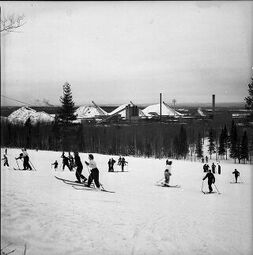 Skiers head uphill, 1939
-
 Knute Hansen jumping, 1939
-
 Knute Hansen jumping, 1939
-
 Port Arthur Ski Club, 1937 (headline)
-
 Port Arthur Ski Club, 1937
-
 New clubhouse, 1938 (page)
-
 New clubhouse, 1938
-
 New clubhouse, 1938 (continued)
-
 Dominion championships, 1939 (A)
-
 Dominion championships, 1939 (B)
-
 Dominion championships, 1939 (C)
-
 Dominion championships, 1939 (D)
-
 Clubhouse fire, Dec. 1939
-
 Rebuilt clubhouse, Jan. 1940
-
 Moose Mountain opens, 1962
-
 "Visitors May Have Trouble With Baldy", 1962
-
 Winter carnival, 1963
-
 Ski fashions, 1963
-
 Judy Young, 1964 (A)
-
 Judy Young, 1964 (B)
-
 Trowbridge Falls jump site, 1964
-
 Lakehead Ski Queen, 1965
-
 Centennial ski hill opens, 1966
-
 Little Norway chairlift, 1960s
-
 Little Norway clubhouse, 1960s


Conflicts in the sources
| Topic | Version A | Version B (and C) | Sources |
|---|---|---|---|
| Little Norway opening | 1963 (Wikipedia, TBNewsWatch; obituary: "early 1960's") | 1964 (MWLSAP); 1969 (skisprungschanzen history text, probably an error) | [38][56][39][22][46] |
| Province buys Sundance | 1983, $540,000 (Globe and Mail, 11 May 1983) | 1984 (TBNewsWatch 2010); 1985 (TBNewsWatch 2015, Wikipedia) | [51][55][56][38] |
| Big Thunder closure | Decided 1995; closed 30 June 1996 | "Operating until 1997" (skisprungschanzen data table); Wikipedia's Training Center stub says 1995 | [56][46] |
| Big Thunder jumps built | 1974 (Wikipedia, skisprungschanzen) | Province funded "main twin jumps" from 1969 | [38][46] |
| Steve Collins's 1980 jump | 128.5 m, 15 December 1980 (Ski Hall of Fame) | 128.0 m (skisprungschanzen) | [2][46] |
| Ontario's first chairlift | Mount Baldy, 1959 (Superior Country) | Blue Mountain South chair, built 1959, opened January 1960 (Lift Blog, quoting Blue Mountain); Mount McKay Poma chair 1960 (chairlift.org) | [32][34][33] |
| Mount McKay first chairlift | 1960 (chairlift.org) | 1973 (Skier 72) | [33][45] |
| Mount McKay closure | 1989 (Skier 72, McKay episode) | 1988 (Skier 72, Candy episode) | [45][6] |
| Loch Lomond vertical | 229 m / 751 ft (Ski Hall of Fame, Indy Pass); 750 ft (NOB) | 179 m (skiresort.info) | [28][159][157][142] |
| Ward Bond at Loch Lomond | Bought 1979 (Ski Hall of Fame) | "Since the mid-1970s" (CBC 2014) | [28][69] |
| Ward Bond at Candy Mountain | 1979 (Skier 72) | "Mid-1980s" (NOB 2002) | [6][64] |
| Loch Lomond quad | 1986 | 1988 | [6][45] |
| Spiess family takeover of Mount Baldy | "Since the 1960's", started by Craig Spiess's father (TBNewsWatch 2016; Bayview); about 1967 inferred from Craig Spiess being 13 at the takeover (NWO Sports Hall of Fame) | "Beginnings in 1969" (Chronicle-Journal 2024); owned from 1988 (Northern Ontario Travel) | [70][5][148][149][71] |
| Candy Mountain vertical | 218 m (Skier 72) | 225 m (MWLSAP) | [6][22] |
| Thunder Bay Ski Club founding | 1970 (club history) | 1972 (zone4) | [43][44] |
| Thunder Bay Nordic Trails founding | Incorporated 1982 (TBNT) | "Established in 1984" (NetNewsLedger) | [53][54] |
| Lappe trail length | About 12 km groomed, 4.6 km lit (Northern Ontario Travel) | Over 14 km, 7 km lit (XC Ontario, 2017); about 20 km (Globe and Mail) | [90][47][59] |
| Centennial Park ski hill | Opened 20 February 1966 (News-Chronicle index) | Park developed 1967 (Wikipedia) | [23][144] |
| "Biggest ski jump in the world" | Claim by 1995 co-chair Sue Prodaniuk | Not supported by record data (K-120 hills were standard large hills; ski-flying hills are far larger) | [62][46][11] |
| "First electric tow in Canada" (Fort William, 1938) | Duluth News Tribune headline | Rope tows ran at Shawbridge from 1932/33 and at Amber, BC, from 1934 (power source not stated) | [22][12][21] |
| Kardas purchase of Mount Baldy | Reported 3 October 2016 (TBNewsWatch); Chronicle-Journal index headline "Ski hill maintains family tradition", 6 October 2016 | November 2016 (Northern Ontario Travel) | [70][71] |
| Big Thunder World Cups | 29 World Cup and 50 Canadian championship events (Wikipedia) | "39 World Cups and 50 National Championships" (The Walleye) | [38][102] |
| Big Thunder opening | Opened 2 February 1975 (Chronicle-Journal, Imrie 2018 and 2021) | First Canadian championships held there 1–2 February 1975 (Wikipedia); site in use as Little Norway from 1963 | [111][26][38] |
| Lappe Nordic Centre opening | 1979 (XC Ontario, Puiras profile) | "During the early 1980s" (Chronicle-Journal 2021) | [47][26] |
| Gerry family and Loch Lomond's north T-bar | Jason Gerry's "great grandfather and great uncle" helped build it (TBNewsWatch 2014) | His "grandfather" (Ski Hall of Fame) | [156][28] |
| Mount Baldy's first downhill use | PASC members begin developing it in 1933–34 (Bayview) | Official opening by civic officials 13 January 1947 (Chronicle-Journal); Spiess-era "beginnings in 1969" (Chronicle-Journal 2024) | [5][26][149] |
| Sundance purchase | 1977 (John Beals's candidate profile) | Around 1978 (Wikipedia) | [49][38] |
| How the province got Sundance | Sold for $540,000 (Globe and Mail, 11 May 1983) | "Provincial expropriation" in 1983 (Beals's profile) | [51][49] |
| Big Thunder: six rejected proposals | 2010 (expressions of interest due March 2010, all six rejected 9 July 2010; TBNewsWatch) | 2012 (CBC 2017) | [55][126][68] |
| Is Big Thunder for sale? | Infrastructure Ontario: "there is no continued need for the province to own this property" (CBC 2017) | "Not for sale. It never was" (Infrastructure Ontario via The Walleye, c. 2018) | [68][102] |
| Little Norway, Sundance and Big Thunder sequence | Little Norway "eventually became Sundance and in 1975 transitioned into Big Thunder National Ski Training Centre" (Bayview Magazine, Diane Imrie, 2017) | Mt. Norway from 1969; the training-centre jumps open in February 1975 while the hill is privately owned; it becomes Sundance only from 1977 under John Beals; the province takes over in 1983 (Beals; Globe and Mail). Bayview's 1975 matches the opening of the jumps, not a change of owner or name. Published discrepancy, flagged. | [5][49][38][51] |
Questions for the museum
- Little Norway: When did it open (1963 or 1964)? Who bought it from the Hansens in 1969 and owned Mt. Norway until John Beals acquired it in 1977? (One unsourced social-media comment says it was sold "to the community"; this needs a newspaper source.)
- Provincial purchase of Sundance: Was it 1983, 1984 or 1985? Is there a copy of the Globe and Mail article of 11 May 1983?
- Mount McKay: Did the first chairlift come in 1960 or 1973? Did skiing end in 1988 or 1989? Does the museum hold photos of the 1930s jump or the 1939 championships?
- Ontario's first chairlift: Is there documentary evidence for a 1959 chairlift at Mount Baldy (as Superior Country claims)? When was Baldy's first lift unveiled? (The Ski Hall of Fame shows a museum photo.)
- Mount Baldy ownership: In what year did the Spiess family take over from the Port Arthur Ski Club (about 1967, 1969 or 1988)? Was it a purchase, a lease or a hand-over, and who owned the land before? What is in the Chronicle-Journal article "Ski hill maintains family tradition" (6 October 2016, A3)?
- Candy Mountain: Did Bond buy it in 1979 or the mid-1980s? Who held the lease in 1999? Was 2001–02 the last season?
- Loch Lomond quad chair: 1986 or 1988?
- Centennial Park ski hill: Did it open in 1966 or 1967? When did it close, and did it have a tow?
- Trowbridge Falls ski jump: Was it ever built, and when did it operate?
- Isku Park: Where exactly was it, and what jumps did it have?
- Pine Top Ski Area: Which Thunder Bay hill appears under this name in 1982?
- Moose Mountain (Beardmore): Who owned it, and when did it close?
- Hillcrest Park and other urban slopes: Is there any record of skiing or a jump at Hillcrest Park, Chippewa or other city slopes? None has been found in the sources searched.
- Canadian Junior Championships: The Canadian Museum of Nordic Sport's results page lists Canadian Junior Championships at Port Arthur in 1954 and 1968, and Port Arthur's Kari Jamsa as a 1966 champion (at Stoneham); it marks a 1953 Fort William event with question marks. Can the newspapers confirm 1953, and were there others (1956, 1962)?[230]
- Strathcona Heights: When did the Port Arthur Ski Club stop using it, and exactly where were the jump and clubhouses?
- Fort William Ski Club before 1932: Who founded the club, and when? Who owned King George's Park, the prison farm and Hawke's Farm sites?
- Nipigon ski hill: Who ran Eric Larson's 1938 hill, when was the T-bar installed, and when did it close?
- Big Thunder after 1997: Who was the buyer in the Chronicle-Journal of 1 March 1997 ("Buyer for Big Thunder?", A3), and was it the same "Alabama company" whose 1998 deal "goes bust"? The province still owned the site in 2017–18 through Infrastructure Ontario.[108][68][102] Can the museum supply the October 1995 "Funding slashed for Big Thunder" article with its figures?[103]
- 1902 races and Andy Ohlgren: Are there newspaper confirmations?
- "First electric tow in Canada" (Fort William Ski Club, 1938): What exactly was claimed?
- 1995 economic impact: Northern Ontario Business (1 November 1990) confirms the $20 million cost estimate and the $426,000 bid cost. Is there a post-event audit of the actual cost and of the roughly $37 million economic impact seen in a search snippet?[99]
- Photos the museum may hold: the 1931 District Ski Meet, the Strathcona clubhouses (1937–40), Knute Hansen, the Mount McKay jump (1930s), Loch Lomond (1950s and 1962), the first lift at Mount Baldy, the 1981 Loch Lomond chairlift, and the Big Thunder pre-World opening ceremonies.[28][5]
Answers from the museum material (October 2026). The Thunder Bay Museum clippings answer or narrow several of these questions:[228]
- Little Norway opening: Trails were cut from April 1963 and the A-frame was going up in December 1963. The first tow ran in late February 1964, when the paper called it "In Operation", and the first race was held in April 1964. So "1963" (Wikipedia) is the founding year and "1964" (MWLSAP) is the first season of operation.[175][164][166] The 1969 buyer is still not named.
- Canadian Junior Championships: The Port Arthur Ski Club hosted them at Mount Baldy from 23 to 25 February 1962.[153]
- Centennial Park ski hill: It opened on 20 February 1966 (650-foot run, weekend tow, two warming huts).[173]
- Trowbridge Falls ski jump: Proposed in December 1964 for the February 1965 Canadian cross-country championships. Whether it was built is still unknown.[94]
- Moose Mountain (Beardmore): It opened officially on 14 January 1962 (400-foot vertical, T-bar, five runs). The owner is not named, and the closing date is still unknown.[180]
- Strathcona Heights: The clubhouses of 1938 and 1940 stood at Strathcona, facing Lake Superior above the golf course's fifth hole. The 1938 clubhouse burned on 3 December 1939.[85][86][87]
- Big Thunder after 1997: The "Alabama company" of 1998 was Southern Ventures Inc.; Ward Bond and investors were the only other bidders.[172]
- Photos: The museum holds 1939 photographs of Knute Hansen jumping and of a Strathcona meet, and 1960s photographs of Little Norway. It offered TIFFs of any chosen for publication. It does not hold the Superior Outdoors article.[228][229][231]
Coverage in Bayview Magazine
Bayview Magazine is a free Thunder Bay quarterly, founded in 2002 and distributed to about 16,000 homes, offices and hotels.[232][233] It has published one feature on local ski history: "High flying" by Diane Imrie of the Northwestern Ontario Sports Hall of Fame (November 2017). The piece is a survey of about 1,200 words, illustrated with six archival photographs, running from the 1907 Shuniah Mine exhibition to the Nordic centres and national development centre of the 1990s.[5] It gives Big Thunder one sentence and dates its creation to 1975 (see Conflicts in the sources).[5]
A review of all 642 articles on Bayview's website (November 2015 to September 2026) found skiing otherwise only in passing:
- Imrie, "50 years of memorable moments in local sports" (November 2020): Steve Collins, Dave Irwin and the 1995 Worlds.[130]
- "The Community Crew" (September 2016): volunteer memories of jumping events at Little Norway around 1979, and the crew's work at the Sleeping Giant Loppet, Lappe and Kamview.[127]
- Imrie, "Life on the links" (June 2022): the Port Arthur Ski Club's jump on the Strathcona golf course.[83]
- "A life devoted to dance" (September 2023): the choreographer of the 1995 ceremonies.[131]
- Imrie, "Keeping the memory of sport alive" (September 2026): the Hall of Fame's ski-chalet exhibit and its sports library and archives, which are open to researchers.[234]
- "Kick Sledding - something old is new again" (November 2024): present-day programmes at Kamview.[235]
No Bayview article has been about Big Thunder itself, its closure in 1996, where its athletes went, the 1990s decline in skiing, the geology and snow of the ski hills, or the ownership history of individual hills. Issues from 2002 to 2015 are not online, so earlier print coverage could not be checked.[233]
See also
- Big Thunder Ski Jumping Center
- Big Thunder National Training Center
- FIS Nordic World Ski Championships 1995
- Surprise Lake (Lappe)
References
- ↑ 1.0 1.1 1.2 1.3 1.4 Kinanen, Karl. "Finnish-Canadians as Forerunners of Cross-country Ski Racing in Northern Ontario 1920–1939". Canadian Museum of Nordic Sport.
- ↑ 2.0 2.1 2.2 2.3 2.4 2.5 "Steve Collins". Canadian Ski Hall of Fame and Museum.
- ↑ 3.0 3.1 3.2 3.3 3.4 3.5 3.6 3.7 Builder profile: Reijo Puiras (inducted 25 September 1993). Northwestern Ontario Sports Hall of Fame.
- ↑ 4.0 4.1 4.2 4.3 4.4 "Meet the family behind the Lappe Nordic Ski Centre in Thunder Bay, Ont.". CBC News, February 2022.
- ↑ 5.00 5.01 5.02 5.03 5.04 5.05 5.06 5.07 5.08 5.09 5.10 5.11 5.12 5.13 5.14 5.15 5.16 5.17 5.18 5.19 5.20 5.21 5.22 5.23 5.24 5.25 5.26 5.27 5.28 5.29 5.30 5.31 5.32 5.33 5.34 5.35 5.36 5.37 5.38 5.39 5.40 5.41 5.42 5.43 5.44 5.45 5.46 5.47 5.48 5.49 5.50 5.51 5.52 5.53 5.54 5.55 5.56 Imrie, Diane. "High flying". Bayview Magazine, November 2017.
- ↑ 6.00 6.01 6.02 6.03 6.04 6.05 6.06 6.07 6.08 6.09 6.10 6.11 6.12 6.13 6.14 6.15 6.16 6.17 6.18 6.19 6.20 6.21 6.22 6.23 6.24 6.25 6.26 6.27 6.28 6.29 6.30 6.31 6.32 6.33 6.34 6.35 6.36 6.37 6.38 6.39 6.40 6.41 6.42 "Candy Mountain". Skier 72, The Lost Resorts.
- ↑ 7.0 7.1 7.2 7.3 7.4 7.5 7.6 7.7 "History of skiing". Wikipedia.
- ↑ 8.0 8.1 8.2 8.3 8.4 8.5 8.6 "Ski". Wikipedia.
- ↑ 9.0 9.1 9.2 9.3 9.4 9.5 9.6 Gadacz, René R.; Filice, Michelle. "Snowshoes". The Canadian Encyclopedia, 2012 (edited 2020).
- ↑ 10.0 10.1 10.2 Morrison, Jean; Pelletier, Catherine. "Fort William". The Canadian Encyclopedia, 2011 (edited 2025).
- ↑ 11.0 11.1 11.2 11.3 11.4 11.5 11.6 11.7 "Ski jumping". Wikipedia.
- ↑ 12.00 12.01 12.02 12.03 12.04 12.05 12.06 12.07 12.08 12.09 12.10 Bailey, Patricia G.; Shaw, Murray C. "Alpine Skiing". The Canadian Encyclopedia, 2011 (edited 2015).
- ↑ "Sondre Norheim". Wikipedia.
- ↑ 14.0 14.1 14.2 14.3 14.4 14.5 14.6 14.7 14.8 Bailey, Patricia G.; Shaw, Murray C. "Cross-Country Skiing". The Canadian Encyclopedia.
- ↑ 15.0 15.1 15.2 15.3 15.4 15.5 15.6 "Ski binding". Wikipedia.
- ↑ 16.0 16.1 16.2 16.3 "Surface lift". Wikipedia.
- ↑ 17.0 17.1 17.2 17.3 17.4 "Athletic Clubs" (Nahjus, Reipas and Nousu athletic club records). Lakehead University Archives.
- ↑ 18.0 18.1 18.2 18.3 18.4 18.5 "BK 3: Section 10" (skiing photographs). Lakehead University Archives.
- ↑ 19.0 19.1 Builder profile: "Tommy", a founder of the Port Arthur Ski Club (inducted 28 September 1991). Northwestern Ontario Sports Hall of Fame.
- ↑ 20.0 20.1 "Chairlift". Wikipedia.
- ↑ 21.0 21.1 21.2 21.3 21.4 21.5 21.6 21.7 "Bill Irwin". Canadian Ski Hall of Fame and Museum.
- ↑ 22.00 22.01 22.02 22.03 22.04 22.05 22.06 22.07 22.08 22.09 22.10 22.11 22.12 22.13 22.14 22.15 22.16 22.17 22.18 22.19 22.20 22.21 22.22 22.23 22.24 22.25 "Ontario lost ski areas". Midwest Lost Ski Areas Project.
- ↑ 23.00 23.01 23.02 23.03 23.04 23.05 23.06 23.07 23.08 23.09 23.10 23.11 Port Arthur News-Chronicle subject index entries, compiled by Michael B. Currie (email to the Thunder Bay Museum, 10 October 2026). Index entries only; the articles themselves have not yet been read.
- ↑ 24.0 24.1 24.2 Brill, B. "The Maple Leaf Ski Factory". Nipigon Museum blog, 24 February 2012.
- ↑ 25.0 25.1 "Skiing in Thunder Bay". Northern Ontario Travel.
- ↑ 26.00 26.01 26.02 26.03 26.04 26.05 26.06 26.07 26.08 26.09 26.10 26.11 26.12 26.13 Imrie, Diane. "Skiing is in fabric of area's city". The Chronicle-Journal, 26 January 2021.
- ↑ 27.0 27.1 "Cross-country skiing". Wikipedia.
- ↑ 28.00 28.01 28.02 28.03 28.04 28.05 28.06 28.07 28.08 28.09 28.10 28.11 28.12 28.13 28.14 28.15 28.16 28.17 28.18 28.19 28.20 28.21 28.22 28.23 28.24 28.25 28.26 28.27 28.28 "Loch Lomond Ski Area, Ontario". Canadian Ski Hall of Fame and Museum.
- ↑ 29.0 29.1 29.2 29.3 29.4 29.5 "The Fort William Ski Club Early Years". Hot Rods and Jalopies (blog), January 2013.
- ↑ 30.0 30.1 30.2 "Snowmaking". Wikipedia.
- ↑ 31.0 31.1 31.2 "Ski boot". Wikipedia.
- ↑ 32.00 32.01 32.02 32.03 32.04 32.05 32.06 32.07 32.08 32.09 "Superior Skiing". Superior Country (Tourism Northern Ontario).
- ↑ 33.0 33.1 33.2 33.3 33.4 "Fort William Ski Club / Mt. MacKay". chairlift.org.
- ↑ 34.0 34.1 34.2 "Blue Mountain, ON". Lift Blog (including reader comments quoting Blue Mountain's lift history).
- ↑ "Snowmobile". Wikipedia.
- ↑ 36.0 36.1 36.2 "A first timer joins one of the last wilderness loppets". The Globe and Mail (c. 2010).
- ↑ 37.0 37.1 37.2 37.3 37.4 37.5 37.6 37.7 37.8 Puumala, Lana. Themes on Finnish Settlement in the Thunder Bay Area (MA thesis, Lakehead University, c. 2004).
- ↑ 38.00 38.01 38.02 38.03 38.04 38.05 38.06 38.07 38.08 38.09 38.10 38.11 38.12 38.13 38.14 38.15 38.16 38.17 38.18 38.19 38.20 38.21 38.22 38.23 38.24 38.25 38.26 38.27 38.28 38.29 "Big Thunder Ski Jumping Center". Wikipedia (drawing on Marion, J.-P., "Big Thunder frozen in time", Superior Outdoors, Winter 2009, pp. 26–30).
- ↑ 39.0 39.1 39.2 39.3 39.4 39.5 "Tor Hansen" (obituary). TBNewsWatch, 27 July 2016.
- ↑ 40.0 40.1 40.2 40.3 40.4 "Snowboarding". Wikipedia.
- ↑ 41.0 41.1 41.2 41.3 "Freestyle skiing". Wikipedia.
- ↑ 42.0 42.1 42.2 42.3 42.4 "Thunder Bay". Wikipedia (amalgamation; climate box, Thunder Bay Airport 1991–2020 normals).
- ↑ 43.00 43.01 43.02 43.03 43.04 43.05 43.06 43.07 43.08 43.09 43.10 "History". Big Thunder Nordic Ski Club.
- ↑ 44.0 44.1 44.2 "Big Thunder Nordic". Zone4 club directory.
- ↑ 45.00 45.01 45.02 45.03 45.04 45.05 45.06 45.07 45.08 45.09 45.10 45.11 45.12 45.13 45.14 45.15 45.16 45.17 45.18 45.19 45.20 "Mount McKay". Skier 72, The Lost Resorts.
- ↑ 46.00 46.01 46.02 46.03 46.04 46.05 46.06 46.07 46.08 46.09 46.10 46.11 46.12 46.13 46.14 46.15 46.16 46.17 46.18 46.19 46.20 46.21 46.22 "Big Thunder Ski Jumping Center, Thunder Bay". Ski Jumping Hill Archive (skisprungschanzen.com).
- ↑ 47.00 47.01 47.02 47.03 47.04 47.05 47.06 47.07 47.08 47.09 47.10 47.11 47.12 Death notice: Reijo Puiras, founder of Lappe Nordic Ski Centre. Cross Country Ski Ontario, August 2017.
- ↑ 48.0 48.1 48.2 48.3 48.4 48.5 "About the Sleeping Giant Loppet". Sleeping Giant Loppet.
- ↑ 49.0 49.1 49.2 49.3 49.4 49.5 49.6 49.7 "2026 Election Candidate Profiles": John Warren Beals (Neebing Ward). City of Thunder Bay, 2026. Profile supplied by the candidate and posted verbatim by the City Clerk.
- ↑ 50.0 50.1 50.2 50.3 "Skate skiing". Wikipedia.
- ↑ 51.0 51.1 51.2 51.3 51.4 51.5 51.6 "Whatever happened to ... Crocker vs. Sundance". LawNow (University of Calgary PRISM repository); cites The Globe and Mail, "Ontario purchases ski-jumping hill", 11 May 1983.
- ↑ "Detachable chairlift". Wikipedia.
- ↑ 53.0 53.1 53.2 53.3 53.4 "History". Kamview Nordic Centre / Thunder Bay Nordic Trails.
- ↑ 54.0 54.1 54.2 54.3 54.4 "Thunder Bay Nordic Trails Supported by OTF". NetNewsLedger, 8 April 2013.
- ↑ 55.0 55.1 55.2 55.3 55.4 55.5 55.6 Dunick, Leith. "Big chance for Big Thunder". TBNewsWatch, 8 February 2010.
- ↑ 56.00 56.01 56.02 56.03 56.04 56.05 56.06 56.07 56.08 56.09 Vis, Matt. "Twenty years after Nordic Games, Big Thunder remains aging and forgotten relic". TBNewsWatch, 9 March 2015.
- ↑ 57.0 57.1 "What might have been: Ontario's Big Thunder almost became 1988 Olympic ski jumping venue". CBC News, 22 February 2018.
- ↑ 58.0 58.1 58.2 58.3 58.4 58.5 58.6 "The numbers game – part 1". Pique Newsmagazine (2001), citing Canadian Ski Council figures.
- ↑ 59.0 59.1 59.2 59.3 59.4 "Peaks and valleys: A ski-jumping legend ponders Thunder Bay's past and present". The Globe and Mail (c. 2018).
- ↑ 60.0 60.1 "FIS Nordic World Ski Championships 1995". Wikipedia.
- ↑ 61.0 61.1 61.2 Prinselaar, Julia. "Through Time: A Swift History of Skiing". Northern Wilds (2021).
- ↑ 62.0 62.1 62.2 62.3 Dunick, Leith. "Anniversary celebration scheduled for 1995 World Nordic Ski Championships". TBNewsWatch, 13 March 2020.
- ↑ 63.0 63.1 63.2 "Thunder Bay ski hill converts to private club (8/02)". Northern Ontario Business, August 2002 issue (web-dated 12 September 2005).
- ↑ 64.0 64.1 64.2 64.3 64.4 64.5 64.6 64.7 64.8 "Ski resort closes, remains in limbo". Northern Ontario Business, October 2002 issue (web-dated 5 March 2003).
- ↑ 65.0 65.1 65.2 "Snowboarders, once shunned, now coveted by ski industry". Summit Daily (c. 2005), citing NSAA.
- ↑ 66.0 66.1 66.2 "Lakehead Nordic Skiing National Champions". Lakehead University, 2006.
- ↑ 67.0 67.1 67.2 "New Study Confirms Snowboarding on the Decline, Skiing on the Rise". ActionHub, 2 January 2014, citing NSAA.
- ↑ 68.0 68.1 68.2 68.3 68.4 68.5 68.6 68.7 "Friends of Big Thunder hope former ski jump and nordic area can be saved". CBC News, 16 October 2017.
- ↑ 69.0 69.1 69.2 69.3 69.4 "Loch Lomond Ski Area gets new owners". CBC News, 3 September 2014.
- ↑ 70.0 70.1 70.2 70.3 70.4 Diaczuk, Doug. "Mount Baldy welcomes new owners". TBNewsWatch, 3 October 2016.
- ↑ 71.0 71.1 71.2 71.3 71.4 71.5 71.6 "Thunder Bay Family Skiing at Mount Baldy". Northern Ontario Travel.
- ↑ 72.0 72.1 72.2 72.3 72.4 72.5 72.6 "Former ski jumping star on a mission to revive his sport among his First Nation". Team Canada (Canadian Olympic Committee), 21 June 2022.
- ↑ 73.0 73.1 73.2 73.3 "Tapiola ski trails to move forward with new owners". CBC News (2020).
- ↑ 74.0 74.1 74.2 74.3 "Coming Together". The Walleye (c. 2021).
- ↑ 75.0 75.1 75.2 "Mount Baldy ski lift opens". TBNewsWatch, 15 January 2023.
- ↑ 76.0 76.1 76.2 "Facts & Stats – Updated December 2023". Canadian Ski Council.
- ↑ 77.00 77.01 77.02 77.03 77.04 77.05 77.06 77.07 77.08 77.09 77.10 77.11 77.12 77.13 77.14 "Historical Skier Visits 1978/79 – 2022/23". National Ski Areas Association (NSAA).
- ↑ 78.0 78.1 78.2 "U.S. Ski Industry Reports Data from 2023-24 Season". NSAA press release, May 2024.
- ↑ 79.0 79.1 "Lappe, Ontario". Wikipedia.
- ↑ 80.0 80.1 80.2 80.3 80.4 "Big plans for Big Thunder Ski Hill". Anishinabek News, September 2015.
- ↑ "Alpine skiing". Wikipedia.
- ↑ 82.0 82.1 "About Us". Port Arthur Ski Club.
- ↑ 83.0 83.1 Imrie, Diane. "Life on the links". Bayview Magazine, June 2022.
- ↑ 84.0 84.1 "Younger Set Enjoy Thrills and Spills at Port Arthur Ski Club". Port Arthur News-Chronicle, 23 January 1937, p. 5; clipping from the Thunder Bay Museum archives, supplied by Emma Hurley Warren (archival assistant) in an email to Michael Currie, 26 October 2026 (personal communication). Scan.
- ↑ 85.0 85.1 85.2 "New Ski Club House Opened After Many Years of Effort" and "Port Arthur Ski Club Opens New Club House Tuesday". Port Arthur News-Chronicle, 5 December 1938, p. 10; clipping from the Thunder Bay Museum archives, supplied by Emma Hurley Warren (archival assistant) in an email to Michael Currie, 26 October 2026 (personal communication). Scan.
- ↑ 86.0 86.1 86.2 "Fire Destroys Ski Clubhouse". Port Arthur News-Chronicle, 4 December 1939, p. 1; clipping from the Thunder Bay Museum archives, supplied by Emma Hurley Warren (archival assistant) in an email to Michael Currie, 26 October 2026 (personal communication). Scan.
- ↑ 87.0 87.1 87.2 Photo, new Port Arthur Ski Club clubhouse. Port Arthur News-Chronicle, 8 January 1940, p. 9; clipping from the Thunder Bay Museum archives, supplied by Emma Hurley Warren (archival assistant) in an email to Michael Currie, 26 October 2026 (personal communication). Scan.
- ↑ "Pohjanpirtti cross-country ski race winners" (photograph, donor News Chronicle). Lakehead University Archives.
- ↑ Bailey, Jim. "Ski program helps masters" ("Around the Trails" column). The Chronicle-Journal, 17 January 1998; clipping from the Thunder Bay Museum archives, supplied by Emma Hurley Warren (archival assistant) in an email to Michael Currie, 26 October 2026 (personal communication). Scan.
- ↑ 90.0 90.1 90.2 90.3 90.4 "Cross Country Skiing, Trails and Wilderness". Northern Ontario Travel.
- ↑ 91.0 91.1 91.2 "Kamview Nordic Centre". Thunder Bay Nordic Trails.
- ↑ 92.0 92.1 "Sleeping Giant Provincial Park". Wikipedia.
- ↑ 93.0 93.1 "Kakabeka Falls". Wikipedia.
- ↑ 94.0 94.1 94.2 94.3 "Trowbridge Falls Ski Jump Site" (staff photo). Port Arthur News-Chronicle, 12 December 1964, p. 2; clipping from the Thunder Bay Museum archives, supplied by Emma Hurley Warren (archival assistant) in an email to Michael Currie, 26 October 2026 (personal communication). Scan.
- ↑ 95.0 95.1 Imrie, Diane (Northwestern Ontario Sports Hall of Fame). Article in Lakehead Living, 1987, as summarised by Emma Hurley Warren, Thunder Bay Museum, email to Michael Currie, 26 October 2026 (personal communication). The 1987 article itself has not been seen.
- ↑ "Kim Hansen" (obituary). TBNewsWatch, 27 December 2019.
- ↑ 97.0 97.1 97.2 "Former Big Thunder ski jumpers lament closure of championship-hosting hill". CBC News, 17 October 2017.
- ↑ "Former Olympic ski jumper hopes to revive ski jumping in Thunder Bay and Ontario". CBC News Thunder Bay (c. 2020).
- ↑ 99.0 99.1 99.2 Bickford, Paul. "Prestigious international championships will cost about $20 million to stage". Northern Ontario Business 11 (2), 1 November 1990 (preview via vLex).
- ↑ 100.0 100.1 Thunder Bay Public Library. Thunder Bay Index 1992 (subject index of the Chronicle-Journal (CJ), Thunder Bay Post (TBP) and other local periodicals), entries under "Big Thunder Ski Training Centre" and "Skiing". Index entries (headline, paper, date, page) only; the articles themselves have not been read.
- ↑ 101.0 101.1 Thunder Bay Public Library. Thunder Bay Index 1993 (subject index of the Chronicle-Journal (CJ), Thunder Bay Post (TBP) and other local periodicals), entries under "Big Thunder Ski Training Centre" and "Skiing". Index entries (headline, paper, date, page) only; the articles themselves have not been read.
- ↑ 102.00 102.01 102.02 102.03 102.04 102.05 102.06 102.07 102.08 102.09 McChristie, Darren. "Big Boondoggle: Will Ford finally unload Big Thunder?". The Walleye (c. 2018).
- ↑ 103.0 103.1 Thunder Bay Public Library. Thunder Bay Index 1995 (subject index of the Chronicle-Journal (CJ), Thunder Bay Post (TBP) and other local periodicals), entries under "Big Thunder Ski Training Centre" and "Skiing". Index entries (headline, paper, date, page) only; the articles themselves have not been read.
- ↑ McDonald, Marci. "Ontario Cuts Back". Maclean's, 31 July 1995 (via The Canadian Encyclopedia).
- ↑ 105.0 105.1 Kaihla, Paul. "Ontario Slashes Spending". Maclean's, 11 December 1995 (via The Canadian Encyclopedia).
- ↑ 106.0 106.1 106.2 106.3 Sport in Canada: Everybody's Business (Sub-Committee on the Study of Sport in Canada, Report 6, 36th Parliament, 1998). House of Commons of Canada.
- ↑ Thunder Bay Public Library. Thunder Bay Index 1996 (subject index of the Chronicle-Journal (CJ), Thunder Bay Post (TBP) and other local periodicals), entries under "Big Thunder Ski Training Centre" and "Skiing". Index entries (headline, paper, date, page) only; the articles themselves have not been read.
- ↑ 108.0 108.1 Thunder Bay Public Library. Thunder Bay Index 1998 (subject index of the Chronicle-Journal (CJ), Thunder Bay Post (TBP) and other local periodicals), entries under "Big Thunder Ski Training Centre" and "Skiing". Index entries (headline, paper, date, page) only; the articles themselves have not been read.
- ↑ Thunder Bay Public Library. Thunder Bay Index 1999 (subject index of the Chronicle-Journal (CJ), Thunder Bay Post (TBP) and other local periodicals), entries under "Big Thunder Ski Training Centre" and "Skiing". Index entries (headline, paper, date, page) only; the articles themselves have not been read.
- ↑ 110.0 110.1 "Canada's nordic combined and jumping programs lose major source of funding". Ski Racing (2005), reporting a CODA announcement.
- ↑ 111.0 111.1 111.2 Imrie, Diane. "Collins was a star on the hills". The Chronicle-Journal, 6 December 2018.
- ↑ Barnes, Dan. "Canada's self-funded ski jumpers persist against all odds". National Post, 5 February 2022.
- ↑ 113.0 113.1 Poulin, Bryan; Ng, Douglas. Big Thunder Sports and Recreation Park: Business Case for Reopening of Big Thunder. Lakehead University Knowledge Commons (final version dated 12 December 2012; prepared with Friends of Big Thunder).
- ↑ Evidence, Meeting No. 6, 11 February 1998 (witnesses: Triathlon Canada; Non-Federally Funded Olympic Sport Organizations; AthletesCAN). Sub-Committee on the Study of Sport in Canada, House of Commons of Canada.
- ↑ "Thunder Bay, Ontario (CAN)". Olympedia (Olympians born or died in Thunder Bay).
- ↑ "Amber Peterson 2014 Inductee Northwestern Ontario Sports Hall of Fame". Northwestern Ontario Sports Hall of Fame induction video, posted 3 October 2014 (YouTube transcript).
- ↑ "Chapter IV. Contemporary Policy Issues in High Performance Sport". In Thibault, Lucie; Harvey, Jean (eds.), Sport Policy in Canada. University of Ottawa Press, 2013 (OpenEdition).
- ↑ Department of Finance Canada. Budget Plan (Budget 1995, February 1995), Table 1.2 and "Profile of federal departmental spending: Canadian Heritage", p. 104.
- ↑ "Canada in Ski Jumping". Olympedia.
- ↑ Nielsen, Klaus; Storm, Rasmus K. "Elite sport in the Nordic countries: A comparative analysis of Denmark, Finland, Norway, and Sweden". In Sæther, S. A.; Høigaard, R. (eds.), Toppidrett i Skandinavia, ch. 1, pp. 15–50. Cappelen Damm Akademisk, 2026. doi:10.23865/cdf.282.ch1.
- ↑ "Ski Academies Are A Vital Part Of Success On The Slopes: The Stams Example". Ski Canada / Alpine Canada (skicanada.org).
- ↑ Kramp. "High Level Sport in the German Armed Forces" (presentation, c. 2004; refers to the 2004 defence budget and 2005 draft). milsport.one.
- ↑ "Australian Sports Commission Historical Budget Information". Australian Sport Reflections (updated September 2026).
- ↑ "National Sport Organizations – 2024/2025 Funding". Canadian Heritage, Government of Canada.
- ↑ Dunick, Leith. "Indoor rinks cost taxpayers $1M in operating losses in 2019". TBNewsWatch, 2019.
- ↑ 126.0 126.1 Labine, Jeff. "Rejected". TBNewsWatch, 21 July 2010.
- ↑ 127.0 127.1 Angus, Nancy. "The Community Crew". Bayview Magazine, September 2016.
- ↑ "Frank Gartrell". Olympedia.
- ↑ "Frank Gartrell" (athlete profile, inducted 26 September 1992). Northwestern Ontario Sports Hall of Fame.
- ↑ 130.0 130.1 Imrie, Diane. "50 years of memorable moments in local sports". Bayview Magazine, November 2020.
- ↑ 131.0 131.1 "A life devoted to dance". Bayview Magazine, September 2023.
- ↑ "Evolution of a City - part 2". Bayview Magazine, June 2016.
- ↑ "Fans, jumpers enjoy World Cup" and "Busy season for jumpers" (staff photos by Doug Shanks). The Chronicle-Journal, 29 January 1980; clipping from the Thunder Bay Museum archives, supplied by Emma Hurley Warren (archival assistant) in an email to Michael Currie, 26 October 2026 (personal communication). Scan.
- ↑ Tolman, Bud. "Big Thunder ski jumps an instant hit". The Chronicle-Journal, "Countdown to the Nordics" supplement, 1 March 1995; clipping from the Thunder Bay Museum archives, supplied by Emma Hurley Warren (archival assistant) in an email to Michael Currie, 26 October 2026 (personal communication). Scan.
- ↑ Tolman, Bud. "Three nations in women's event". undated clipping from a Thunder Bay Museum scrapbook (ref. A106-1-13); the museum notes that the paper name and exact date were not recorded, but it is probably The Chronicle-Journal, March 1995; clipping from the Thunder Bay Museum archives, supplied by Emma Hurley Warren (archival assistant) in an email to Michael Currie, 26 October 2026 (personal communication). Scan.
- ↑ "Jumper hits hill record in K120". undated clipping from a Thunder Bay Museum scrapbook (ref. A106-1-13); the museum notes that the paper name and exact date were not recorded, but it is probably The Chronicle-Journal, March 1995; clipping from the Thunder Bay Museum archives, supplied by Emma Hurley Warren (archival assistant) in an email to Michael Currie, 26 October 2026 (personal communication). Scan.
- ↑ 137.0 137.1 137.2 137.3 OpenStreetMap Nominatim geocoder, positions of the Mount Baldy Ski Area (375 Mount Baldy Road), Loch Lomond Ski Area (1800 Loch Lomond Road) and Candy Mountain Drive, queried 25 October 2026.
- ↑ 138.00 138.01 138.02 138.03 138.04 138.05 138.06 138.07 138.08 138.09 138.10 138.11 138.12 138.13 138.14 138.15 138.16 138.17 138.18 Ontario Geological Survey (2011). 1:250 000 scale bedrock geology of Ontario, Miscellaneous Release–Data 126, Revision 1; queried by point through Macrostrat map_query API (bedrock unit and DEM elevation), 25 October 2026.
- ↑ 139.0 139.1 139.2 139.3 "Mount McKay". Wikipedia.
- ↑ 140.0 140.1 140.2 140.3 140.4 Scott, J. (1990). Geology of MacGregor Township. Ontario Geological Survey Open File Report 5719.
- ↑ 141.0 141.1 141.2 141.3 141.4 141.5 141.6 "About Us". Mount Baldy Ski Area.
- ↑ 142.0 142.1 142.2 142.3 142.4 "Size: Loch Lomond". skiresort.info.
- ↑ 143.0 143.1 143.2 143.3 143.4 143.5 143.6 "Nor'Wester Mountains". Wikipedia.
- ↑ 144.0 144.1 144.2 144.3 "Centennial Park (Thunder Bay)". Wikipedia.
- ↑ 145.0 145.1 "Pine Top" (1970 trail map, contributed by Skier 72). skimap.org.
- ↑ 146.0 146.1 146.2 "The History of an Abandoned Ontario Ski Resort". Unofficial Networks, 25 July 2025.
- ↑ "History of Port Arthur Ski Club". Port Arthur Ski Club (after Imrie, Bayview, November 2017).
- ↑ 148.0 148.1 148.2 Builder profile: Craig Spiess (inducted 28 September 1996). Northwestern Ontario Sports Hall of Fame.
- ↑ 149.0 149.1 149.2 149.3 149.4 Krasowski, Sandi. "Mount Baldy builds operation beyond skiing". The Chronicle-Journal, 13 January 2024.
- ↑ 150.0 150.1 150.2 Pascone, Chris. "Mount Baldy: Revitalizing skiing north of Thunder Bay". Northern Wilds, 1 February 2024.
- ↑ "1945 – 2021 Slavomir Kardas". Ski Jumping Canada, 2021.
- ↑ "Mount Baldy Ski Area". Indy Pass.
- ↑ 153.0 153.1 153.2 "Visitors May Have Trouble With Baldy". Fort William Daily Times-Journal, 15 February 1962; clipping from the Thunder Bay Museum archives, supplied by Emma Hurley Warren (archival assistant) in an email to Michael Currie, 26 October 2026 (personal communication). Scan.
- ↑ 154.0 154.1 "Port Arthur Girls Entered In Ski Events". Port Arthur News-Chronicle, 23 February 1939, p. 1 (continued p. 12); clipping from the Thunder Bay Museum archives, supplied by Emma Hurley Warren (archival assistant) in an email to Michael Currie, 26 October 2026 (personal communication). Scan.
- ↑ 155.0 155.1 "Winter Gets Rough As Carnival Opens". Port Arthur News-Chronicle, 2 February 1963, p. 1; clipping from the Thunder Bay Museum archives, supplied by Emma Hurley Warren (archival assistant) in an email to Michael Currie, 26 October 2026 (personal communication). Scan.
- ↑ 156.0 156.1 156.2 156.3 Dunick, Leith. "New owners: Loch Lomond Ski Area sale complete". TBNewsWatch, 6 September 2014.
- ↑ 157.0 157.1 157.2 157.3 "New Thunder Bay ski hill owners aim for year-round operation". Northern Ontario Business, 17 November 2014.
- ↑ 158.0 158.1 158.2 "Loch Lomond officially opens ski hill for season using artificially created snow". TBNewsWatch, 16 November 2014.
- ↑ 159.0 159.1 159.2 159.3 159.4 "Loch Lomond". Indy Pass.
- ↑ 160.0 160.1 Crocker v. Sundance Northwest Resorts Ltd., 1988 CanLII 45 (SCC), [1988 1 SCR 1186].
- ↑ Sports column ("A new ski resort is in the making..."). Port Arthur News-Chronicle, 29 August 1963; clipping from the Thunder Bay Museum archives, supplied by Emma Hurley Warren (archival assistant) in an email to Michael Currie, 26 October 2026 (personal communication). Scan.
- ↑ "Ski Club Progressing" (staff photo). Port Arthur News-Chronicle, 10 December 1963; clipping from the Thunder Bay Museum archives, supplied by Emma Hurley Warren (archival assistant) in an email to Michael Currie, 26 October 2026 (personal communication). Scan.
- ↑ "'Little Norway' Progressing Well". Port Arthur News-Chronicle, 8 February 1964; clipping from the Thunder Bay Museum archives, supplied by Emma Hurley Warren (archival assistant) in an email to Michael Currie, 26 October 2026 (personal communication). Scan.
- ↑ 164.0 164.1 164.2 "'Little Norway' In Operation". Port Arthur News-Chronicle, 28 February 1964; clipping from the Thunder Bay Museum archives, supplied by Emma Hurley Warren (archival assistant) in an email to Michael Currie, 26 October 2026 (personal communication). Scan.
- ↑ Advertisement, "Skiing is great at Little Norway Ski Resort". Port Arthur News-Chronicle, 6 March 1964; clipping from the Thunder Bay Museum archives, supplied by Emma Hurley Warren (archival assistant) in an email to Michael Currie, 26 October 2026 (personal communication). Scan.
- ↑ 166.0 166.1 "'Little Norway' To Hold Race". Port Arthur News-Chronicle, 3 April 1964; clipping from the Thunder Bay Museum archives, supplied by Emma Hurley Warren (archival assistant) in an email to Michael Currie, 26 October 2026 (personal communication). Scan.
- ↑ "Legs Broken In Ski Mishap". Port Arthur News-Chronicle, 1 April 1966, p. 2; clipping from the Thunder Bay Museum archives, supplied by Emma Hurley Warren (archival assistant) in an email to Michael Currie, 26 October 2026 (personal communication). Scan.
- ↑ Olofsson, Anders. "Nordic party scotches rumors". Saturday section (probably The Chronicle-Journal), 27 February 1993; clipping from the Thunder Bay Museum archives, supplied by Emma Hurley Warren (archival assistant) in an email to Michael Currie, 26 October 2026 (personal communication). Scan.
- ↑ "1995 Nordic World Ski Championships" (advertisement and schedule). The Chronicle-Journal, 17 February 1995; clipping from the Thunder Bay Museum archives, supplied by Emma Hurley Warren (archival assistant) in an email to Michael Currie, 26 October 2026 (personal communication). Scan.
- ↑ Doetzel, Nancy. "A Nordic festival: thousands turn out for opening ceremonies". Thunder Bay Post, 14 March 1995; clipping from the Thunder Bay Museum archives, supplied by Emma Hurley Warren (archival assistant) in an email to Michael Currie, 26 October 2026 (personal communication). Scan.
- ↑ Kelly, Jim. "Nordics were a Thunder Bay success story". undated clipping from a Thunder Bay Museum scrapbook (ref. A106-1-13); the museum notes that the paper name and exact date were not recorded, but it is probably The Chronicle-Journal, March 1995; clipping from the Thunder Bay Museum archives, supplied by Emma Hurley Warren (archival assistant) in an email to Michael Currie, 26 October 2026 (personal communication). Scan.
- ↑ 172.0 172.1 Kelly, Jim. "Firm has big plans for Big Thunder". The Chronicle-Journal, 23 January 1998; clipping from the Thunder Bay Museum archives, supplied by Emma Hurley Warren (archival assistant) in an email to Michael Currie, 26 October 2026 (personal communication). Scan.
- ↑ 173.0 173.1 173.2 173.3 "Centennial Ski Hill Is Opened". Port Arthur News-Chronicle, 21 February 1966, p. 1; clipping from the Thunder Bay Museum archives, supplied by Emma Hurley Warren (archival assistant) in an email to Michael Currie, 26 October 2026 (personal communication). Scan.
- ↑ 174.0 174.1 "Stylish Skier" (photo by Stan Jaskinski, PACI Camera Club). Port Arthur News-Chronicle, 8 February 1963, p. 10; clipping from the Thunder Bay Museum archives, supplied by Emma Hurley Warren (archival assistant) in an email to Michael Currie, 26 October 2026 (personal communication). Scan.
- ↑ 175.0 175.1 175.2 Patola, Roger. "On the Slopes: Local Clubs Geared For Snow". Port Arthur News-Chronicle, 23 November 1963; clipping from the Thunder Bay Museum archives, supplied by Emma Hurley Warren (archival assistant) in an email to Michael Currie, 26 October 2026 (personal communication). Scan.
- ↑ Patola, Roger. "On the Slopes: Skiing Commencing This Weekend". Port Arthur News-Chronicle, 29 November 1963; clipping from the Thunder Bay Museum archives, supplied by Emma Hurley Warren (archival assistant) in an email to Michael Currie, 26 October 2026 (personal communication). Scan.
- ↑ 177.0 177.1 Patola, Roger. "Big Plans Ahead For Skiing Areas". Port Arthur News-Chronicle, 28 April 1964; clipping from the Thunder Bay Museum archives, supplied by Emma Hurley Warren (archival assistant) in an email to Michael Currie, 26 October 2026 (personal communication). Scan.
- ↑ 178.0 178.1 "Skiing and Schooling Combine For Port Arthur's Judy Young". Port Arthur News-Chronicle, 8 September 1964, p. 8; clipping from the Thunder Bay Museum archives, supplied by Emma Hurley Warren (archival assistant) in an email to Michael Currie, 26 October 2026 (personal communication). Scan.
- ↑ 179.0 179.1 "Lakehead Ski Queen Crowned". Port Arthur News-Chronicle, 5 November 1965, p. 1; clipping from the Thunder Bay Museum archives, supplied by Emma Hurley Warren (archival assistant) in an email to Michael Currie, 26 October 2026 (personal communication). Scan.
- ↑ 180.0 180.1 180.2 Last, Shirley. "District Ski Resort Opens Sunday at Beardmore". Port Arthur News-Chronicle, 10 January 1962, p. 15; clipping from the Thunder Bay Museum archives, supplied by Emma Hurley Warren (archival assistant) in an email to Michael Currie, 26 October 2026 (personal communication). Scan.
- ↑ 181.0 181.1 181.2 181.3 181.4 181.5 Facts + Stats 2014–2015. Canadian Ski Council.
- ↑ Paper O06.6 (economics of US ski areas and climate). Proceedings, International Snow Science Workshop 2018, Innsbruck.
- ↑ Gill, David. Liability Insurance. Fraser Institute, 1987.
- ↑ Ifedi, Fidelis. Sport Participation in Canada, 2005. Statistics Canada, Catalogue no. 81-595-MIE2008060 (2008); summary in The Daily, 7 February 2008.
- ↑ Yang, Yiqi. Factors Affecting Downhill Skiing Participation of Canadian Consumers (MA thesis, University of Ottawa, 2019), citing Statistics Canada (2013) and Williams and Basford (1992).
- ↑ Condon, Scott. "Snowboarding stalls after a decade of rapid growth". Aspen Times (2007), citing NSAA.
- ↑ Putnam, Robert D. "Bowling Alone: America's Declining Social Capital". Journal of Democracy 6 (1) (January 1995): 65–78.
- ↑ "Lake Superior". Wikipedia.
- ↑ "Ishpatina Ridge". Wikipedia.
- ↑ "Niagara Escarpment". Wikipedia.
- ↑ 191.0 191.1 191.2 "Blue Mountain (ski resort)". Wikipedia.
- ↑ "Searchmont, Ontario". Wikipedia.
- ↑ "Blue Mountain Resort – Stats". SkiGrade.
- ↑ 194.0 194.1 "Mount St. Louis Moonstone". Wikipedia.
- ↑ 195.0 195.1 "Horseshoe Valley Resort". Wikipedia.
- ↑ 196.0 196.1 "Calabogie Peaks". Wikipedia.
- ↑ 197.0 197.1 "Mont Tremblant Resort". Wikipedia.
- ↑ 198.0 198.1 "Mont-Sainte-Anne". Wikipedia.
- ↑ 199.0 199.1 "Le Massif". Wikipedia.
- ↑ "Mount Norquay". Wikipedia.
- ↑ "Marmot Basin". Wikipedia.
- ↑ "Lake Louise Ski Resort". Wikipedia.
- ↑ "Banff Sunshine". Wikipedia.
- ↑ "Big White Ski Resort". Wikipedia.
- ↑ "Sun Peaks Resort". Wikipedia.
- ↑ "Kicking Horse Resort". Wikipedia.
- ↑ 207.0 207.1 "Whistler Blackcomb". Wikipedia.
- ↑ 208.0 208.1 "Revelstoke Mountain Resort". Wikipedia.
- ↑ 209.0 209.1 209.2 209.3 209.4 Thunder Bay: Geology of the Lakehead Region (GeoTours guide). Ontario Geological Survey, 2021.
- ↑ 210.0 210.1 210.2 210.3 210.4 210.5 Burwasser, G. J. (1977). Quaternary Geology of the City of Thunder Bay and Vicinity. Ontario Geological Survey Report GR164.
- ↑ "Midcontinent Rift System". Wikipedia.
- ↑ 212.0 212.1 Pigeon River Provincial Park Management Plan. Ontario Parks.
- ↑ 213.0 213.1 213.2 213.3 213.4 213.5 Pye, E. G. (1969). Geology and Scenery, North Shore of Lake Superior. Ontario Department of Mines, Geological Guide Book No. 2.
- ↑ "Rove Formation". Wikipedia.
- ↑ Franklin, J. M.; McIlwaine, W. H.; Poulsen, K. H.; Wanless, R. K. (1980). "Stratigraphy and depositional setting of the Sibley Group, Thunder Bay district, Ontario, Canada". Canadian Journal of Earth Sciences 17: 633–651. doi:10.1139/e80-060.
- ↑ "Sibley Peninsula". Wikipedia.
- ↑ 217.0 217.1 217.2 "Thunder Bay Snowfall Totals & Snow Accumulation Averages". Current Results, from Environment Canada 1981–2010 climate normals.
- ↑ 218.0 218.1 218.2 218.3 "Toronto Snowfall Totals & Snow Accumulation Averages". Current Results, from Environment Canada 1981–2010 climate normals.
- ↑ 219.0 219.1 219.2 219.3 219.4 219.5 219.6 "Average Yearly Snowfall in Ontario". Current Results, from Environment Canada 1981–2010 climate normals.
- ↑ "Barrie". Wikipedia (climate box, 1981–2010 normals).
- ↑ "Greater Sudbury". Wikipedia (climate box, 1991–2020 normals).
- ↑ "Blue Mountain Ski Resort". SkiCentral.
- ↑ "Hockley Valley Resort, Ontario". Canadian Ski Hall of Fame and Museum.
- ↑ 224.0 224.1 224.2 Muñoz-Sabater, J. et al. (2021). "ERA5-Land: a state-of-the-art global reanalysis dataset for land applications". Earth System Science Data 13: 4349–4383. doi:10.5194/essd-13-4349-2021. Copernicus Climate Change Service / ECMWF.
- ↑ 225.0 225.1 225.2 Open-Meteo Historical Weather API (ERA5-Land model, daily mean snow depth), queried 25 October 2026. Data licensed CC BY 4.0.
- ↑ 226.0 226.1 English Wikipedia articles on each North American ski area (infobox vertical, top elevation and snowfall), revisions current on 25 October 2026; the revision used for each resort is listed in the data file.
- ↑ 227.0 227.1 skiresort.info country lists for Austria, Switzerland, France, Italy, Germany, Norway, Sweden and Finland (elevation information), accessed 25 October 2026.
- ↑ 228.0 228.1 228.2 Warren, Emma Hurley (Archival Assistant, Thunder Bay Museum). Email to Michael Currie, "Re: Big Thunder", 26 October 2026, 8:18 PM Bangkok time (personal communication; Cc Michael deJong, curator). The email shared a Hightail folder, "Big Thunder Resources", of about 80 files: newspaper clippings from 1937 to 1998 and museum photographs.
- ↑ 229.0 229.1 Thunder Bay Museum photographs 984.53.1018.a, .e, .h and .n, "1939 meet, Strathcona Heights, Port Arthur Ski Club", supplied by Emma Hurley Warren, email to Michael Currie, 26 October 2026 (personal communication).
- ↑ "Junior Nationals Results". Canadian Museum of Nordic Sport.
- ↑ Thunder Bay Museum photographs 984.80.575B, D, F, R and U, Little Norway ski area, dated by the museum to about the mid-to-late 1960s, supplied by Emma Hurley Warren, email to Michael Currie, 26 October 2026 (personal communication).
- ↑ "About". Bayview Magazine. Retrieved 25 October 2026.
- ↑ 233.0 233.1 "20 years of enjoying the view" (publisher's note). Bayview Magazine, November 2022.
- ↑ Imrie, Diane. "Keeping the memory of sport alive". Bayview Magazine, September 2026.
- ↑ White, Donna. "Kick Sledding - something old is new again". Bayview Magazine, November 2024.